Skills Based Training: How to Design Workplace Programs
Skills based training is a learning approach that teaches people to perform specific skills a job requires, then has them practice and demonstrate those skills, instead of concentrating mainly on knowledge or seat time. In the workplace, a program built this way starts with the tasks people must do, breaks each task into observable skills, gives learners guided practice with feedback, and confirms competence through a practical assessment. The result is learning that measures what people can do at work, not just what they remember from a course.
This guide explains what the approach means for employers, how it differs from knowledge based instruction, practical examples, how it connects to workforce development and public funding, how the term is used differently in applied behavior analysis, and how to design a program your workforce will use.

What Does a Performance Focused Program Include?
Sometimes called skill based learning or competency based instruction, this approach organizes learning around performance. Each module answers a simple question: what will the learner be able to do when this is finished?
It usually includes four parts:
- A defined skill. A specific, observable behavior, such as completing a safety lockout, handling a customer escalation, or running a quality inspection.
- Demonstration. An expert, video, or simulation shows the skill done correctly.
- Practice with feedback. Learners attempt the skill, often several times, and get specific feedback from a trainer, coach, or system.
- Assessment. Learners show they can perform the skill to a defined standard, usually through a practical assessment or observation checklist.
Knowledge still matters. People need to understand why a step exists and what can go wrong. But in a performance focused program, knowledge supports performance instead of standing in for it.
Performance vs. Knowledge Based Learning
Traditional workplace learning often measures completion: did the employee attend the class or finish the course? A knowledge based course adds a quiz to confirm people remember key facts. Both are useful for policies and concepts, but neither proves an employee can do the job.
This approach changes the measure of success from completion to capability. A new technician does not finish by watching a video on a procedure; they finish by performing the procedure correctly while a qualified trainer observes. That shift has practical benefits for employers:
- Managers can see which specific skills each employee has demonstrated.
- Time can focus on the abilities people have not yet mastered.
- Gaps show up during practice instead of on the job.
- Workers gain confidence because they have already practiced the work.
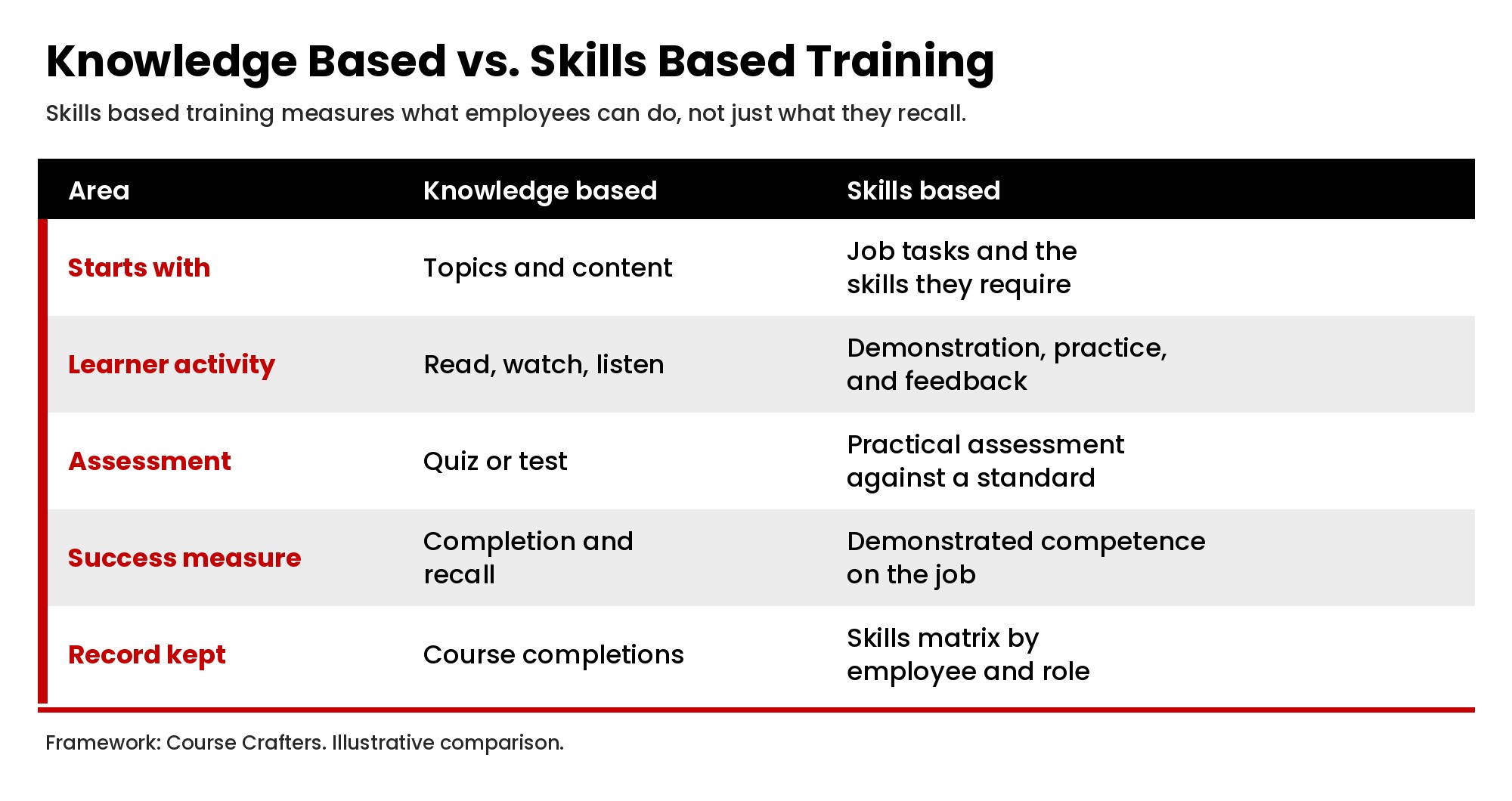
How skills based training differs from knowledge based training.
Examples of Skill Based Learning
This kind of learning shows up across industries and roles. Some common examples:
- Technical and trade skills: equipment operation, maintenance procedures, and quality inspections, often taught through supervised practice on the floor.
- Customer service: greeting, de escalation, and resolution steps, practiced through role plays and call reviews.
- Sales: discovery questions, demos, and objection handling, practiced through scenarios and coaching.
- Healthcare and safety: procedures that must be performed to a standard, practiced in simulations and checked by a qualified observer.
- Leadership: giving feedback, running one on ones, and coaching, practiced with peers and reviewed by a facilitator.
- Software and systems: completing real tasks in a practice environment instead of reading a manual.
In each case the program ends with a practical demonstration, not just a test of knowledge.
How to Design a Program Around Job Tasks
1. Start with the work, not the course
List the tasks employees perform and the outcomes that matter to the business. Talk with managers and top performers about what good work looks like. This task analysis becomes the foundation of the program. Use real data where you have it, such as error rates, quality results, or time to proficiency for new hires.
2. Break tasks into specific skills
For each task, define the skills and steps involved, the standard for doing them correctly, and the common mistakes. Write them as observable actions so a trainer could check them off.
3. Build practical assessments first
Design the assessment before the lessons. A practical assessment might be an observation checklist, a simulation, a work sample, or a supervised task. When the assessment is clear, the lessons can focus on preparing learners to pass it.
4. Choose the right mix of formats
Use short eLearning, video, or classes to explain concepts and show demonstrations, then live practice for hands on work. Our guides to corporate eLearning development and training video production explain how to build those pieces so they support practice instead of replacing it.
5. Give practice time and feedback
Plan enough time for learners to practice, make mistakes, and try again. Feedback should be specific and tied to the standard. Peer practice, coaching, and job shadowing all help.
6. Track skills, not just completions
Record which skills each employee has demonstrated and when. A simple skills matrix can show managers where gaps exist and help plan development. If you deliver content through a learning platform, make sure it can track assessments, not just course completions. Our guide on when organizations need learning management system consulting covers what to evaluate.

7. Refresh as the work changes
New equipment, processes, and products create new skill requirements. Review the list regularly and update the program when the role changes.
Benefits and Challenges for Employers
Benefits. This approach connects learning directly to job performance, makes progress visible, and helps employees build confidence through practice. It also helps organizations develop talent internally, because managers can see who is ready for new responsibilities.
Challenges. It takes more design effort than a slide deck. Practical assessments require trained observers and time on the floor or in a simulation. Skills lists must be maintained as jobs change. Those costs are real, so many organizations start with the roles where errors are most expensive or where onboarding takes longest.
Skill Based Programs and Workforce Development
The same approach is the foundation of many workforce development efforts. When employers, community colleges, and industry partners build talent pipelines for in demand careers, they usually organize programs around the specific skills those jobs require, then confirm them through practical assessments, work experience, or industry certifications. The same logic applies inside a single organization: it helps employers develop workers for new roles, prepare employees to advance in their careers, and close gaps when jobs change.
For employers, workforce development adds a few questions to the design process:
- Which roles are hardest to fill? Those are often the best place to start building internal skills pathways.
- Which skills transfer across roles? Shared skills, such as safety, quality, and customer communication, can be trained once and reused.
- How will employees show progress? A clear skills path, with practical assessments at each step, gives people visible goals and helps with motivation and long term success.
- Who are the partners? Education providers, schools, and industry groups can help with curriculum, equipment, and paid work experience such as apprenticeships and internships.
WIOA funding for employer programs
In the United States, the Workforce Innovation and Opportunity Act (WIOA) provides funding for workforce development through state and Local Workforce Development Boards and American Job Centers. These programs offer employment services, career coaching, and training for adults, dislocated workers, and youth, including young adults entering the workforce.
One option that matters to employers is on the job training (OJT). Under federal regulations, employers that hire and train an eligible WIOA participant through an OJT contract may be reimbursed up to 50 percent of the participant's wage rate for the extraordinary costs of training and supervision, and a Governor or Local Workforce Development Board may raise that to up to 75 percent based on factors such as the size of the employer and the quality of the training. Sources: 20 CFR 680.700, 20 CFR 680.720, and 20 CFR 680.730. WIOA also gives veterans priority of service in all Department of Labor funded employment programs, though a veteran still has to meet each program's eligibility rules (20 CFR 680.650).
Training is only part of the support. Under 20 CFR 680.900, supportive services that help adults and dislocated workers take part in WIOA activities may include linkages to community services, assistance with transportation, child care and dependent care, assistance with housing, reasonable accommodations for individuals with disabilities, and help with work attire and tools. For an employer, this matters because a qualified candidate who lacks reliable transportation or child care may still be able to complete a program with that support in place.
Rules and available funds vary by state and local area, so contact your local workforce board or American Job Center to ask what grants and support services are available.
A clear task and assessment design makes these partnerships easier. When an employer can show the specific abilities a role requires and how each one will be assessed, it is easier for workforce partners, community colleges, and education providers to agree on a plan, and that kind of collaboration is what turns a single class into a pathway to employment.
How employers can work with workforce partners
Workforce development is a partnership between businesses, education providers, and public agencies. Employers bring knowledge of labor demand: which careers are growing, which roles are hard to fill, and what new hires need to do in their first months. Workforce boards, community colleges, and nonprofits bring access to job seekers, instructors, and support services, which can include the supportive services described above. Practical first steps for an employer:
- Contact your Local Workforce Development Board or American Job Center and ask about on the job training, apprenticeship, and incumbent worker programs.
- Share the task list and assessments for one hard to fill role, so partners can align their classes and coaching with what the work requires.
- Agree on data you will share, such as completion, hiring, and retention, so both sides can see whether the initiative works.
- Start small, with one role and one cohort, then expand to other careers when the model is proven.
These partnerships help businesses find and grow talent, help communities connect people to employment, and give learners access to resources and career coaching that support long term careers.
A shared list of abilities gives these programs a common language. Employers can describe what a role requires, instructional designers can build learning around it, and employees can see exactly what they need to learn next.
A Different Meaning: Skill Based Treatment in Applied Behavior Analysis
Some people searching for this term are looking for something else entirely. In applied behavior analysis (ABA), Skill Based Treatment (SBT) is a clinical approach, developed by Dr. Gregory Hanley and colleagues, that is paired with a Practical Functional Assessment (PFA) to understand why problem behavior happens and then teach communication, toleration, and other contextually appropriate skills that make the problem behavior unnecessary. It is used with children and young adults, including people with autism, and is delivered by trained professionals such as behavior analysts and educators. Source: FTF Behavioral Consulting, PFA and SBT overview.
That clinical meaning is different from workplace learning. If you are looking for support for a child's problem behavior, speak with a qualified behavior analyst. The rest of this guide focuses on employee development.
Frequently Asked Questions
What does skills based learning mean?
It teaches the specific skills a job requires through demonstration, practice, and feedback, and confirms each skill with a practical assessment rather than a knowledge test alone.
What are some examples of skills training?
Examples include equipment operation, safety procedures, customer service role plays, sales call practice, leadership coaching practice, and completing real tasks in a software training environment.
How is it different from traditional training?
Traditional programs often measure attendance or course completion. A task based program measures whether employees can perform the work to a defined standard.
What is workforce training?
Workforce training prepares people for specific jobs or careers, often through programs run by employers, schools, or community partners. Many of these programs use a demonstrate and assess approach so participants can show they are ready for the work. In the U.S., WIOA programs run through American Job Centers can help pay for some training.
What is a skills matrix?
A skills matrix is a table that lists team members and the abilities a role requires, showing what each person has demonstrated. It helps managers spot gaps and plan development.
What kind of training will a WIOA grant pay for?
It depends on the state and local area. WIOA programs can support occupational training, on the job training contracts with employers, and other services for eligible participants. Your local American Job Center can explain what is available.
How do you assess what learners can do?
Use practical assessments such as observation checklists, simulations, work samples, or supervised tasks, scored against a clear standard for each skill.
Build Training Around What People Need to Do
This kind of learning works when it starts with real job tasks, gives people time to practice, and confirms competence with practical assessments. If you want help designing a program like this, see our instructional design consulting approach or our training consulting services, or contact Course Crafters.