When Organizations Need Learning Management System Consulting
When Organizations Need Learning Management System Consulting
Why Learning Management System Consulting Matters in 2026
Learning management system consulting helps organizations turn an LMS from passive content storage into a strategic training infrastructure that supports onboarding, compliance, skills development, and leadership development. It covers the full lifecycle: selecting, implementing, and optimizing digital learning platforms around real business goals.
Between 2023 and 2026, the shift to hybrid work and cloud-based lms platforms like Docebo, Cornerstone, and TalentLMS accelerated dramatically. Learning ecosystems now connect to human resource information systems, CRMs, collaboration tools, and AI engines. That added complexity means internal teams often lack the bandwidth or cross-platform expertise to manage a major LMS project solo.
This guide is for HR, L&D, and IT leaders evaluating whether to bring in lms consulting services for platform selection, implementation, migration, or fixing underperforming systems. Vendor-neutral lms consultants help define strategy, compare platforms, manage integrations, migrate content, and drive adoption tied to measurable business outcomes.
What Is Learning Management System Consulting?
Learning management system consulting blends strategy, technical implementation, and change management to help organizations select, configure, and optimize a learning management system lms. Good lms consulting involves vendor-neutral recommendations based on the organization's specific needs, not a single product's sales targets.
Here is what typically falls within scope:
Conducting a comprehensive needs assessment to identify specific organizational requirements and current training gaps
Supporting lms selection through RFI/RFP design and vendor evaluation
Building implementation plans with timelines, milestones, and governance
Managing course migration, data mapping, and content management across systems
Designing integrations with hr systems, SSO, video platforms, and other tools
Setting up learning analytics, dashboards, and reporting capabilities
Establishing governance models and continuous improvement processes
It helps to understand the players involved. An external LMS consultant provides independent, cross-platform expertise. An internal LMS administrator handles day-to-day operations. Vendor implementation services configure a specific product but rarely challenge whether that product is the right fit. For a 500-person SaaS company selecting its first enterprise grade lms, or a 5,000-employee manufacturer migrating from legacy on-premise software to a cloud platform, that independent perspective makes a measurable difference.
When Organizations Should Consider Hiring an LMS Consultant
Most LMS implementations fail due to inadequate pre-launch preparation. Bringing in a consultant early reduces that risk. Here are the trigger scenarios that justify external help:
New LMS purchase:
First enterprise LMS for a workforce of 300+ across multiple locations
Need to support delivering effective training programs across departments with different training needs
Migration:
Moving from platforms like Moodle or legacy in-house systems to cloud LMS options (Docebo, Absorb, Litmos)
Replacing a current lms that can no longer scale as the organization grows
Rescue or fix:
Poor lms adoption after a 2022–2024 rollout: low logins, confused learners, weak data integrity
User resistance is a common challenge in these situations and requires structured change management
Complex integrations:
Connecting to HRIS (Workday, UKG, SAP SuccessFactors), CRM (Salesforce), or SSO (Okta, Azure AD)
Compliance pressure:
Upcoming regulatory or accreditation requirements (ISO 27001, HIPAA, SOC 2, OSHA) that the new system must track reliably; compliance with regulatory training requirements is a critical focus of lms consulting services
Even smaller organizations of 150–250 employees may hire a consultant for focused, short engagements: a strategic roadmap, vendor shortlist, or lms migration planning sprint.
Key Services Offered by LMS Consulting Firms
LMS consulting is a full-lifecycle partnership, from initial assessment through adoption and optimization. Consulting firms typically offer these core services:
Strategic LMS selection and RFP/RFI support to evaluate lms systems against real requirements
LMS implementation planning and project management with realistic timelines
Lms migration of users, enrollments, historical completions, and certificates between systems
Lms integration design connecting the learning management system to HRIS, CRM, SSO, and content libraries
UX, taxonomy, and catalog design to improve findability and learner engagement
Learning analytics setup with dashboards and KPIs for tracking training effectiveness
Governance frameworks including operating rhythms, content management policies, and continuous optimization
Post-launch support from lms consultants includes ongoing optimization and performance monitoring. Consultants also guide organizations in migrating existing educational materials to new lms systems and help set up tracking and analytics for training impact assessment.
Engagements can be end-to-end (a typical 12–16 week implementation) or modular. An L&D team that needs to consolidate three regional LMS instances into a single global tenant might engage a consultant only for that scope. Another might need only platform selection or analytics redesign. LMS consulting can improve user engagement and reduce support requests by optimizing system configuration from the start.
Strategic LMS Selection and Requirements Definition
A successful lms implementation starts with a structured process for discovery and lms selection, not by jumping into vendor demos. LMS selection should involve stakeholder alignment on platform requirements before any product is evaluated.

Here is what the consultant's role looks like during this phase:
Conduct stakeholder interviews across HR, L&D, IT, compliance, and business units to capture training goals and constraints. Stakeholder feedback is essential in the needs assessment process.
A comprehensive needs assessment identifies specific organizational requirements by gathering qualitative and quantitative data. Prioritized needs are documented to define business requirements.
Document functional and technical system capabilities: content types (SCORM, xAPI), certification tracking, multi-language support, mobile learning, social learning features like discussion forums and peer feedback, and AI recommendations
Translate needs into an RFI/RFP with clear evaluation criteria for platform selection
Build a vendor shortlist and comparison matrix across dimensions including UX, integrations, scalability, reporting capabilities, cost, vendor roadmap, and security
A tailored selection process considers business requirements and IT standards together. Vendor-neutral consultants help avoid common pitfalls in lms selection that can lead to regrettable decisions:
Overbuying features not tied to strategy (feature bloat)
Underestimating admin workload or lms integration complexity
Overlooking data residency and security requirements for regulated industries and government agencies
Evaluating LMS features against actual organizational business requirements prevents costly misalignment down the road.
Planning and Executing LMS Implementation
An lms implementation consultant converts requirements into a practical plan covering system configuration, content, integrations, testing, and launch. LMS implementation should align with organizational training goals, and effective LMS implementations typically take 12 to 16 weeks from discovery to adoption.
For a mid-sized organization of 400–3,000 employees, here are realistic phases:
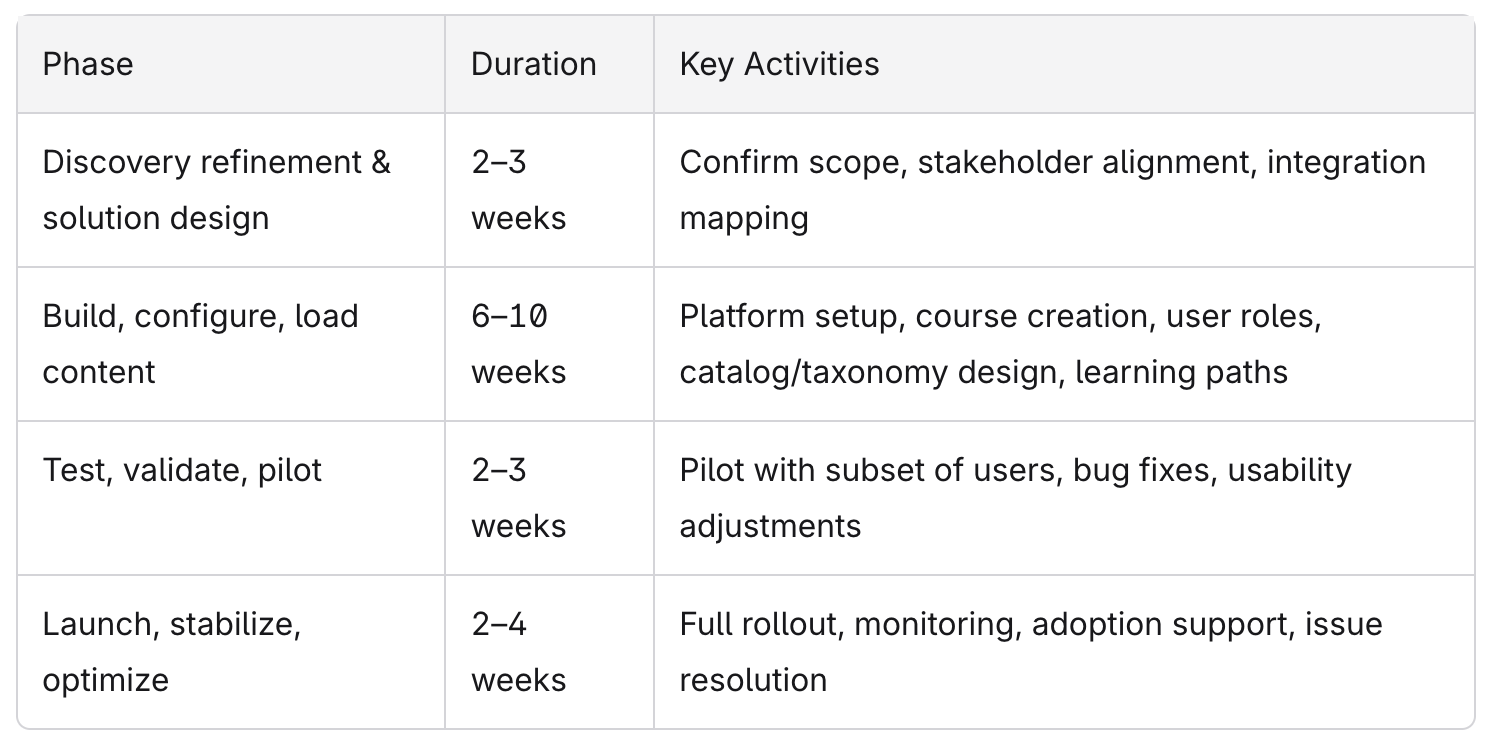
Concrete configuration tasks include setting up organizational hierarchies, roles, and permissions; defining curricula and learning paths for key roles; and establishing compliance rules with re-certification periods and reminder schedules.
A comprehensive needs assessment is crucial for successful lms implementation, and expert guidance in lms consulting can lead to significant cost and time savings during this phase. Effective LMS implementation includes data migration and user training. Effective LMS administration requires skilled administrators for optimal management, and LMS administrator training reduces technical issues and system downtime.
The consultant manages project governance through steering meetings, risk logs, cutover planning, and employee communications with IT and leadership.
Migrating Content and Data Between Learning Management Systems
There is a meaningful difference between starting fresh with a new lms and migrating years of courses, SCORM/xAPI packages, user histories, and certificates from a prior system.

Key migration activities include:
Inventory and audit existing learning content: ILT sessions, self paced learning modules, e learning courses, videos, PDFs, legacy SCORM 1.2/2004 packages
Decide what to retire, update, or rebuild - many older courses (especially Flash-era training materials) need conversion to HTML5
Map data for users, groups, enrollments, completion rates, due dates, and custom fields to ensure accuracy in the new system
Run test migrations in a sandbox environment, validate sample users and records, and reconcile discrepancies before cutover
Consultants help organizations avoid critical pitfalls: losing compliance histories needed for audits, breaking links between courses and curriculum requirements, or bringing over poorly structured catalogs that undermine the new UX and learner experience.
Real-world results show this works. Western University migrated roughly 100 courses from Sakai to Brightspace using AI-aided review to preserve question formats, video embeds, and links. A separate university migration case achieved 99.99% uptime, a 35% reduction in instructor admin time, and a 28% decrease in forecasted three-year TCO.
Integrations, Key Features, and Technical Architecture
Modern learning management systems rarely operate as standalone tools. They sit within a broader architecture that includes other systems for HR, CRM, collaboration, and content delivery.
Common integrations an LMS consultant helps design and validate:
HRIS (Workday, SAP SuccessFactors, ADP, UKG) for user provisioning and org data
Identity providers (Okta, Azure AD, Google Workspace) for SSO and access control
Video platforms (Zoom, Microsoft Teams, Webex) for virtual classrooms and webinar attendance
Content providers (LinkedIn Learning, Udemy Business, Skillsoft) via LTI or content marketplaces
Productivity tools (Slack, Microsoft Teams) for nudges, notifications, and microlearning delivery
Consultants also evaluate key features against requirements:
Mobile learning and offline access for frontline workers
Support for blended learning (ILT + VILT + self paced learning)
Social and collaborative features: discussion boards, peer feedback, user-generated content
Learning analytics and dashboards that feed BI tools like Power BI or Tableau
Customization options and support for instructional design standards
Choosing an LMS consultant involves evaluating their expertise in vendor selection and system integration. Field experience in specific industries - healthcare, manufacturing, SaaS, educational institutions - enhances the effectiveness of consulting services because consultants understand the technical issues, compliance frameworks, and training process unique to each related field.
Driving LMS Adoption, Engagement, and Governance
LMS adoption is often the hidden failure point. Platforms go live, but learners rarely return after initial compliance assignments. A well-implemented LMS can increase learner engagement by 20%, but only if adoption is designed in from the start.
LMS consultants typically provide change management and comprehensive training to facilitate adoption. Effective consultants focus on user experience to ensure high user adoption rates. A seamless user experience boosts engagement and adoption. Here is how they approach it:
Adoption and engagement tactics:
Simplify catalog structure and tags so employees quickly find relevant learning content
Design homepages and dashboards aligned with key personas: new hires, managers, frontline staff
Create launch campaigns via email, MS Teams posts, town halls, and role-based training for admins
Use tailored messaging and training to enhance user adoption and address resistance
Deliver training for multiple clients and internal teams on how to use the platform effectively
Governance model elements:
Define who owns which decisions across L&D, HR, IT, and business units
Establish how new content is approved, reviewed, and retired
Enforce data integrity and reporting standards for learner progress tracking
Run quarterly governance councils to review metrics and make roadmap decisions
LMS consultants analyze learner engagement data to identify areas and address bottlenecks in learning outcomes. Regular feedback and data analysis improve LMS effectiveness and user engagement. Ongoing auditing of LMS performance is integral to the consulting lifecycle to ensure continued effectiveness. Only about 30% of organizations effectively use learning program data for decisions - a governance model closes that gap.
Metrics worth tracking: login rates, course completion rates, time-to-productivity for new hires, overdue compliance, NPS ratings on the learning experience, and knowledge retention improvements.
How Much Do LMS Consulting Services Cost and How to Choose a Partner?
Realistic 2026 cost ranges for lms consulting services:
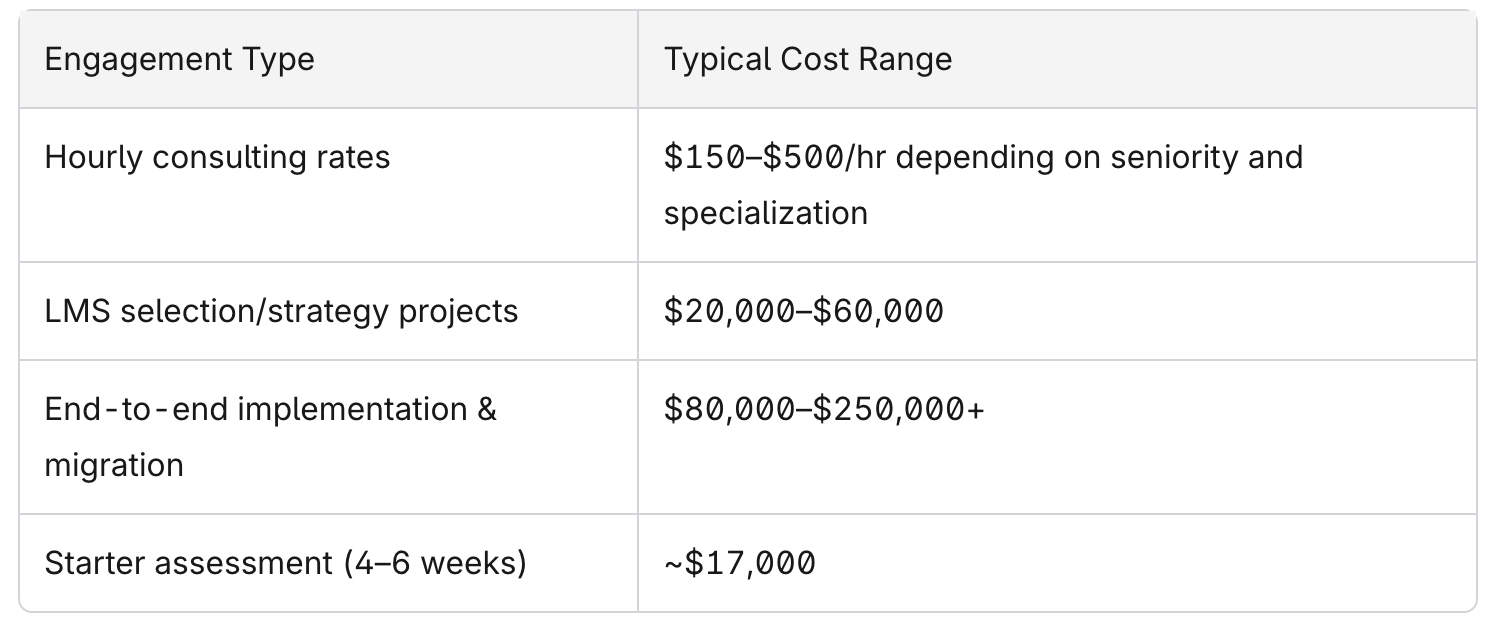
Common pricing models include fixed-scope projects, time-and-materials retainers, or ongoing advisory packages. An effective LMS can reduce training costs by 20–50%, making ROI analysis essential to determine financial feasibility. Calculating ROI allows informed decisions on LMS projects, and ROI analysis identifies risks affecting project outcomes early.
Criteria for choosing a partner:
Vendor-neutral stance with no reseller commissions that bias platform choices
Evidence of similar project experience in your industry - whether healthcare, manufacturing, SaaS, or serving government agencies
Balanced team skills across learning strategy, instructional design, system configuration, integrations, analytics tools, and change management
Clear methodology with timelines, deliverables, and communication cadence
Strong references and case studies from recent projects supporting professional development and customer success outcomes
Questions to ask in discovery calls:
"How do you balance learning strategy vs. technical implementation?"
"Can you share an example where you advised against a popular vendor?"
"What governance model do you typically establish with clients?"
"How do you measure long term success beyond go-live?"
A personalized approach to partner selection matters more than choosing the lowest bidder. The right consulting partner plays a critical role in whether your LMS drives effective training programs or collects dust.
Getting Started: First Steps Toward an Effective LMS Implementation

If you are considering lms consulting, start with these concrete steps:
Clarify your top 3–5 business goals to solve: shorten onboarding time, automate compliance tracking, support global product or client training, or accelerate employee development and leadership development
Inventory existing learning assets and tools: spreadsheets, SharePoint sites, content libraries, and your current learning processes
Identify key internal stakeholders and a small decision group to provide support and drive accountability
Gather baseline data on current training: completion rates, manual effort, cost effective alternatives, and tools in use
A needs assessment is critical for successful lms implementation. Schedule an initial 30–60 minute strategy call with an LMS consultant to review your current state, roadblocks, and desired outcomes. Decide early whether you need full lifecycle support - selection through adoption - or targeted help with a specific challenge like migration or analytics redesign.
Thoughtful learning management system consulting turns your LMS from a compulsory system of record into a cost effective, strategic engine for skill development, compliance, knowledge retention, and growth. The difference between an LMS that sits idle and one that drives measurable business outcomes usually comes down to the strategy and expertise behind its implementation.
Schedule an LMS strategy and migration consultation. Visit www.thecoursecrafters.com or contact our team directly at (404) 726-7261 to schedule a tour of Masterly Studios and discover how our expert services can transform your learning management system experience.
