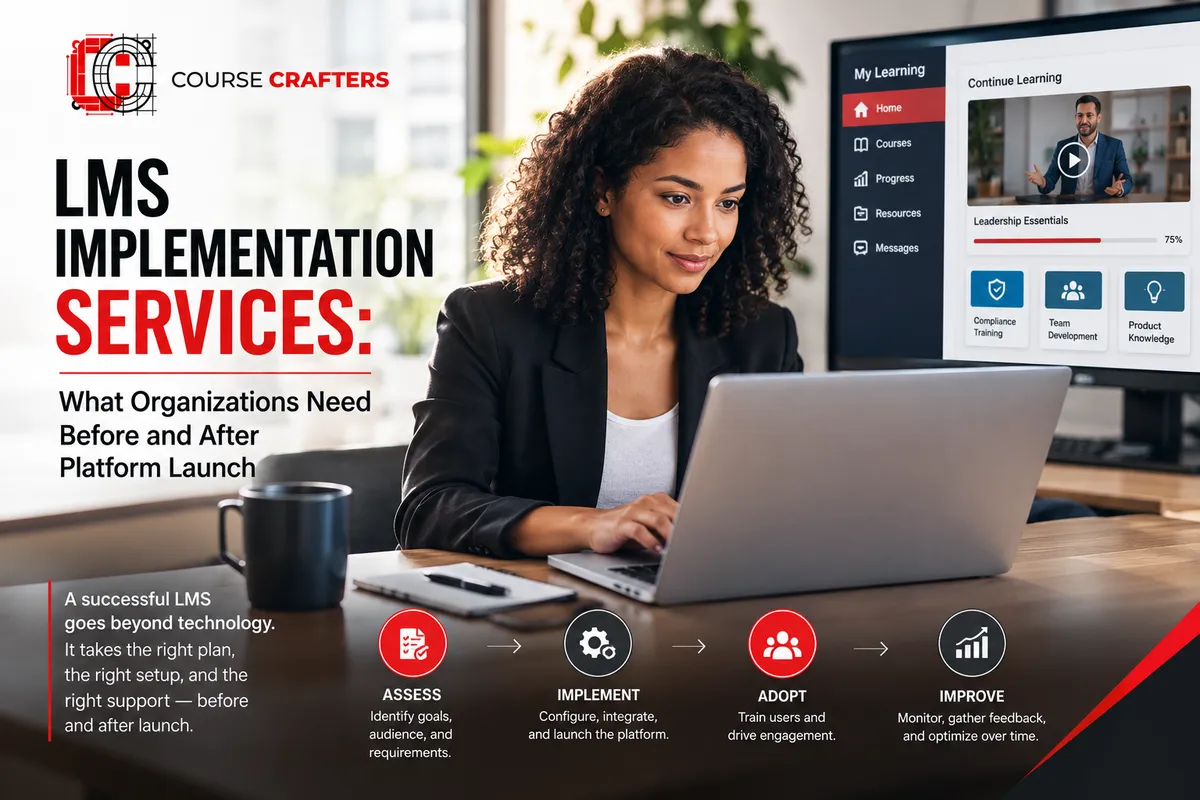
LMS Implementation Services for Businesses
What Are LMS Implementation Services and Who Are They For?
An LMS implementation service helps organizations deploy and integrate a learning management system into their operations. But "implementation" is a much wider scope than most teams expect when they sign a platform contract. It covers platform selection, configuration, data migration, course migration, user roles, reporting setup, launch strategy, and post-launch optimization - not just the technical setup that happens in the first two weeks.
Organizations may require LMS implementation services when adopting their first LMS or replacing an existing one. Between 2024 and 2026, the most common buyers are organizations running professional training programs: corporate L&D teams, associations, healthcare systems managing compliance, and financial services firms handling certifications. Course Crafters by Masterly focuses on exactly these organizations - not higher-ed degree programs with different accreditation and pedagogical requirements.
Here are concrete outcomes that drive most LMS implementation projects:
Establishing a single system of record for compliance training with audit-grade reporting by a fixed deadline
Reducing onboarding time by 30–40% through centralized course delivery
Migrating 5+ years of historical data from a legacy LMS without losing completion records or certifications
Reaching 90%+ mandatory course completion rates within 30–60 days of rollout
Enabling manager dashboards so leadership can track learner progress and compliance status in real time
Effective LMS implementation improves user adoption and engagement, and research shows a well-planned LMS implementation can improve talent retention by 91%. The rest of this article walks through what that process looks like, phase by phase.
Ready now? Request an LMS implementation consultation with Course Crafters by Masterly. Details are at the bottom of this article.

From Assessment to Adoption: Our LMS Implementation Consulting Approach
Effective learning management system implementation starts before a platform is chosen and continues well past launch. Most LMS implementations involve planning, configuration, testing, and launch stages, but the organizations that see real returns treat each stage with equal rigor.
Course Crafters by Masterly provides end-to-end LMS implementation consulting across these areas:
Needs assessment and training strategy alignment
Platform selection support (vendor-agnostic)
Implementation plan design with realistic milestones
Configuration oversight and governance
Data migration guidance
Launch planning, change management, and employee training
Continuous improvement and ongoing support
The philosophy is simple: process before technology. Learning management strategy and governance come first; software integrations and LMS configuration come second. Most LMS implementations take between 6 to 12 weeks for small to mid-sized deployments. Standard LMS implementation typically takes 12 weeks, and most LMS implementations run 12 to 16 weeks depending on scope - especially when enterprise integrations or multi-region rollouts are involved. Key components of LMS implementation services include needs assessment and planning, which is why that phase comes first.
Services can support a new LMS launch, re-implementation of an underused system, or migrations from legacy platforms originally deployed between roughly 2010 and 2018. Typical engagement formats range from 8–16 week projects to multi-phase engagements aligned to fiscal-year milestones.
Phase 1: Discovery and Defining LMS Implementation Success
Discovery starts with a training needs analysis and a current-state review of learning management across the organization. That means auditing your existing LMS or learning platform usage, identifying manual processes and shadow systems, mapping compliance obligations, and documenting what works and what does not.
Concrete discovery activities include:
Stakeholder interviews across HR, L&D, IT, operations, compliance, and front-line supervisors
Content inventory: format, owner, usage frequency, age, and versioning
Audit of current reporting capabilities, policies, and SOPs
Review of training requirements tied to regulations, certifications, or role-based competencies
The implementation team works with leaders to define 2–4 measurable objectives. Examples: "95% compliance completion within 30 days of assignment by December 2026" or "reduced time-to-productivity for new sales reps by 20% by Q2 2027." Failing to align training with organizational objectives leads to underuse of the platform - this is where that alignment gets locked in. Set a baseline before launch to compare results at 90 days.
From here, the team builds a high-level implementation plan covering phases, major milestones, launch date targets, and dependencies such as HRIS integration timelines or union agreement sign-offs. Defining clear project milestones helps align expectations and responsibilities during LMS implementation.
Phase 1 deliverables include a written success definition, a prioritized requirements list (must-have vs. nice-to-have), and an initial risk register for the LMS implementation project.

Phase 2: Governance, User Structure, and Learning Management Framework
Governance in a learning management system implementation means defining decision rights, approval workflows, naming conventions, and content ownership. Without this foundation, every region or business unit configures the LMS independently - creating duplicate courses, inconsistent taxonomy, and no reliable way to report across the organization.
Course Crafters by Masterly helps clients design user structures (organizations, departments, groups), user roles, and permissions that reflect real-world reporting lines and compliance obligations. This includes:
Translating the org hierarchy into LMS user groups, job families, and regional units
Defining role templates: global admin, regional admin, content creator, curriculum author, manager, learner
Handling special populations: external learners, contractors, multi-tenant setups, remote employees
Governance questions that need answers before configuration begins:
Who can publish courses globally vs. regionally?
Who can create curricula and assign mandatory training?
Who approves content updates, and who can edit historical records?
What naming conventions apply to courses, categories, and learning paths?
This upfront work prevents "failure by democracy." Ninety-one percent of L&D leaders say personalised learning paths improve retention, but personalised learning paths only work when the underlying structure is consistent and governed.
The phase produces a governance charter and admin playbook. These artifacts guide both the initial LMS configuration and continuous improvement decisions for years after launch. A change management plan starts taking shape here, too - underestimating change management can stall LMS adoption entirely.
Phase 3: Platform Selection and LMS Setup Services
Some clients arrive with a platform already selected. Others need help finding the right learning management system. Course Crafters by Masterly offers LMS implementation consulting that is vendor-agnostic, focused on matching requirements to capabilities.
For organizations still selecting a platform:
Translate prioritized requirements into a vendor shortlist using weighted scoring criteria
Build use-case scenarios that test real workflows (onboarding, compliance, leadership development)
Coordinate demos with actual staff - not just decision-makers
Document tradeoffs in LMS features, integrations, reporting, and total cost of ownership
For clients with a chosen learning platform (LMS setup services):
Configure tenant settings, terminology, and branding (logo, colors, domain)
Set up SSO and domain authentication, role templates, and baseline security defaults
Establish system configuration for password policies, encryption, and audit logs
Align every setting with the governance framework from Phase 2
Data security and compliance are critical aspects of LMS implementation services. Whether evaluating LMS platforms or configuring a selected one, security controls (SOC 2, HIPAA, GDPR) and integration capabilities with other systems must be addressed. A well-planned implementation must address integration and user training - both are validated during this phase.
This phase produces a signed-off configuration blueprint and a detailed configuration checklist for tracking every decision in the implementation project.
Phase 4: Data Migration and Course Migration
Data migration is where most learning management system implementations underestimate effort. There are three distinct categories of data, each with different challenges:
User and profile data: names, employee IDs, department affiliations, manager hierarchies
Historical training records: completed certifications, assessment scores, completion dates, compliance status
Training content: SCORM and xAPI packages, videos, PDFs, instructor-led schedules, attached online resources
Data migration is critical during LMS implementation. Proper data migration minimizes issues like data loss and compliance failures during LMS launch.
Typical data migration steps in the implementation process:
Map old LMS fields to new LMS fields; identify mismatches or gaps
Cleanse data: remove duplicates, correct invalid records, fill missing fields
Run test loads in a sandbox LMS environment and validate with sample reporting
Time the cutover to avoid disrupting month-end or quarter-end compliance cycles
Migrating user data can be complex and requires collaboration between the project team, IT, and HR. Allocate sufficient time for data migration to avoid issues - rushing it is one of the top causes of post-launch problems. Migrate only essential data to minimize potential issues, and expect that data migration may involve adjustments to ensure compatibility with the new system.
Course migration decisions follow a clear framework:
Retire obsolete or redundant training materials
Rebuild content that is valuable but outdated
Update training content for 2025–2027 regulatory changes (e.g., updated anti-harassment requirements, OSHA revisions)
Migrate as-is when content meets current standards
Prioritize critical compliance courses first - OSHA, HIPAA, SOC 2–related training, state-specific requirements - before optional libraries. Back up all legacy data exports and establish validation reports comparing historical data between old and new systems.

Phase 5: Integrations, Configuration, and End-to-End Testing
LMS implementation involves integrating the system into existing processes and enterprise software. Common integrations the implementation team helps plan with IT include:
HRIS or HCM systems for automated user provisioning and data exchange
Identity providers and SSO (Azure AD, Okta) for seamless login
Payroll or timekeeping systems for eligibility verification
External content libraries or third-party training providers
LMS configuration tasks tied to real use cases include building learning paths for job families, setting certification rules and re-certification windows, defining equivalencies, configuring session management for instructor-led or virtual training, creating manager dashboards for progress tracking, and setting up automated assignments.
Testing a new LMS is essential before its official launch. A structured LMS testing cycle looks like this:
Unit testing - verify individual configuration pieces (roles, permissions, course rules)
Integration smoke tests - confirm SSO, HRIS provisioning, and data exchange work correctly
Administrator user-acceptance testing - LMS administrators validate workflows
Pilot program - a small learner cohort (one region or job role) tests real scenarios over 2–4 weeks
Testing scripts should mirror real scenarios: onboarding a new employee hired on the 15th of the month, handling a promotion mid-quarter, a manager assigning online training to a team, or a learner self-enrolling in elective learning programs. Conducting a pilot test helps gather user feedback before the full LMS launch.
Course Crafters by Masterly facilitates defect tracking, prioritization, and stakeholder sign-off on go-live readiness criteria.
Phase 6: Launch Strategy, Change Management, and Communication
A successful LMS implementation depends as much on how the platform is introduced as on how it is configured. Change management strategies facilitate acceptance and effective use of the LMS by employees. Without them, even a technically perfect LMS deployment stalls.
Launch patterns:
Big-bang launch - works for smaller organizations or uniform use cases
Phased rollout - by region, function, or job role; appropriate for 1,000+ employees or multi-timezone operations. Case studies show mid-market firms using phased rollouts over 9 months with strong results
Change management plan components:
Stakeholder mapping and executive sponsorship model
Internal champions at the department or regional level
Administrator training for core LMS tasks (assigning courses, running reports, managing users)
Manager enablement so leaders understand their role in employee adoption
Communication deliverables the implementation team helps produce:
Pre-launch email announcements and reminder campaigns
Intranet posts explaining what is changing, why, and how to access the new system
Leadership slide decks for town halls or team meetings
Short job aids and video walkthroughs for end users
Structured training for administrators and end-users boosts LMS adoption and proper usage. A customized onboarding strategy is essential for user engagement and training efficiency, especially for remote employees who cannot attend in-person sessions. In-app guidance improves user engagement with the LMS during those critical first weeks. Faster deployment accelerates user activation and early training wins in organizations.
White glove implementation services - hands-on setup assistance that extends through launch - are available for organizations that need dedicated support during the transition. The launch plan should cover at least the first 90 days post-go-live with planned touchpoints, FAQs, and feedback mechanisms.
After Launch: Reporting, Continuous Improvement, and Ongoing Learning Management
Learning management system implementation is not finished at launch. This is where continuous improvement begins, and where most organizations leave value on the table. Only 30% of organizations effectively use learning data for decisions.
Course Crafters by Masterly helps clients define reporting dashboards and success metrics aligned to the criteria set in Phase 1:
Compliance completion percentages and compliance status by department
Overdue training and time-to-completion trends
Assessment scores and learner progress by role
Manager engagement with dashboards and reporting tools
Gathering feedback post-launch helps improve the LMS experience. Track completion rates and assessment scores to measure success. Post-implementation reviews help assess training program effectiveness and identify gaps. Not measuring results can hinder future LMS improvements.
Establish a reporting cadence: weekly dashboards during the hypercare period (first 2–4 weeks), monthly admin reviews, and quarterly leadership reports. Post-launch support includes troubleshooting and ongoing improvements for the LMS.
Continuous improvement activities include:
Maintaining a backlog of user feedback, new regulatory requirements, and requests from new business lines
Annual content audits to retire outdated training materials and refresh critical training content
Evaluating new LMS features, AI-driven recommendation engines, or adaptive learning paths
Automating manual learning workflows as the development process matures
A dedicated LMS administrator is crucial for long-term success. A successful LMS can result in better learning outcomes and compliance tracking capabilities, and a well-implemented LMS can enhance scalability and support growing user bases and content over time. The goal is a sustainable learning platform that remains accurate, trusted, and easy to manage 2–5 years after implementation.

How Course Crafters by Masterly Partners With Your Implementation Team
Course Crafters by Masterly works alongside internal project managers, IT teams, HR, and LMS vendor implementation services - not as a replacement, but as an experienced partner who fills gaps and accelerates decisions.
Engagement models:
Lead implementation consultant for the full LMS project (end-to-end)
Strategic advisor to an internal implementation team already managing the project plan
Specialist support focused on data migration, governance, instructional design, or learning design
Artifacts produced for the client team:
Implementation project plan and project schedule
RACI matrix defining responsibilities for each key stakeholder
Governance guide and admin playbook
Configuration workbook detailing every setting and its rationale
Data migration mapping documents
Administrator training curriculum and user-role permissions matrices
The project manager from Course Crafters by Masterly aligns milestones with your corporate PMO, fiscal deadlines, and regulatory calendars - for example, ensuring compliance-ready reporting is operational before January 1, 2027. The aim is to leave clients with internal capability: trained LMS administrators, clear documentation, and a defined process for changes so ongoing support does not require perpetual external dependency.
When to Engage LMS Implementation Services (and Common Pitfalls to Avoid)
Organizations benefit from LMS implementation services in several scenarios:
Purchasing and deploying a new learning management system for the first time
Migrating from a legacy on-premise LMS to a cloud-based platform
Consolidating multiple learning platforms after mergers or acquisitions
Rescuing a stalled implementation project where the existing LMS sits underused
Common pitfalls Course Crafters by Masterly helps clients avoid:
Choosing a platform before defining training goals and requirements - feature checklists without outcome alignment lead to mismatches
Underestimating data migration complexity in volume, quality, and field mapping
Skipping pilot testing, which surfaces usability and configuration issues before they reach thousands of users
Neglecting the change management plan - explaining "why" matters as much as explaining "how"
Ignoring data security, which can lead to breaches and penalties
Early engagement - ideally 3–6 months before your target LMS launch date - enables a realistic implementation timeline and avoids last-minute compromises that hurt employee adoption. Warning signs that an implementation is off track include missed integration deadlines, unclear ownership of training content decisions, long-standing "test" environments with no go-live date, and low engagement during pilot programs.
A structured, consultant-led implementation process reduces rework, protects your LMS investment, and increases long-term ROI from the learning platform.

Next Step: Request an LMS Implementation Consultation
Course Crafters by Masterly helps organizations design, implement, and sustain a learning management system that employees actually use and leaders can measure. A well-planned learning management system implementation - before and after platform launch - becomes the foundation for every future training investment.
Here is what to bring to the consultation:
Your current training challenges and training needs
Any existing LMS contracts, RFP timelines, or LMS vendor evaluations in progress
Target launch dates and key metrics leadership cares about
Questions about your LMS implementation plan, whether you are starting fresh or fixing a stalled rollout
A well implemented LMS does not happen by accident. It starts with the right process, the right project team, and valuable feedback loops that keep the system relevant long after go-live.
COURSE CRAFTERS by Masterly Request your consultation (404) 726-7261
