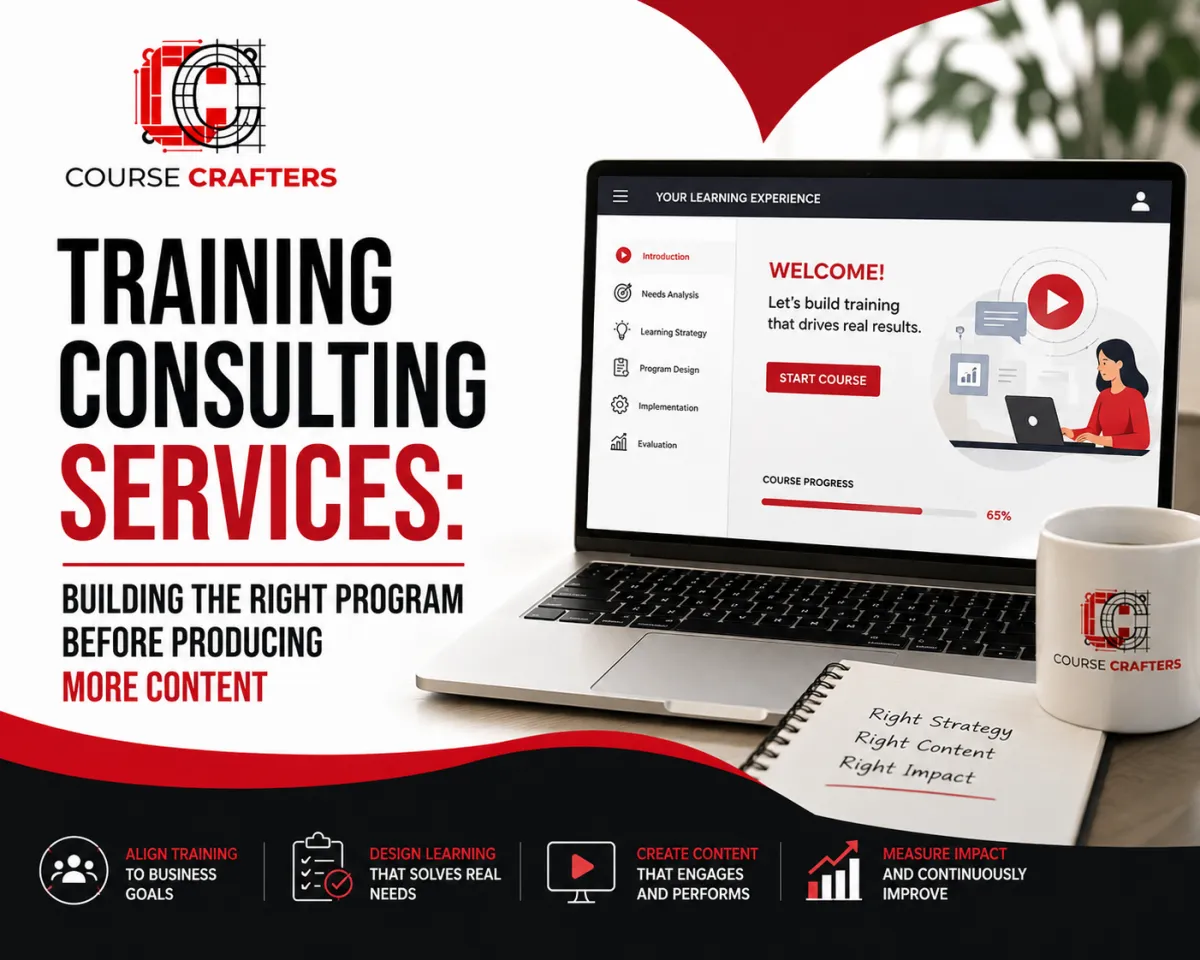
Training Consulting Services for Businesses
Course Crafters by Masterly helps organizations design a training strategy before producing a single frame of video or writing a single slide. Training consultants assess corporate needs to craft tailored programs; custom training design aligns with specific organizational goals. This page is for organizations, associations, universities, and experts who already feel "we need better training" but lack a structured plan to act on that instinct.
Training programs should align with business objectives for effectiveness. That means connecting learning initiatives to concrete targets: higher sales per rep by Q3 2025, 20% fewer support tickets after a product launch, or full compliance readiness by a 2026 deadline. Effective training connects learning to measurable business outcomes, and that connection starts with consulting, not content. Every engagement we run builds in continuous learning, continuous improvement, and a measurement plan that ties learner performance to business impact and sustainable growth.
Ready to stop guessing? Request a training strategy consultation with Course Crafters by Masterly. Call (404) 726-7261.
When Your Organization Needs Training Consulting Instead of More Content
Many organizations face the same development challenges: scattered courses built by different teams over several years, low completion rates, inconsistent curriculum across regions, and no clear link between training content and employee development outcomes. Training consulting services support companies in improving worker performance by solving the root problem, not adding more modules on top of a broken foundation.
Specific situations where consulting services come first:
Rapid headcount growth after a 2024 funding round, with onboarding that varies by office
A new software rollout in Q1 2025 that exposes skills gaps across departments
Merger integration requiring unified practices and leadership training
Accreditation requirements for a 2026–2027 academic year with new standards
A development consultant helps decide whether the problem is a skills gap, a process issue, or an unclear learning path. Training needs analysis separates knowledge gaps from process issues. Consultants help identify critical skill gaps to target training resources effectively, and training consultants help bridge skill gaps and improve performance rather than commissioning courses that address the wrong problem. This prevents "course clutter" and focuses resources on effective training that drives business impact.

Our Approach: From Gap Analysis to a Training Roadmap
Course Crafters combines learning strategy consulting with practical implementation planning using a thoughtful approach built around six phases. Core services include skills gap analysis, program design, and performance tracking.
Phase | Focus | Typical Duration |
|---|---|---|
1. Discovery & Needs Analysis | Stakeholder interviews, performance data review, business alignment | 2–3 weeks |
2. Audience Analysis & Learning Objectives | Learner personas, constraints, measurable objectives | 1–2 weeks |
3. Curriculum Development | Learning architecture, module mapping, content development | 2–4 weeks |
4. Delivery Model & Technology | Platform selection, delivery methods, production planning | 1–2 weeks |
5. Measurement & Improvement | KPI hierarchy, feedback loops, iteration plan | 1–2 weeks |
Every engagement results in a concrete course roadmap with timelines, not a slide deck of abstract recommendations. Each step ties back to business goals; for example, Carter Bank & Trust reduced its new analyst training cycle from twelve months to six months after aligning program design to business operations. |
Phase 1: Discovery and Training Needs Analysis
Every project starts with clarifying the problem and desired performance outcomes. Effective training requires a comprehensive needs analysis before any content is scoped.
The discovery phase covers:
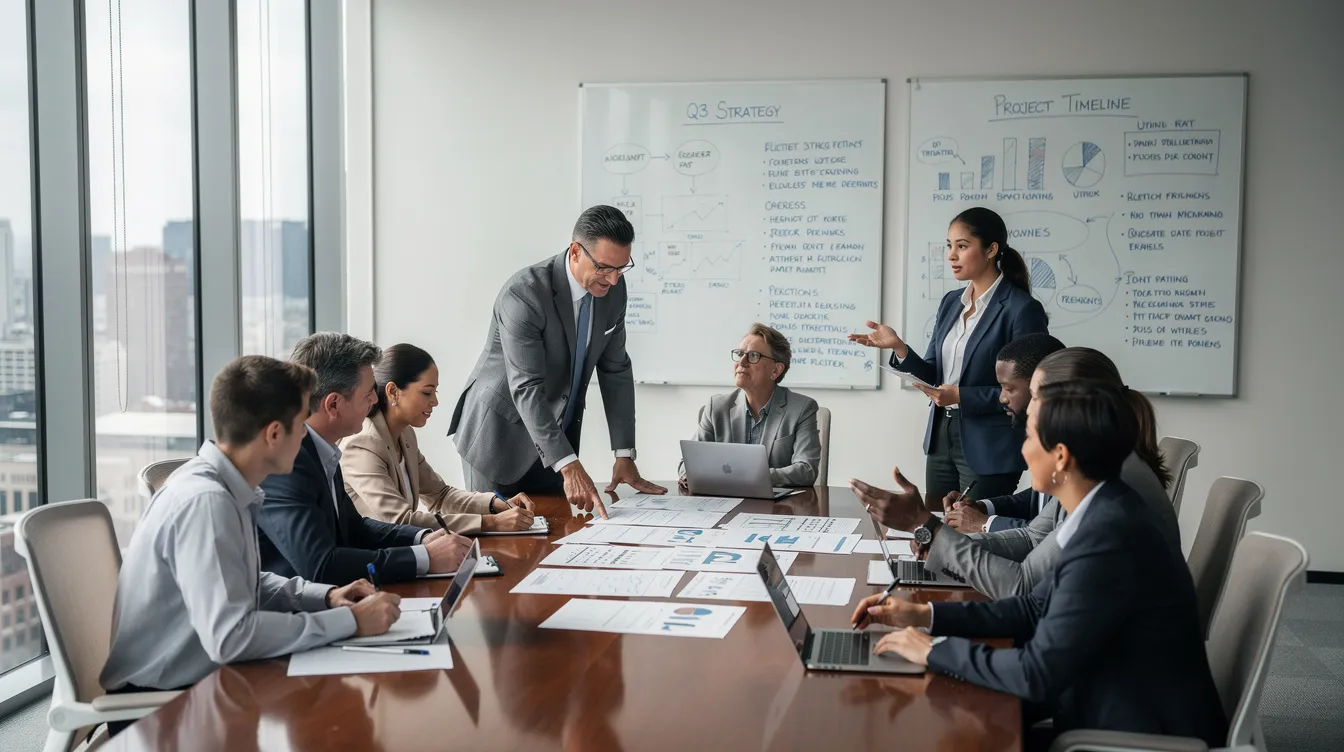
Stakeholder interviews with executives, managers, and frontline staff to capture expectations and pain points
Review of existing training programs, including completion rates, drop-off points, and regional inconsistencies
Analysis of performance data from the previous 6–12 months: customer satisfaction scores, error rates, support response times, quality metrics
Alignment with upcoming business milestones (product launches, regulation deadlines, merger integration dates)
Training needs analysis identifies gaps between current and desired performance. A comprehensive training needs analysis informs custom training solutions by comparing current capabilities against targets. Training needs analysis can include stakeholder interviews and performance data; the NCCER 2025 ROI report found that construction firms routinely tracking performance metrics built stronger cases for future training investment than those relying on anecdotal evidence.
Performance consulting involves diagnosing performance gaps in processes and tools, not only in knowledge. This phase differentiates when training is the right solution versus when human performance problems stem from missing tools, unclear workflows, or management gaps. Human resources and hr teams contribute data at this stage to ground the analysis in organizational reality.
Phase 2: Audience Analysis and Learning Objectives
Understanding distinct learner groups matters because frontline staff, managers, and external partners learn differently, face different constraints, and need different specific skills to perform successfully.
What we analyze for each audience segment:
Roles and prior knowledge: new hires vs. tenured staff, technical vs. non-technical
Language and literacy considerations: multilingual workforces, reading level requirements
Tech access: mobile-only users, field workers without laptops, semester-bound schedules
Constraints: shift work, time zones, bandwidth limitations
Effective training needs analysis helps prioritize learning objectives. Course Crafters writes measurable learning objectives tied to business goals. Example: "By week 8 post-training, first-line support reps reduce average handle time from 8 minutes to 5 minutes." Effective training requires clear learning objectives and measurable outcomes; without them, no one can confirm whether skill acquisition occurred.
Customized training improves employee engagement and performance. Tailored training solutions enhance learning outcomes when objectives connect directly to what each learner group needs. Clear objectives also support continuous learning by giving learners and managers a shared standard for progress.
Phase 3: Curriculum Development and Learning Architecture
This phase turns strategy into a structured curriculum rather than isolated sessions. Training consultants design and implement targeted learning programs for organizations by organizing content into modules, pathways, and levels.
Curriculum development at Course Crafters addresses:
Onboarding tracks: foundational knowledge for new hires, time-bound to reduce ramp-up
Role-specific modules: technical skills required for each job family
Leadership development tracks: leadership skills, emotional intelligence, and decision-making skills for managers and executives
Leadership development enhances emotional intelligence and decision-making skills, which is why it gets a dedicated track rather than a single workshop. Training programs should be flexible and scalable to adapt to organizational needs; we design learning architecture that accommodates multiple job families, regions, and compliance requirements.
Content development maps modules to delivery methods (microlearning for refreshers, workshops for collaboration, simulations for technical practice) and builds in reinforcement: spaced repetition, job aids, peer review. The goal is learning experiences that produce new skills and behavior change, not one-time events that learners forget within a week.
Phase 4: Delivery Model and Learning Technologies
The right delivery model turns a plan on paper into actual behavior change. This phase determines how training delivery happens across your organization.
Key decisions:
Instructor led training at a single location for high-stakes, hands-on skills
Virtual synchronous sessions for distributed teams across time zones
Blended learning: a blended learning approach combines various training modalities for effectiveness
Self-paced digital modules for compliance, onboarding, or refresher content
Digital learning is one of the fastest-growing segments in training. AI integration is reshaping learning and development strategies through adaptive learning paths and personalized recommendations. Virtual reality enhances training by simulating real-world scenarios in safety, manufacturing, and healthcare. Gamification increases engagement through competitive training experiences in sales and customer service contexts.
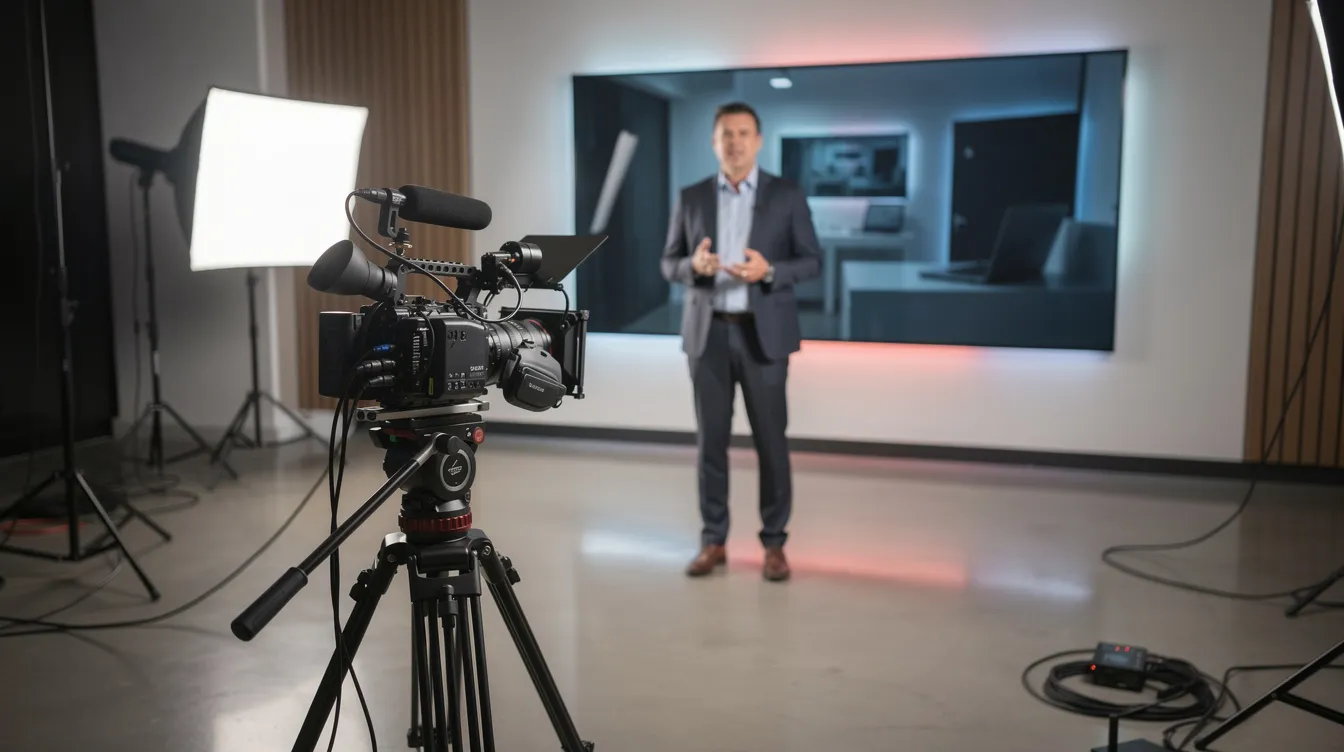
We advise on using existing LMS platforms and prepare assets optimized for those systems. Traditional learning formats (classroom lectures, printed manuals) still serve specific audiences, but the learner experience improves when the format matches the content type and audience constraints. Masterly Studios production capabilities (professional video, audio, branded visuals) activate only after the strategy is confirmed, avoiding wasted production costs on misaligned content.
Phase 5: Measurement, Continuous Improvement, and Business Impact
Every engagement includes a measurement plan. Measuring training effectiveness involves tracking outcomes against defined metrics, not just counting completions.
Metrics we build into every program:
Learning: pre/post assessment scores, certification pass rates
Behavior: manager observations and peer feedback at 30, 60, and 90 days
Business KPIs: revenue per rep, error reduction rates, customer satisfaction, time to competency
Efficiency: training hours per employee, cost per learner, reduced support call volume
Post-training assessments measure effectiveness and inform improvements. They utilize data analytics to refine training content and effectiveness across each cycle. Data analytics refine training content for maximum impact when paired with stakeholder feedback and performance data.
Concrete example: after a 2025 product training rollout, we track product return rates and support ticket volume in Q2 2025, then refine modules for 2026 cohorts based on what the data shows. Continuous evaluation ensures training remains relevant and impactful. Consultants provide ongoing support to ensure continuous improvement through feedback loops, dashboard reviews, and curriculum versioning.
Who We Serve: Organizations We Help Design Smarter Training
Course Crafters by Masterly focuses on strategy-led training for organizations, not individual DIY creators. Training consulting services address both current and future employee capabilities across industries. Specialized consulting services cater to specific industry needs.
Client types and sample scenarios:
Mid-market and enterprise companies: sales enablement programs, customer service academies, workforce development initiatives, partner certification tracks
Professional associations: member education pathways, credentialing and CEU programs, compliance and safety training that ensures adherence to industry regulations
Universities and schools: faculty development, student credential pathways, bridging academic and corporate training
Expert-led firms and consultancies: internal curriculum for growing teams, learning programs for client-facing staff, learning strategies for scaling operations
Training consulting improves employee retention rates when learning programs connect to career progression. Each engagement produces development solutions sized for the organization's complexity and business objectives.
Why Partner with Course Crafters by Masterly as Your Training Consultant
Generic training vendors produce content. A strategic partner architects the entire learning ecosystem: from needs analysis through content development, delivery, and performance improvement. Course Crafters operates as a trusted partner and experienced consultants with a dedicated team, not a marketplace of freelancers.
Specific strengths:
Done-for-you approach: strategy, curriculum development, production, and launch support handled end-to-end
In-house studios in Buckhead Atlanta with professional audio, lighting, and multiple sets
Multi-location support: Atlanta–Buckhead, Dallas–Uptown, Houston–Galleria, West Palm Beach–Downtown
Business acumen: we design training solutions that support organizational performance and organizational effectiveness, not one-off events
Expert knowledge from training consultants aids organizations without full-time L&D staff or in house trainers. Our track record includes helping organizations cut onboarding time, reduce performance gaps, and build continuous learning cultures that drive positive change and performance improvement across teams.

What to Expect from a Training Strategy Consultation
The initial call covers:
Current training assets and existing training programs
Top 3 business goals and strategic goals for the next 12–18 months
Key audiences and their development challenges
Timelines and budget parameters
Next steps after the call: a proposal for a defined consulting engagement, an estimated timeline (typically 6–12 weeks for mid-sized organizations), and a deliverables list. This service is for organizations ready to update or rebuild an existing training strategy. It is not for DIY course builders.
Request a training strategy consultation with Course Crafters by Masterly. Call (404) 726-7261.
