Corporate eLearning Development for Scalable Employee Training
Corporate eLearning Development for Scalable Employee Training
Corporate eLearning development is the systematic process of creating digital training content that replaces inconsistent live sessions with structured, LMS-ready training programs. For organizations with 500 to 20,000+ employees, it offers something slide decks and traveling trainers never could: consistent messaging, measurable results, and scalable learning that reaches every location and role.
Many organizations today invest in custom corporate eLearning rather than relying solely on in-person workshops. Custom eLearning is tailored to specific organizational needs - your internal workflows, compliance requirements, brand voice, and the tools your team actually uses. By contrast, off the shelf elearning is pre-made and generic, covering universal topics but rarely reflecting the nuances of how your company operates.
Effective corporate eLearning programs align training with business goals and employee needs. The benefits leaders care about most include scalable learning platforms that can grow with your business needs, consistent training across diverse locations, faster time-to-competency for new employees, and measurable results tied to KPIs.
This article is written for learning leaders, human resources directors, and business unit owners evaluating how to create elearning that evolves with the organization. Professional instructional design and modern authoring tools turn subject matter expertise into repeatable, high-impact employee training development.

From Live Workshops to Scalable Learning: Why Organizations Shift to eLearning
Picture this: in 2018, your compliance team flew trainers to six offices quarterly, delivering slightly different versions of the same policy update to rooms full of distracted employees. In 2026, that same update ships as an interactive module - available globally, translated into local languages, tracked by your LMS, and completed on each person's own schedule.
Traditional in-person training suffers from problems that compound at scale:
Inconsistent delivery across instructor sessions
Scheduling conflicts, especially for remote and hybrid teams
High travel costs and venue expenses
No reliable learner data beyond attendance sheets
Corporate eLearning development solves these by making content always available, standardized, and easy to update. Active learning enhances engagement compared to passive presentations or lectures, and analytics dashboards give managers real visibility into who completed what - and how well they understood it.
Post-2020 distributed work and increased regulatory scrutiny in industries like finance and healthcare have made scalable learning a strategic requirement, not a convenience. The connection to business outcomes is direct: Paychex, for example, cut new sales rep time-to-competency by 41% and reduced travel expenses by 68% after shifting to a blended elearning approach.
Real-world relevance in training helps employees transfer new skills to their work - which is exactly why organizations rarely eliminate live training entirely. Instead, they blend virtual instructor-led sessions with custom elearning modules for pre-work, reinforcement, and ongoing development.

Core Components of Corporate eLearning Development
Corporate elearning development is a structured process - not just uploading slides to a portal. The development lifecycle typically follows a structured approach using frameworks like ADDIE or SAM, each guiding decisions about course length, interactivity, assessments, and practice activities.
Here are the core components:
Needs analysis: Custom eLearning development involves a thorough needs analysis. You identify performance gaps, define business goals, and analyze your audience's baseline skills and workflows. Content creation involves designing curriculum with Subject Matter Experts who understand the job.
Instructional design: The instructional design phase maps out course structure and objectives, assessment strategies, and the learner journey from start to finish.
Content development: This includes creating text, visuals, and interactive elements - video, audio narration, animations, branching scenarios, and simulations that mirror real decisions.
Technical development: Technical development ensures the course functions across all devices, browsers, and meets accessibility standards like WCAG 2.1 AA and Section 508. Mobile responsiveness and inclusive language ensure content reaches every employee.
Evaluation: Pre- and post-assessments establish baselines and track mastery. Providing timely feedback improves the learning experience and reinforces correct behaviors.
Many organizations combine different types of content in one solution: short scenario-based modules, job aids, reference guides, and spaced microlearning refreshers. Microlearning is effective for busy professionals as it consists of short modules that fit into the workday without disrupting productivity.
Custom Corporate eLearning vs. Off-the-Shelf Courses
Most organizations use a mix of both approaches. Understanding when to choose each saves development time and budget while maximizing learner outcomes.
Off-the-shelf elearning covers universal topics - harassment prevention, cybersecurity basics, general leadership. Strengths include fast deployment, predictable pricing, and broad catalog coverage. But off-the-shelf courses may require adaptation to fit specific needs, and they rarely reflect your internal policies, systems, or cultural nuances.
Custom elearning development builds from the ground up around your workflows, system screenshots, data examples, and brand voice. Custom eLearning allows for greater engagement through interactive elements that mirror how work actually gets done. Custom eLearning enhances learner engagement through relevant content that experienced employees recognize as authentic, not generic.
A concrete example: a 2025 sales enablement program built around a client's CRM, pricing model, and objection-handling playbook outperformed a generic sales skills module by every metric Paychex tracked - retention increased 8%, revenue rose 10%, and online training courses replaced costly in-person sessions.
Custom courses can be updated easily as organizational needs evolve, making them particularly valuable for fast-changing compliance requirements or product launches. Custom eLearning can be easily updated as organizational needs change without rebuilding from scratch.
The recommended strategies: use off-the-shelf for universal topics to save resources. Allocate custom corporate eLearning for high-stakes, high-variance training where competitive advantage or compliance depends on specificity.
Designing for Business Impact: Instructional Design and Measurable Results
Modern employee training development must prove ROI - not just completion rates. The focus should be on how training changes what people do on the job and how that shows up in business data.
Instructional design translates business metrics into precise learning objectives:
Reduce support tickets → design courses around common customer issues with scenario-based practice
Improve sales conversion → build branching conversations that mirror real objection handling
Lower compliance findings → create interactive simulations of regulated workflows
Interactive formats promote active participation for better knowledge retention. Software simulations let learners practice in environments that feel real before they touch live systems. Branching scenarios show consequences of different choices, encouraging critical thinking.
Implementing analytics allows organizations to measure training impact beyond completion rates. Custom eLearning provides measurable results through assessments and analytics by connecting LMS data - scores, attempts, time-on-task - with operational dashboards in tools like Salesforce, ServiceNow, or your HRIS.
Measurable results span both learning metrics and business metrics: error rates, sales conversion over specific quarters, compliance findings, and performance review outcomes. Professional providers should propose an evaluation plan - from pilot cohorts to A/B testing alongside existing training - so leaders can discover concrete impact within defined timeframes and achieve the business outcomes that justify the investment.

Step-by-Step Corporate eLearning Development Process
A typical corporate elearning project for a 30–45 minute module runs 10–16 weeks. Here is the development journey broken into clear milestones:
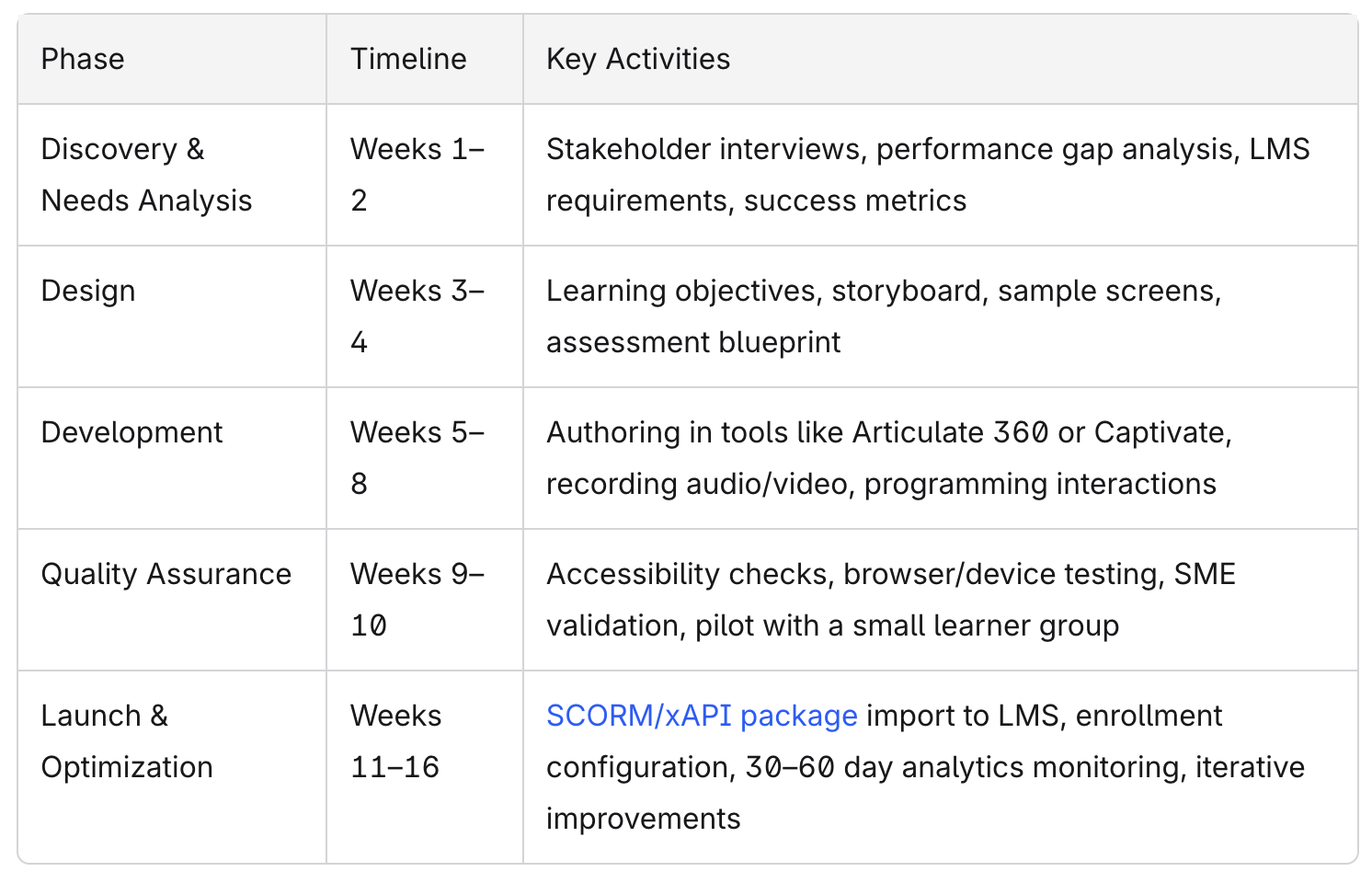
Implementation includes launching the course and providing ongoing support - this is where many organizations underinvest.
Artifacts clients should expect at each stage:
Discovery: needs analysis report, business goal-to-objective mapping
Design: storyboard, design comps, assessment blueprints
Development: alpha and beta builds with review cycles
Final delivery: SCORM/xAPI package, source files, style guide, admin documentation
This clarity helps your team work closely with the development partner and ensures every module supports scalable learning long after launch.
Integrating eLearning with Your LMS and Tech Stack
LMS-ready training and smooth integration are critical for companies managing multiple audiences, languages, and compliance requirements. A Learning Management System is used to track employee progress and engagement - but only if the elearning content is built to communicate with it properly.
Technical standards matter. SCORM (1.2 and 2004) handles standard tracking: completion, score, time. xAPI goes further, capturing learner data from simulations, mobile learning, and offline activities through a Learning Record Store for richer analytics.
When deploying to enterprise LMS platforms like Cornerstone, SAP SuccessFactors, Workday, or Docebo, key considerations include SSO, user provisioning, role-based enrollments, and multilingual support. Aligning your course structure to how the LMS organizes learning paths, certifications, and recertification rules ensures efficient employee skills maintenance.
Integration with HR systems and performance management tools allows training data to inform performance reviews, development plans, and succession pipelines. A strong learning platform should deliver an enterprise-level experience - yet 38% of LMS users want an improved user experience, and one in three companies plan to buy a new learning platform. Building content to be platform-agnostic makes future migrations easier.
Continuous improvement of eLearning programs is essential to keep content relevant and effective. Professional corporate eLearning development should include technical implementation guidance, test packages, and documentation to make future updates low-friction.
Use Cases: Where Corporate eLearning Delivers the Most Value
Not every training need requires custom elearning. This section spotlights high-impact scenarios where the investment delivers the strongest returns.
Compliance and risk training: Data privacy (GDPR, CCPA), anti-bribery, and safety protocols demand tailored scenarios by region and role. Custom eLearning allows for easy updates as organizational needs change - essential when regulations shift quarterly.
Product and sales enablement: Launching a new product line, training account executives on pricing, or building objection-handling skills with simulations and role-plays. This is where engaging, scenario-based elearning solutions outperform generic class materials.
Onboarding and role transitions: Structured digital paths for new hires or employees moving into leadership roles replace ad hoc shadowing. Lloyds Business Banking reduced onboarding attrition from 20% to 5% within three months using realistic simulations.
Operations and systems training: Step-by-step guided practice in ERP, CRM, or custom software reduces errors before employees access live data.
Sector-specific applications: Higher education staff training, healthcare protocol updates, manufacturing safety refreshers, and financial services regulatory programs all benefit from the consistency and documentation that elearning development provides.

Planning Your Corporate eLearning Roadmap and Next Steps
Corporate eLearning development is most effective when planned as a multi-year program, not a one-off project. The organizations that develop a roadmap - rather than reacting to individual training fires - see the strongest returns.
A practical starting point:
Inventory existing training and identify 3–5 high-impact topics where inconsistent live training is most costly
Build an internal business case: quantify current training costs, estimate development time savings, and tie proposed elearning projects to strategic initiatives for 2026–2027
Establish design standards - tone, visual guidelines, accessibility expectations - so each new module strengthens a coherent learning community and ecosystem
Evaluate any elearning company or vendor against clear criteria: experience with corporate eLearning development, instructional design depth, LMS integration expertise, and demonstrated success through case studies with measurable results
From a quality and perspective standpoint, the right partner helps you adapt quickly, encourage adoption, and build knowledge that compounds across your organization.
Schedule a corporate eLearning development consultation to review your current programs and map a scalable learning plan that delivers efficient, measurable impact for your team.
