Corporate Training Programs: From Content to Measurable Employee Performance
Corporate Training Programs: From Content to Measurable Employee Performance
Corporate training programs are no longer a nice-to-have budget line. They are the mechanism that connects what your workforce knows to what your business needs them to do. This guide walks through the full lifecycle of building, deploying, and measuring custom training that drives real performance.
Corporate Training Today: Why Custom Programs Outperform Generic Courses
Organizations are spending more each year to close skill gaps that directly affect revenue, safety, and retention. According to Training magazine's 2018 Training Industry Report, average training expenditures for large companies increased from $17 million in 2017 to $19.7 million in 2018. The question is no longer whether to invest but how to invest so the money actually moves a metric.
Generic, off-the-shelf employee training and compliance-only job training typically deliver underwhelming results. Completion and behavior change are generally stronger when content is built around a company's own processes and environments, rather than generic material that is not tied to the work people actually do.
According to ASTD's 2000 study, Profiting From Learning, firms in the top quarter of per-employee training expenditures had 218% higher income per employee than firms in the bottom quarter. Effective corporate training programs drive performance and foster a culture of growth by tying learning directly to measurable outcomes: revenue per employee, defect rates, sales conversion, safety incidents, employee engagement, and retention.
Modern corporate learning development follows an end-to-end pipeline:
Needs analysis tied to business goals
Custom program design with role-specific learning paths
Content production including training modules and filming
Course deployment across the organization
Skills transfer measurement and continuous improvement
Turning Business Needs into Training Outcomes (Needs Analysis)
Every effective corporate training program begins with a rigorous needs analysis. Needs assessments identify skill gaps and measurable business goals before training starts, ensuring every module connects to an outcome the business cares about.
The data sources available in 2024 to 2026 are richer than ever:
Performance reviews and 360-degree feedback
QA scores and defect logs
CRM data (cart abandonment, conversion rates)
Safety incident logs
Customer NPS and CSAT scores
Exit interviews and employee engagement surveys
Translating business problems into learning objectives is where this phase earns its value. An 18% cart-abandonment rate in Q1 becomes a learning objective around checkout communication scripts and coaching. High defect rates on a specific production line become a targeted retraining program with a measurable 30% reduction goal. Training can enhance both technical and soft skills to improve job performance, but only if you first diagnose the right gap.
There are three distinct types of gaps, and each demands a different approach:
Skill gaps - the employee lacks procedural know-how
Knowledge gaps - missing information or conceptual understanding
Mindset/behavior gaps - attitudinal barriers that knowledge alone won't fix
Stakeholder involvement is essential. Include business leaders who own the KPIs, human resources and L&D leaders for strategic alignment, frontline managers who see daily performance, and a small sample of learners through interviews or focus groups. A structured needs analysis phase typically takes 2 to 6 weeks depending on organization size, and skipping it is the single most common reason training courses fail to produce results.
Inputs to collect before design begins:
Business goals and target KPIs
Current performance data (defects, sales, safety, quality)
Learner personas and employee roles
Existing training material and content assets
Subject matter experts
Tools, systems, and processes in use
Budget, timeline, and tech constraints
Designing Custom Corporate Training Programs
The ADDIE model - analysis, design, develop, implement, evaluate - remains the industry standard for corporate training development. It provides a systematic framework that prevents teams from jumping straight into content production without a blueprint. Diverse training types support different employee lifecycle stages and organizational needs, and the design phase is where that differentiation happens.
Learning designers turn needs analysis findings into a program blueprint covering:
Target audiences, prerequisite knowledge, and learning objectives
Modality mix (microlearning, eLearning, virtual instructor-led training, simulations, coaching)
Assessment strategy (pre/post tests, scenario-based evaluations, capstone tasks)
When choosing modalities, match them to complexity and risk. Interactive training through simulations and branching scenarios works best for high-stakes decisions. Microlearning fits quick refreshers or procedure updates. Coaching is critical for leadership and mindset shifts. Engaging delivery methods include microlearning, simulations, and peer-led workshops, and the right combination depends on who the learners are and what behaviors you need to change.
Practical application through real-world scenarios enhances skills retention far more than passive video-only content. Role plays, branching simulations, on-the-job assignments, and practice with immediate feedback should be woven into every program.
Define success metrics during design, not after deployment:
Business KPIs (defect rates, revenue, safety incidents)
Learning metrics (pre/post test score improvement)
Behavior metrics (observation checklists, QA audits)
Adoption metrics (completion rate, time-to-complete)

Core Types of Corporate Training Programs and When to Use Them
Here is a practical catalog of the most common categories. Each serves a different stage of the employee lifecycle and addresses distinct organizational needs.
Onboarding and job training. According to a 2007 Wynhurst Group study, cited by SHRM, newly hired employees are 58% more likely to still be at the company three years later if they had completed a structured onboarding process. Customer service training is essential for onboarding new employees in client-facing roles. Structure a 30/60/90-day roadmap that blends orientation, role-specific skills, and company culture. Best delivered at hire and refreshed on process changes.
Leadership and manager development. Leadership training enhances communication and problem-solving skills, building coaching, feedback, and performance-management abilities. Deliver when promoting individuals, rolling out new management expectations, or during organizational change.
Technical and role-specific skills training. Training courses for software systems, machinery, or data tools need regular updates as technology evolves. Deliver pre-launch of new tools or when error rates rise.
Project management training. Project management training boosts employee productivity and organization, giving teams frameworks for planning, execution, and stakeholder communication. Deploy when teams take on cross-functional initiatives.
Conflict management and emotional intelligence. Conflict management training helps employees resolve disputes effectively, while emotional intelligence training enhances team interactions and leadership. Both are valuable for managers and customer-facing staff.
Culture, inclusion, ethics, and compliance. Compliance training includes sexual harassment and racial discrimination modules. Training in governance and risk compliance is mandatory for new employees. Deliver at onboarding and refresh annually or when policies change.
Change management training. Used during mergers, new system implementations, and process redesigns to help employees adopt new ways of working. Begin before the change launches and continue through sustainment.
Tailoring Workplace Learning by Role, Location, and Risk
One-size-fits-all employee training underperforms because it ignores the context that makes learning stick. Customized training aligned with specific roles, geographies, and risk profiles consistently outperforms generic alternatives.
Segment learners into meaningful groups:
Job families and seniority levels
Geography and language
Risk exposure (customer-facing vs. back office vs. high-risk operations)
Concrete example: a call-center agent's learning path focuses on empathy scripts and first-contact resolution, while a field technician's path prioritizes safety protocols and equipment diagnostics. A store manager needs coaching skills and operational compliance; a regional director needs strategic thinking and change leadership.
Adaptive learning and branching scenarios personalize pace and difficulty based on assessment results and learner choices. Localization means adjusting legal references, case studies, and examples to fit specific countries while maintaining a consistent global corporate learning strategy. Effective training improves adaptability to new technologies and market changes when it reflects the actual workplace employees operate in.
Accessibility is a core requirement: WCAG-aligned captioning, transcripts, keyboard navigation, and inclusive representation in scenarios.
Blended and Digital-First Delivery: Choosing the Right Training Modes
Modern workplace learning programs blend multiple modalities because no single format covers every need. Here are the four primary modes and when each works best:
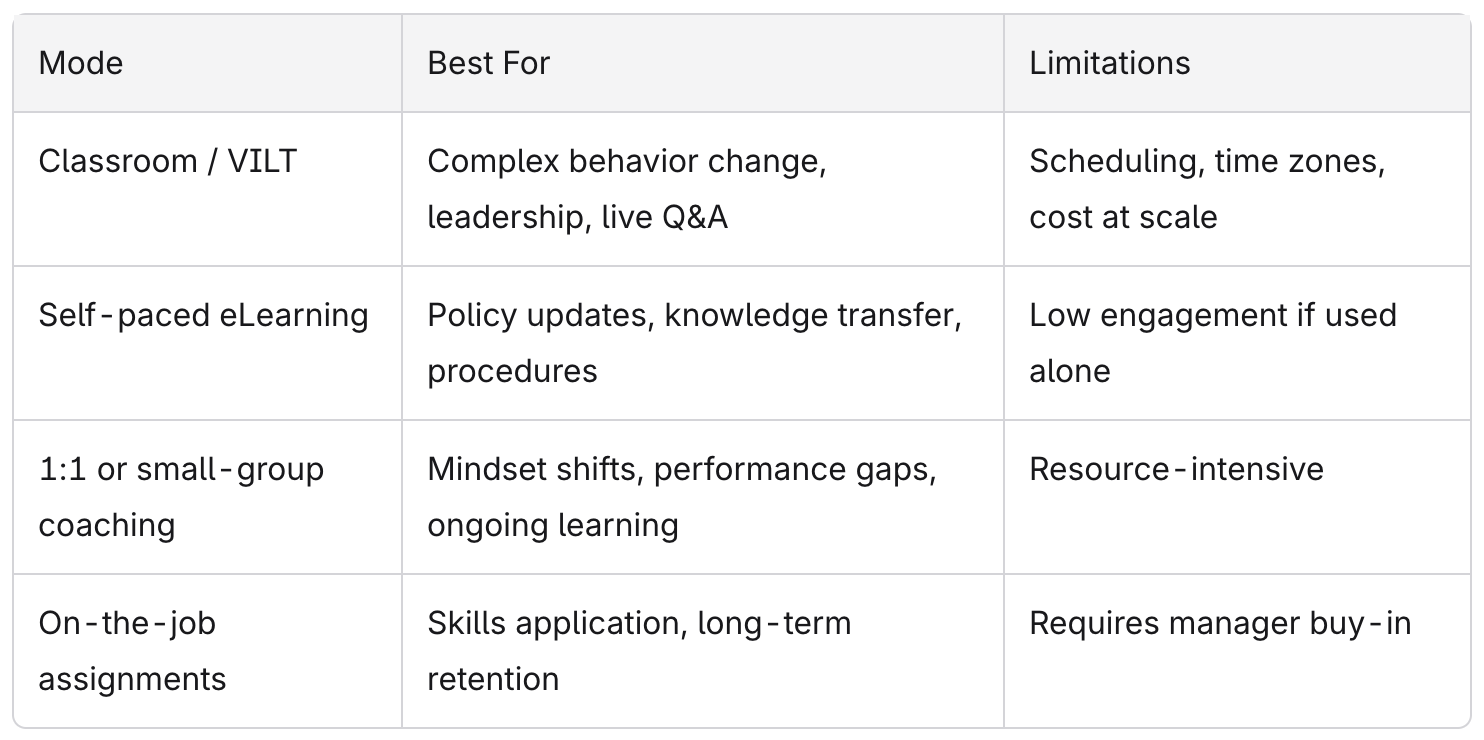
According to Training magazine's 2018 Training Industry Report, 69.3% of training hours were delivered with blended learning techniques. Blended learning paths outperform single-mode training, especially when spaced over weeks with reinforcement and opportunities to practice.
Digital adoption platforms and just-in-time microlearning support employees learning in the flow of work during software and process changes. Leverage the organization's existing tech stack - LMS, LXP, collaboration tools - to distribute, track, and reinforce learning without adding friction.
Producing Training Content: From Storyboards to Filmed Modules
Content production is a structured creative process: scriptwriting, storyboarding, filming or animation, interactive build-out, and review. The storyboard is the backbone, detailing learning objectives, on-screen text, visuals, narration, interaction points, and assessment items.
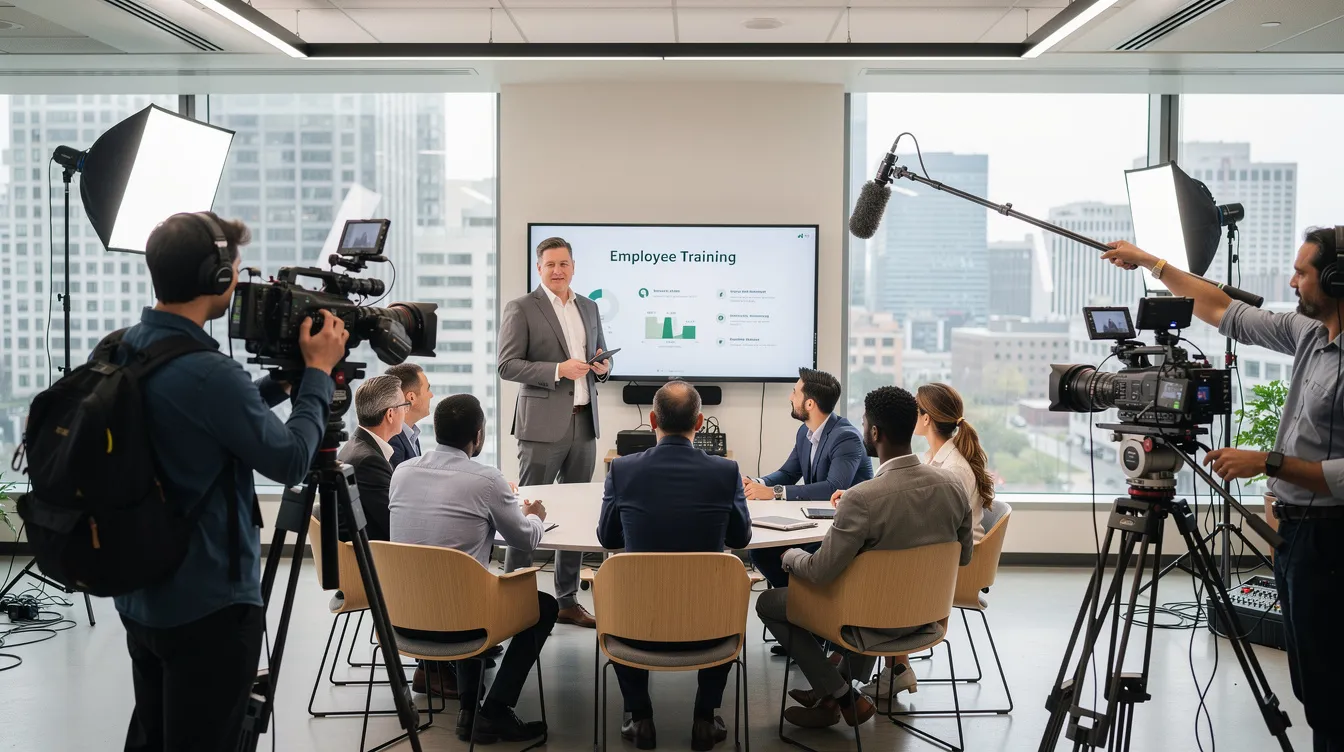
Prioritize filming for high-impact skills: complex interpersonal situations like handling a customer complaint, giving constructive feedback, safety procedures, and scenarios where body language and tone matter. Lower-complexity topics can use animated graphics or narrated slides.
A typical filming process involves pre-production planning, casting internal or external talent, 1 to 3 days of on-site or studio filming, and post-production editing with graphics and captions. Best practices for engaging training videos include short segments of 3 to 7 minutes, realistic workplace settings, clear calls to action, and diverse representation of employees.
Subject matter experts review scripts, validate accuracy, and sometimes appear on camera for credibility. Continuous feedback and assessments track knowledge retention and curriculum refinement, so build assessment checkpoints into every module.
For version control, build modular content with separate script, graphics, and footage layers so updates can be made without refilming everything. Maintain reusable templates and version history.

Deploying Corporate Training Programs Across the Organization
Course deployment is a change initiative, not just uploading content to a platform. Leadership support fosters a culture that values learning and development, and visible executive backing is the single strongest predictor of adoption.
Roll out in phases:
Pilot with a representative group to test content and gather feedback
Incorporate learner and manager feedback
Scale regionally, then company-wide
Key LMS/LXP setup tasks include audience targeting, enrollment rules, prerequisite logic, deadlines, reminders, and completion tracking.
Communication planning matters. Launch emails from leaders, manager toolkits with discussion guides and coaching questions, intranet announcements, and short promo videos explaining the benefit to each role all drive participation. Give managers talking points to reinforce learning during 1:1s and team meetings.
Align course deployment with peak seasons, shift schedules, and time zones. Deploying training during the busiest quarter guarantees low completion and resentment.
Measuring Skills Transfer and Training ROI
Leaders need to see how corporate training programs impact performance, not just completions. Training effectiveness should be evaluated through learning application and business results using a straightforward framework:
Reaction - Did learners find it relevant and engaging?
Learning - Did knowledge and skills improve? (Pre/post assessments, scenario-based questions)
Behavior - Are employees applying new skills on the job? (Manager observations, QA audits, mystery shopping)
Results - Did business KPIs move? Compare trained vs. untrained cohorts on sales, quality, safety, or customer satisfaction over 3 to 12 months
According to Gallup's 2012 Q12 meta-analysis, work units in the top quartile of employee engagement outperformed bottom-quartile units by 21% in productivity and 22% in profitability. A 2025 meta-analysis of 159 studies in the Journal of Management found a statistically significant, modest positive relationship between organization-level training and performance.
Use learner analytics dashboards to track adoption, drop-off points, average scores, and correlations between engagement and performance. Then conduct continuous improvement: refine modules, adjust scenarios, add job aids, and update content when processes or regulations change.
Driving Employee Engagement Through Workplace Learning
The link between meaningful workplace learning programs and retention is well documented. Career growth opportunities increase employee satisfaction and retention. Specifically, LinkedIn's 2018 Workplace Learning Report found that 94% of employees say they would stay at a company longer if it invested in their career development.
These figures are not limited to younger workers. According to Gallup, 87% of millennials rate professional or career growth and development opportunities as important in a job, compared with 69% of non-millennials. Yet only 4 in 10 employees strongly agree they have opportunities at work to learn and grow, a gap that custom employee training programs can help close.
Build learning into daily work rather than treating it as an event:
Microlearning in existing tools for ongoing learning
Peer mentoring and communities of practice
Manager-led "learning time" on team calendars so employees can develop new skills on their own time
Digital badges, internal certifications, and integrating learning achievements into performance reviews
Psychological safety is the foundation. Employees need safe spaces to practice, ask questions, and make mistakes without penalty. When managers model openness to feedback and ongoing development, the entire team benefits.
When to Commission Custom Corporate Training (and When Not To)
HR and L&D leaders frequently ask when custom training development justifies the investment. Here is a practical decision framework:
Custom training is usually worth it when:
You're launching proprietary products, services, or processes
The topic directly impacts revenue, safety, or critical compliance unique to your operations
You have a large learner population and the content will have a long shelf life
You need to differentiate your customer experience or employer brand
Off-the-shelf or curated content may suffice when:
The topic is universal with stable content (basic productivity tools, general office skills)
Speed to launch matters and resources are limited
The learner population is small or the need is short-lived
Decision factors to evaluate:
Number of learners and frequency of use
Risk level and cost of failure
Expected shelf life of the content
Strategic value of differentiating your approach from industry competitors
Start with a small, high-impact pilot project before scaling to an enterprise-wide program. Measure results, refine, and expand.
Getting Started: From First Conversation to Launched Program
The end-to-end journey from idea to impact follows a clear path:
Discovery call - scope business goals, audience size, timelines, existing platforms
Needs analysis - 2 to 6 weeks of data gathering and stakeholder interviews
Program blueprint - audiences, objectives, modalities, success metrics
Content design - scripts, storyboards, interactive frameworks
Production - filming, animation, eLearning build
Deployment - phased rollout with manager enablement
Measurement - skills transfer tracking and continuous improvement
A realistic timeline for a medium-sized program is 10 to 16 weeks from kick-off to initial course deployment, depending on complexity and filming needs. Organizations don't need a fully mature L&D function to explore this - external learning development services provide the strategy, design, and production capacity to create programs that perform.
The difference between training that checks a box and training that moves a metric is the rigor you bring to every stage. If you're ready to build corporate training programs that produce measurable results, start with a done-for-you course development consultation to scope your first project and map the path from needs analysis to launched program.
