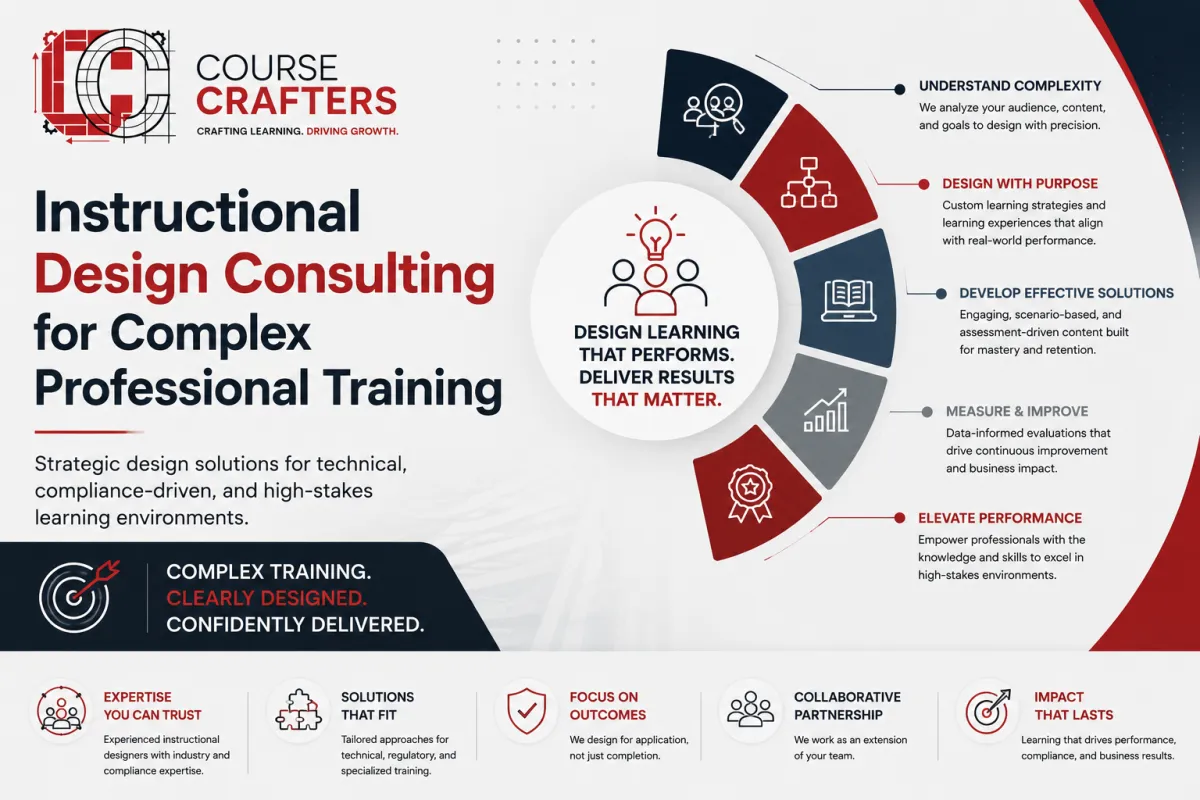
Instructional Design Consulting for Complex Professional Training
Instructional Design Consulting for Complex Professional Training
High-stakes training programs - clinical protocols, financial compliance, safety-critical operations - demand more than a slide deck and a quiz. They demand precision in how knowledge transfers from expert to practitioner. That is where instructional design consulting comes in.
This guide breaks down what instructional design consulting involves, when your organization actually needs it, and how to evaluate a partner who can deliver measurable results.
Instructional Design Consulting: What It Is and Why It Matters Now
Instructional design consulting is a strategic service that transforms information into engaging learning experiences by applying learning theories to create effective educational experiences. It goes well beyond content production. An instructional design consultant conducts rigorous analysis, defines learning objectives, architects curricula, designs assessments, and advises on modality - work that a generic content creator or off-the-shelf vendor simply does not do.
The distinction matters. Content creators produce materials they are handed. Instructional design consulting services own the upstream decisions: what learners need to know, how to sequence it, how to measure it, and how to make it stick. The result is training that aligns with measurable business goals rather than just checking a box.
Several forces make this expertise more relevant now than ever. Rapid technology shifts, hybrid work models, and tightening regulations across healthcare, finance, and cybersecurity are pushing organizations to replace ad-hoc, slide-based training with structured, evidence-based programs. AI-augmented design tools, immersive simulations, and microlearning are expanding what is possible - but only when guided by sound instructional design.
Core terms you will see throughout this article: learning objectives, assessment design, content architecture, training curriculum consulting, and experience design. Each represents a building block that helps engage learners, improve performance, and demonstrate ROI for corporate training and elearning initiatives.
The next section clarifies when outside instructional design services are worth the investment.

When You Need Instructional Design Consulting (And When You Don't)
Not every training effort warrants a full consulting engagement. Simple tool updates, routine process refreshers, or low-risk content for a small audience can often be handled by your internal team with minimal outside support.
However, certain situations strongly call for instructional design consulting:
Launching a new regulatory or compliance program under evolving 2026 mandates
Rolling out global product certification with localization, multiple proficiency levels, and regulatory tie-ins
Re-architecting legacy instructor-led training into blended learning or e learning formats
Aligning training to a revised competency framework, especially when shifting to skills-based models
Building training for safety-critical operations such as aviation maintenance, clinical protocols, or cybersecurity operations centers
Watch for these triggers that signal a deeper problem:
Learners pass assessments but still make errors on the job
Completion rates are high but behavior change is absent
Content quality varies across regions or business units
Your organization cannot measure training impact beyond satisfaction surveys
A needs analysis evaluates content and learner needs, and it identifies performance gaps to align training with business goals. If any of these triggers sound familiar, a brief discovery consultation can clarify whether external expertise is the right move.
The Role of an Instructional Design Consultant
An instructional design consultant is not a course builder who waits for a brief. They lead the thinking - conducting performance gap analyses, defining what success looks like, and making strategic decisions about how training is structured and delivered.
Key responsibilities include:
Conducting learning needs and performance analyses across roles and proficiency levels
Defining clear learning objectives tied to business and regulatory requirements
Creating content architecture: modules, sequences, and learning paths
Designing formative assessments and summative assessments - from knowledge checks to scenario-based simulations
Advising on modality mix: ILT, VILT, elearning courses, microlearning, and performance support
Leading experience design decisions around cognitive load, feedback, and practice spacing
Senior instructional design consultants lead discovery, stakeholder alignment, and curriculum analysis for complex programs. Junior instructional designers typically execute under that guidance. Consultants partner directly with SMEs, HR, compliance teams, and L&D leaders to translate expert knowledge into structured training.
Common outputs from training curriculum consulting include curriculum maps, course outlines, assessment blueprints, and evaluation plans aligned to frameworks like Kirkpatrick or Phillips ROI.
Instructional design consultants help organizations scale training development without permanent staff. They provide outside expertise and fresh perspectives while bringing diverse skills tailored to specific project needs. They create structured training programs from planning to delivery. A consultant can work as an embedded extension of your team or as a project-based advisor for a defined initiative.
Core Components of Effective Instructional Design Consulting
Strong consulting engagements share a set of essential building blocks. Here is what separates rigorous instructional design from guesswork.
Translating business goals into learning objectives. Consultants define what learners must be able to do - not just know - and tie those objectives to performance metrics like error rates, time to proficiency, or compliance incidents. Effective course design includes learner analysis and structured content, and instructional designers conduct needs analysis for target audiences before writing a single word. Needs analysis informs the design of effective learning experiences at every stage.
Content architecture. Organizing topics into modules, sequences, and role-based learning paths is where curriculum blueprints focus on individual learning steps. Structured learning programs align with skills and competencies so that a new hire and a ten-year veteran do not sit through the same generic course. Curriculum design ensures training is relevant and clear, and effective instructional design ensures training is clear and relevant across audiences.
Assessment design. Formative assessments provide in-course feedback; summative assessments determine readiness. For high-stakes programs, scenario-based assessments and performance checklists measure real-world capability, not just recall. Effective curriculum design includes learner analysis and content creation - assessments are built into the architecture, not bolted on.
Experience design. Managing cognitive load, spacing practice, timing feedback, and building challenge progression keeps professionals engaged over multi-week programs.
Inclusive design considers accessibility and multiple learning preferences to support diverse learners - a non-negotiable in global or multi-role programs.
Consider a 40-hour compliance course that is entirely slide-based. A strong consulting engagement might restructure it as blended: 10 hours of facilitated sessions for core theory, self-paced micro modules, simulation lab practice, scenario-based assessments, spaced reinforcement via job aids, and follow-up evaluation at 30 and 90 days.
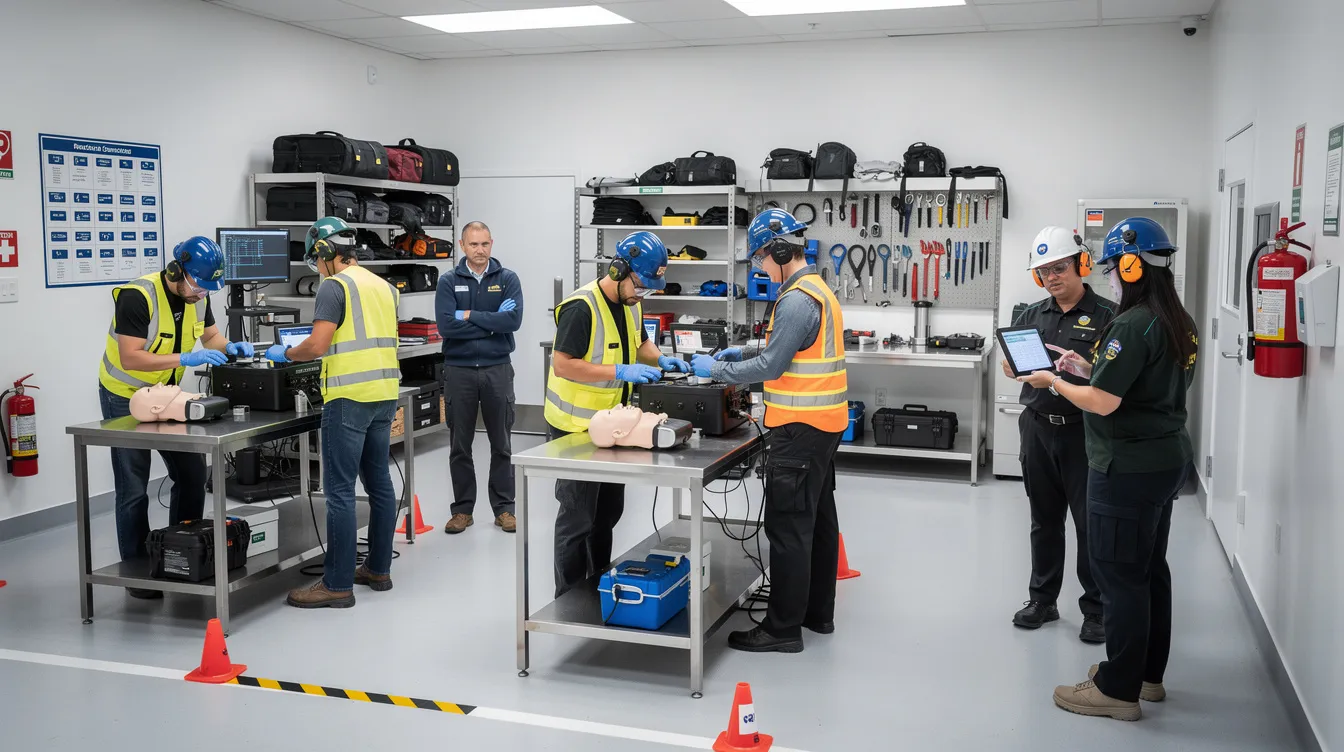
Our Instructional Design Consulting Process for Complex Training
Instructional design consulting follows a clear, repeatable process adapted to each client's context. Common instructional design frameworks include ADDIE and SAM models, and the stages below reflect their principles while fitting the realities of complex, high-stakes programs.
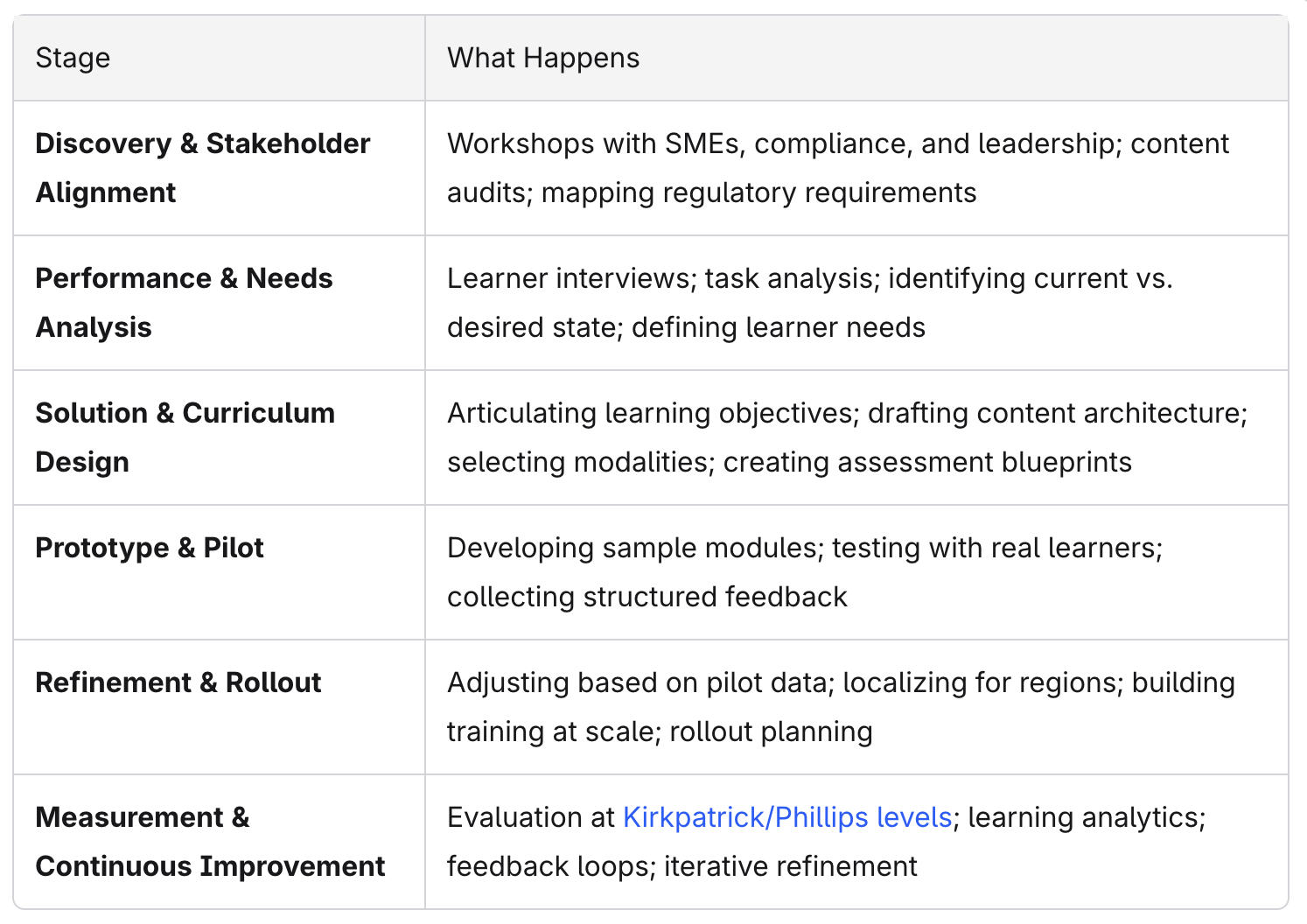
Evaluation and improvement are essential stages in instructional design consulting to measure outcomes and justify continued investment.
This process is designed for environments where mistakes in training design carry real business, legal, or safety consequences. Course development can take 4 to 12 weeks depending on complexity, with larger multi-role curricula sometimes extending further. Project management rigor keeps timelines and resources on track throughout.
Engaging Learners in High-Stakes Corporate Training and E-Learning
In complex professional settings, engagement is not about flashy graphics. It is about relevance, challenge, and feedback. Interactive learning elements enhance engagement in course content when they mirror the decisions learners face on the job.
Concrete strategies that work for busy learning professionals:
Scenario-based learning that replicates real-world pressure and consequences
Branching case studies where choices lead to different outcomes
Simulations for hands on experience in safe environments
Guided practice with corrective feedback at the point of error
Spaced reinforcement via microlearning and performance support tools
Peer discussion and collaborative problem-solving for complex judgment calls
Engagement tactics should be chosen based on learning objectives and assessment design, not trends alone. A 2025 survey of 282 software engineering professionals found that cognitive engagement, variety of activities, and instructor performance were the strongest predictors of perceived training quality. Mandatory participation without context actually decreased motivation. The takeaway: even required training needs to be framed around relevance to daily tasks.
Experience design principles - realistic constraints, progression from simple to complex, and learning activity design that respects cognitive load - keep professionals engaged without overwhelming them. Short, focused learning sprints and mobile-friendly online courses accommodate the realities of working schedules. Traditional methods give way to strategies that meet learners in the flow of work.
Examples and Case-Style Scenarios of Instructional Design Consulting Impact
Abstract consulting concepts become clearer through concrete scenarios. The following case-style examples illustrate what strong instructional design consulting services deliver.
Healthcare technology: consistency at global scale. A medical technology company needed to standardize training for Technical Application Specialists across multiple regions. Instructional design firms conducted learner analysis to identify needs, then built a Trainer Excellence Program that established instructional design standards and quality assessment tools. The outcome: minimized customer callbacks and operational disruptions, with over 100 learning assets reviewed and elevated to consistent quality. This case shows how training curriculum consulting drives both risk reduction and client experience.
Steel manufacturing: compressing time to competence. Plant personnel relied on unstructured on-the-job training led by SMEs who had never been taught to teach. After a consulting engagement that restructured content development and learning paths, critical-function training time dropped from six months to six weeks - with higher consistency in knowledge and skills across shifts.
Financial services onboarding. A compliance-heavy organization struggled with new-analyst onboarding that took too long and produced uneven results. Data-driven evaluation helped refine courses and ensure training effectiveness over time. After curriculum analysis and redesign, onboarding time shortened measurably, and first-year audit findings related to training gaps declined.
These outcomes align with broader research. A meta-analysis of 159 studies (N ≈ 75,000) confirms that organizational-level training has a positive effect on performance, with effect sizes varying by industry and design quality. ROI benchmarks for 2026 show sales training yielding 100–350% ROI and onboarding 100–200%, while compliance training delivers value primarily through risk avoidance. Yet only about 8% of organizations currently measure the business impact of learning programs. Good instructional design aligns training with measurable business goals - and then proves it.

How to Evaluate and Select an Instructional Design Consulting Partner
Choosing the right instructional design company or instructional design agency is a strategic decision with long-term consequences. Here are the criteria that matter most:
Proven experience in high-stakes or regulated industries
Clear consulting process with defined phases, roles, and deliverables
Depth in learning objectives and assessment design, not just content production
Strong portfolio with case studies showing measurable outcomes
Stakeholder communication skills - ability to align SMEs, compliance, and executives
Familiarity with your tools and learning platforms (LMS, authoring tools like Articulate Storyline, simulation platforms)
Capacity to measure outcomes and ROI, not just completion and satisfaction
Commitment to achieving strategic goals through education and training, not just deliverables
Questions to ask during discovery calls:
"How do you handle conflicting SME input or shifting regulatory requirements?"
"Show me an example of your content architecture for a multi-role audience."
"What intended learning outcomes did you define for a similar program, and how did you measure them?"
When deciding between a contract instructional designer, a full agency, or building internal capacity, consider this: hiring consultants can speed up project timelines significantly and consultants can handle time-consuming tasks, freeing internal teams. Using consultants can reduce overhead costs compared to full-time hires while providing instructional design expertise you may not have in-house. Agencies bring scalability for large or global training projects; internal hires offer embedded institutional knowledge for ongoing programs.
Red flags to watch for: vendors who jump straight to slide design without discussing performance gaps or assessment strategy, no early focus on learning outcomes, or reliance solely on satisfaction surveys as proof of impact.
Organizations with a large or evolving training portfolio should look for a long-term advisory relationship - not just a one-off course build.
Getting Started: From First Conversation to Training Roadmap
If you are considering whether your organization needs outside instructional design consulting, here is what happens next.
A typical initial consultation covers:
Reviewing existing training materials and learning content
Clarifying your audience, risks, and strategic goals
Discussing current learning objectives and where they fall short
Identifying quick wins versus long-term curriculum work
Understanding the tools, resources, and learning solutions already in place
What to prepare before that call:
Current training materials, policy documents, and compliance requirements
Any performance data or learning analytics you have access to
Examples of training projects that succeeded - and ones that did not
A list of roles, skills, and focus areas the program must address
After an early engagement phase, you can expect a written training roadmap, prioritized recommendations, and a high-level content architecture with timeline options. Instructional design consulting enhances learning experiences through tailored solutions - and the roadmap ensures those solutions connect to real business outcomes.
Engagement models are flexible. Pilot projects, phased rollouts, or advisory-only support all lower the barrier to getting started. Consultants help align training with measurable business goals from the first conversation forward.

Schedule an instructional design consultation to map out your next move and turn complex expertise into training that performs under pressure.
