Sales Enablement Training: How to Build a Program That Works
Sales enablement training is the structured program that gives sales reps the knowledge, skills, tools, and coaching they need to sell effectively in their day to day work, from onboarding through every product launch and process change. Good sales enablement training is built around the sales process the team actually uses, measured against outcomes like ramp time and deal progression, and reinforced through ongoing coaching sessions rather than a single workshop. The difference from traditional sales training is scope: sales training teaches selling skills, while sales enablement connects training to the content, tools, data, and support sellers need to apply those skills.
This guide explains what sales enablement training includes, how it differs from sales training, the components of a strong sales enablement program, and a practical way to design training your sales team will use.

What Is Sales Enablement Training?
Sales enablement is the ongoing work of equipping sellers to have better conversations with buyers. It usually sits between marketing, sales leadership, operations, and learning and development. Sales enablement training is the learning side of that work: the courses, practice, coaching, and reference resources that help sales professionals learn the product, the buyer, the sales methodology, and the tools.
A strong sales enablement training program answers three questions for every rep:
- What do I need to know? Products, pricing logic, buyers, competitors, and the sales process.
- What do I need to be able to do? Discovery, qualification, demos, objection handling, negotiation, and forecasting.
- Where do I find help when I need it? Playbooks, enablement tools, content libraries, and a manager who coaches.
Training that covers only the first question produces reps who can pass a quiz but struggle in live conversations. Training that covers all three produces sellers who can apply what they learned on real deals.
Sales Enablement vs. Sales Training
The two terms are often used interchangeably, but they describe different scopes of work.
Sales training focuses on skills and knowledge. It typically includes a sales methodology, product training, and skill practice, and it is often delivered as events: a bootcamp for new hires, a workshop on negotiation, or a certification on a new product.
Sales enablement is broader. It includes sales training, but also the content reps send to buyers, the playbooks they follow, the CRM data and enablement tools they use, onboarding, coaching, and the feedback loop between sales, marketing, and product. Sales enablement treats training as one part of a system that supports sellers continuously.
In practice, the best sales enablement strategy uses training to teach a skill, tools and content to support it in the field, and coaching to reinforce it until it becomes habit.
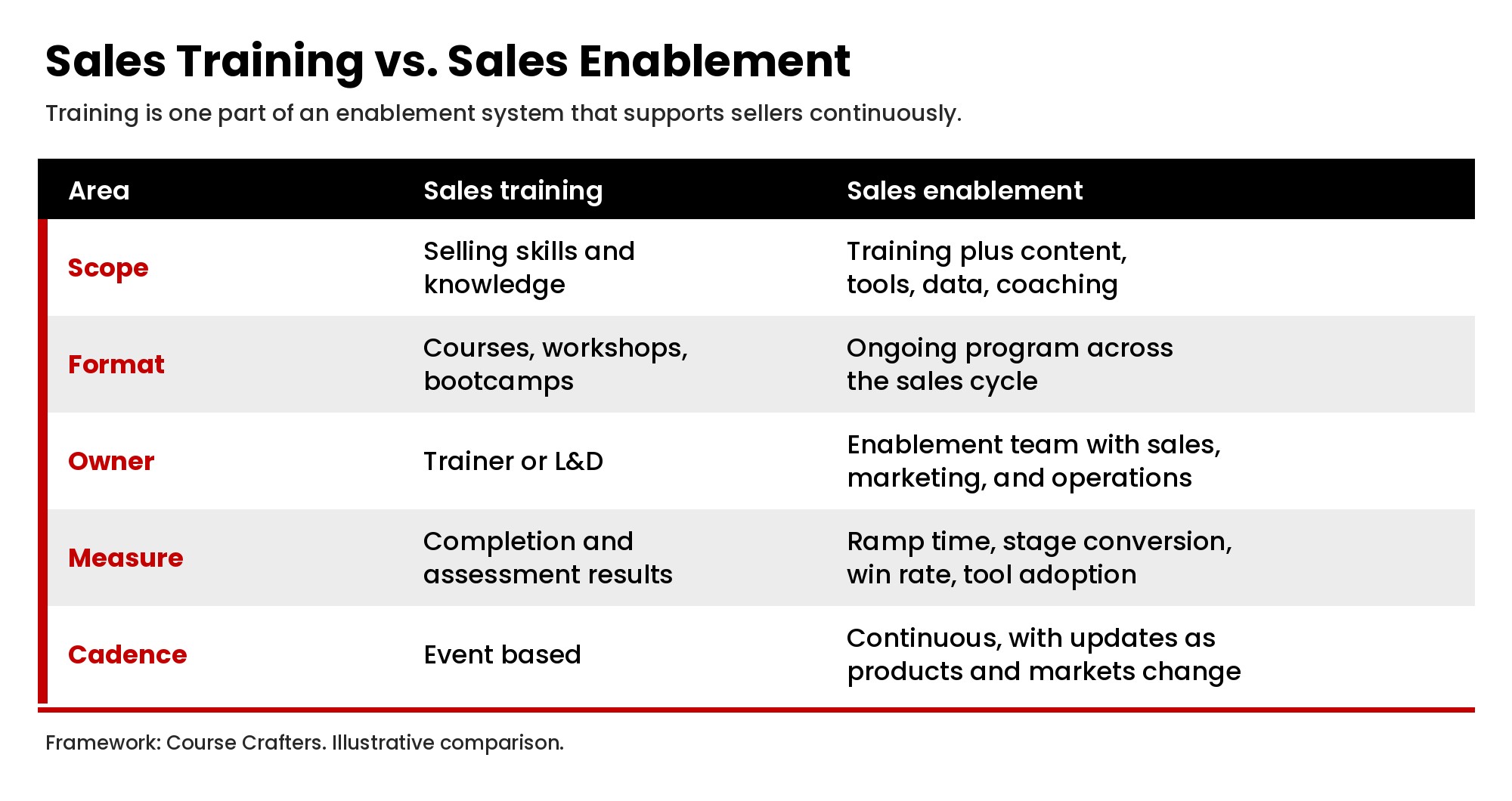
How sales training fits inside a broader sales enablement program.
What a Sales Enablement Program Includes
Most sales enablement programs include the same core components, even if the names differ by company.
Onboarding for new sales reps
Onboarding is where sales enablement training has the most visible effect. A structured onboarding path covers the product, the ideal customer profile, the sales process, the CRM, and the first conversations a rep will have. Many teams track ramp time, the time it takes a new rep to reach a defined level of productivity, as the primary measure of onboarding success. Define what ramped means for your team before you measure it, such as a first closed deal, a pipeline target, or a set of certified skills.
Sales methodology training
A sales methodology gives the team a shared language for discovery, qualification, and deal progression. Whether the team uses a lead qualification framework such as BANT or MEDDIC or a custom process, training should show reps how the methodology applies to their deals, with examples drawn from your market. Teaching a methodology in the abstract and leaving reps to translate it is one of the most common reasons training does not stick.
Product and market knowledge
Reps need to understand what the product does, who it serves, how it compares with alternatives, and how market conditions affect buying decisions. Product training works best when it is organized around buyer problems rather than feature lists, so reps can connect capabilities to value in a conversation.
Skills practice
Knowledge is not the same as skill. Role plays, call reviews, demo practice, and written exercises give reps a safe place to practice before they meet real buyers. Practice should be specific: a discovery call for a particular buyer, an objection that comes up often, a pricing conversation at a common deal size.
Coaching and reinforcement
Coaching sessions are where training becomes behavior. Managers who review calls, observe demos, and give targeted feedback help reps apply what they learned. A continuing enablement plan, with short refreshers, new methodologies, and updates when the product or market changes, keeps skills current after onboarding ends.
Enablement tools and content
Sales enablement tools range from content libraries and playbooks to call recording, CRM guidance, and learning platforms. Training should teach reps where these resources live and when to use them. A sales enablement team that builds great content nobody can find has not enabled anyone.

How to Design Sales Enablement Training That Works
Effective sales enablement training follows the same principles as any good workplace learning program: start with the performance you need, then design backward.
1. Start with the sales process
Map the stages of your sales process and the skills, knowledge, and tools each stage requires. This tells you what the training must cover and in what order. It also prevents a common problem: training content that does not match how the team actually sells.
2. Define success before you build
Decide how you will measure success. Useful metrics include ramp time for new hires, conversion between pipeline stages, win rates, average deal size, forecast accuracy, and adoption of key tools. Pick a small set, record a baseline from your CRM data, and agree with sales leadership on what improvement looks like.
3. Mix self paced and live learning
Self paced modules let reps learn product details and process steps at their own pace, revisit them when needed, and complete them around a selling calendar. Live sessions work better for practice, discussion, and feedback. Connect the two so each self paced module prepares reps for the live session that follows. Our training consulting services page explains how we help teams plan that mix.
4. Build around real scenarios
Use examples from your own deals, buyers, and objections. Short scenario based lessons, call snippets, and practice prompts make training relevant and help reps transfer skills to real conversations. This is where clear instructional design for complex professional training pays off.
5. Give managers a role
Managers are the most important part of reinforcement. Give them coaching guides, call review checklists, and a simple way to track which skills each rep is working on. When managers coach to the same framework the training teaches, the program has accountability built in.
6. Keep it current
Product launches, pricing changes, new competitors, and shifts in market conditions all create new training needs. Assign ownership for updating modules, and schedule regular reviews so content does not drift out of date.
Choosing the Right Format
Sales enablement training can be delivered in several formats, and most programs use more than one.
- Self paced eLearning for product knowledge, process steps, and tool training. See our guide to corporate eLearning development.
- Training video for demos, customer stories, and leadership messages. See training video production for corporate learning.
- Live workshops for role plays, methodology practice, and team discussion.
- Microlearning for quick refreshers before calls or after product updates.
- Certifications for skills that must be verified before reps work certain deals or products.
If you deliver training through a learning platform, the platform should make it easy for reps to find modules, for managers to see progress, and for the enablement team to update content. Our guide on when organizations need learning management system consulting covers what to evaluate.
Common Mistakes to Avoid
- Treating training as a one time event. Skills fade without practice and coaching.
- Teaching features instead of buyer problems. Reps need to connect the product to the buyer's priorities.
- Ignoring the sales process. Training that does not match how deals actually move gets ignored.
- Skipping measurement. Without a baseline, you cannot show whether the program helped.
- Leaving managers out. Reinforcement depends on the people who coach reps every week.
Frequently Asked Questions
What is the difference between sales enablement and sales training?
Sales training teaches selling skills and knowledge, often through workshops or courses. Sales enablement is broader: it includes training plus the content, tools, playbooks, coaching, and data that help sellers apply those skills on real deals.
What are the five pillars of sales enablement?
There is no single official list, but most sales enablement programs cover onboarding, ongoing training, content and playbooks, coaching, and the tools and data sellers use. The exact pillars depend on the company and how it organizes sales, marketing, and operations.
What should sales enablement training include?
It should include onboarding, product and market knowledge, the sales methodology and process, skills practice, coaching, and training on enablement tools and the CRM, with clear metrics to measure success.
How do you measure sales enablement training?
Choose a few metrics tied to performance, such as ramp time, stage conversion, win rate, deal size, and tool adoption. Record a baseline before training and compare results over time, alongside feedback from reps and managers.
How long should sales enablement onboarding take?
It depends on the complexity of the product, the sales cycle, and the role. Define what a ramped rep looks like for your team, then design onboarding around reaching that milestone rather than a fixed number of days.
Build Sales Enablement Training Your Team Will Use
Sales enablement training works when it is built around how your team sells, measured against real outcomes, and reinforced by managers who coach. Start with the sales process, define success, and design learning that connects knowledge, practice, and support. For help planning the structure, see our approach to course strategy and structure, or contact Course Crafters to talk about building a sales enablement training program.