
Learning Objectives: How to Write Clear, Measurable Objectives
Learning objectives are short statements that describe what a learner will be able to do by the end of a course, module, or training session. Good learning objectives are specific, measurable, and written around an observable behavior, such as "identify," "demonstrate," or "explain," rather than vague goals like "understand" or "know." They guide what you teach, how you assess it, and how you prove the training worked.
Whether you design courses for a university, a professional certification, or corporate training, the same rules apply. This guide explains what learning objectives are, how they differ from learning goals and learning outcomes, how to write them with Bloom's taxonomy and the ABCD method, and the common mistakes to avoid, with examples you can adapt.

What Are Learning Objectives?
The Johns Hopkins University Office of the Provost defines a learning objective as student centric: it states what the student will learn and be able to accomplish by the end of instruction, describes a specific behavior that leads to the desired goal, and is specific and measurable. It has three major components:
- What the student will be able to do
- The conditions needed for the student to do it
- The criteria for evaluating the student
In other words, a learning objective focuses on the learner's performance and the end product, not on teacher performance, the subject matter, or how knowledge was acquired. "This module covers project budgeting" describes content. "Participants will create a project budget that stays within 5 percent of the approved total" describes learning.
Why learning objectives matter
Clear objectives make every other part of course design easier:
- They focus the content. If material does not support an objective, it can be cut or moved to optional resources.
- They shape the assessment. Each objective tells you what to measure and how to evaluate it.
- They set expectations. Learners know what success looks like before they start.
- They connect training to business goals. Objectives tie a program to the skills and performance the organization needs.
Learning Objectives vs. Learning Goals vs. Learning Outcomes
These terms are often used interchangeably, but the difference matters when you plan a curriculum.
| Term | What it describes | Example |
|---|---|---|
| Learning goal | A broad intention for the course or program | Improve customer service skills |
| Learning objective | A specific, measurable action the learner will demonstrate | Resolve a billing complaint using the four step service model |
| Learning outcome | The result actually achieved after completing instruction | Participants passed the service simulation at the target standard |
A learning goal is the destination. Learning objectives are the specific, observable steps that get learners there. A learning outcome is the evidence of what learners can do once training ends. Many institutions write program level learning outcomes, then break them into course objectives and module objectives so each single course contributes to the larger educational goals.
How to Write Learning Objectives
Writing learning objectives is easier with a repeatable structure. Most instructional designers use one of two frameworks, often together.
Use SMART learning objectives
The Johns Hopkins guidance says learning objectives should have S.M.A.R.T. attributes:
- Specific: Concise and well defined in describing what students will be able to do.
- Measurable: Uses action verbs that can be observed through an assessment such as a test, assignment, or project.
- Attainable: Learners have the prerequisite knowledge to achieve the objective by the end of the course.
- Relevant: The skills or knowledge fit the program and the course in the curriculum.
- Time bound: States when learners should be able to demonstrate the skill, such as the end of a module or program.
Use the ABCD method
The ABCD method breaks each objective into four parts:
- Audience: Who the learner is, such as "new account managers."
- Behavior: The observable action, written with an action verb.
- Condition: The context, tools, or materials the learner will use.
- Degree: The standard for success, such as accuracy, speed, or quality.
Example: "Given a sample client brief (condition), new account managers (audience) will draft a project scope (behavior) that includes all six required sections (degree)."
Step by step
- Start with the business goal or educational goal. Ask what learners need to do differently after the course.
- Identify the tasks. List the specific skills and knowledge required to perform well.
- Choose the level of thinking. Decide whether learners need to recall, apply, analyze, or create. Bloom's taxonomy helps here.
- Pick one action verb. Use a single observable action per objective.
- Add the condition and the standard. Describe the context and how you will measure success.
- Check alignment. Make sure each objective has a matching activity and assessment.
Our guide to skills based training shows how to turn job tasks into training that builds measurable skills.
Use Bloom's Taxonomy to Choose Action Verbs
Bloom's taxonomy, revised by Anderson and Krathwohl in 2001, organizes the cognitive domain into six levels of increasing complexity. Writing objectives across these levels helps a course move learners from recall to mastery.
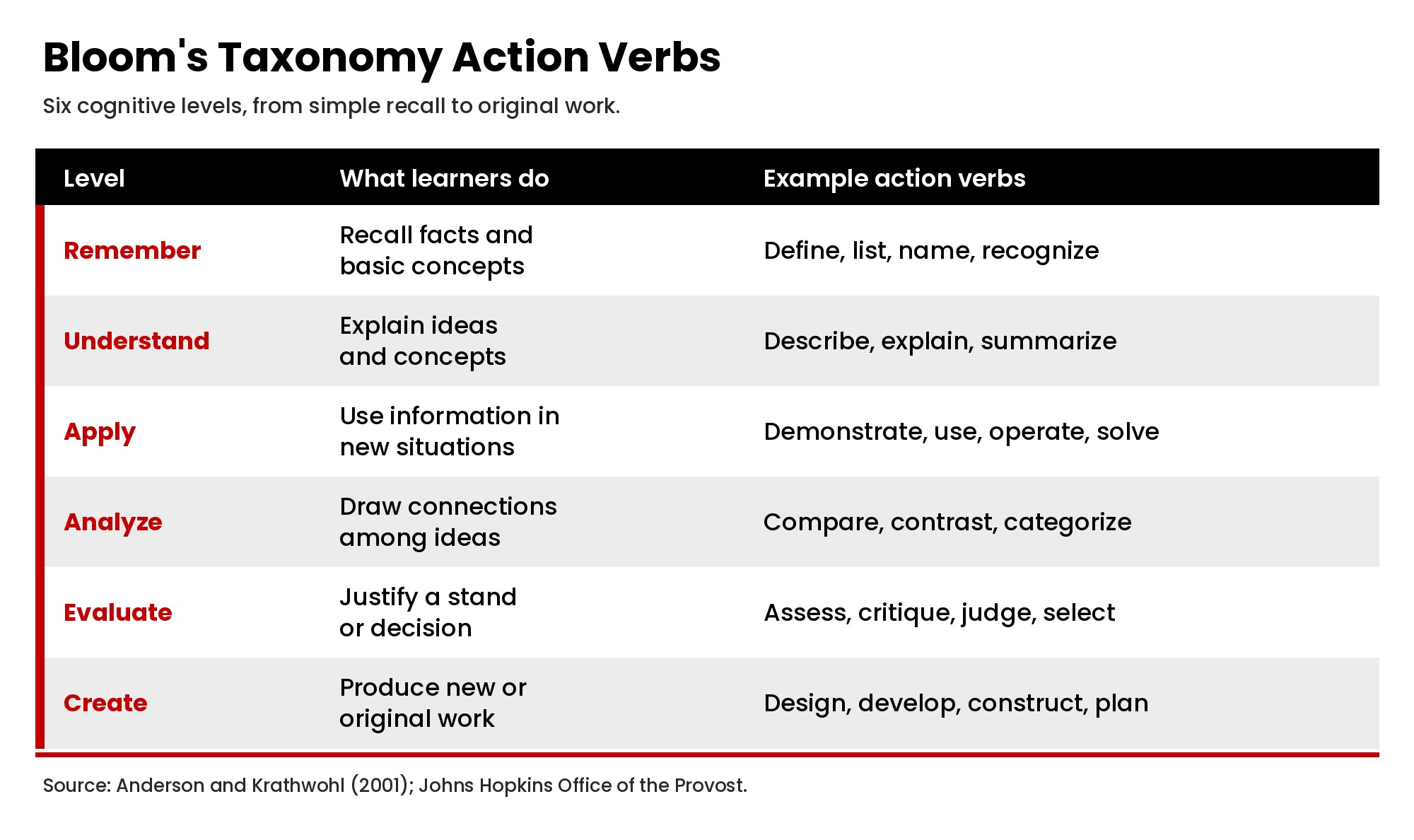
- Remember: Recall facts and basic concepts. Verbs: define, list, name, recognize.
- Understand: Explain ideas and concepts. Verbs: describe, explain, summarize, interpret.
- Apply: Use information in new situations. Verbs: demonstrate, use, operate, solve.
- Analyze: Draw connections among ideas. Verbs: compare, contrast, categorize, differentiate.
- Evaluate: Justify a stand or decision. Verbs: assess, critique, judge, select.
- Create: Produce new or original work. Verbs: design, develop, construct, plan.
Avoid verbs that cannot be observed, such as "understand," "know," "learn," "appreciate," or "be aware of." You cannot assess them directly. Replace "understand the sales process" with "describe each stage of the sales process" or "apply the sales process to a case study."
The three domains of learning
Educational objectives are commonly grouped into three domains, a framework that grew out of the work of Bloom and his colleagues:
- Cognitive domain: Knowledge and thinking skills, such as analyzing data or explaining concepts.
- Affective domain: Attitudes and values, such as valuing safety or accepting feedback.
- Psychomotor domain: Physical skills, such as operating equipment or performing a procedure.
Most corporate courses focus on the cognitive domain, but safety, leadership, and hands on technical training often include affective and psychomotor objectives as well.
Learning Objectives Examples
Here are examples of measurable learning objectives for different contexts.
Corporate training
- By the end of the module, participants will identify the five warning signs of a phishing email with 100 percent accuracy.
- Given a customer scenario, sales representatives will demonstrate the discovery call framework in a role play.
- New managers will develop a 30 day onboarding plan for a direct report using the company template.
Higher education
- Students will compare two research methods and explain the strengths of each.
- By the end of the course, the student will evaluate a business case study and recommend a course of action.
Professional and online courses
- Learners will create a monthly budget using the provided spreadsheet.
- Learners will describe the three main types of contracts covered in the module.
Notice that each objective names a single observable action and, where possible, a condition and a measure.
Align Objectives With Assessment and Activities
Objectives only work when assessment and practice match them. If an objective says learners will "demonstrate" a skill, a multiple choice quiz cannot measure it; a practice task or observation can. The Johns Hopkins guidance recommends mapping each objective to specific assessments, direct and indirect, formative and summative, and using rubrics to guide evaluation.
A simple alignment check for each objective:
- What will the learner do? (the objective)
- How will they practice it? (the learning experience)
- How will we measure it? (the assessment)
This alignment is the core of instructional design models such as ADDIE, where objectives written in the design phase guide development and evaluation. For workplace programs, it also connects to business results, as our guide to corporate training programs that drive measurable employee performance explains.
Common Mistakes When Writing Learning Objectives
- Using vague verbs. "Understand" and "know" are not observable.
- Describing content instead of performance. "Cover the safety policy" is a teaching plan, not a learning objective.
- Combining several actions. "Identify and analyze and present" makes the objective hard to assess. Write one action per objective.
- Writing too many objectives. A short module usually needs a few focused objectives, not a long list.
- Skipping the standard. Without a degree or criteria, you cannot tell when the objective is achieved.
- Never revisiting them. Review objectives after each delivery and revise them based on assessment results and learner progress.
Learning Objectives in Corporate Training
In the workplace, learning objectives should connect directly to job performance. Start from the behavior the business wants to see after training ends, such as fewer errors, faster onboarding, or higher customer satisfaction, and work backward to the skills and knowledge required. Programs like an employee onboarding program, sales enablement training, or blended learning for workplace training all start with clear objectives.
Frequently Asked Questions
What are the 3 parts of a learning objective?
According to the Johns Hopkins Office of the Provost, a learning objective states what the student will be able to do, the conditions needed to do it, and the criteria for evaluating the student.
How many learning objectives should a course have?
There is no fixed number. Write enough objectives to cover the essential skills, and keep each module focused on a small set that learners can practice and you can assess.
What is the difference between a learning objective and a learning outcome?
A learning objective describes what learners should be able to do. A learning outcome describes what they actually achieved, measured after instruction.
Build Courses Around Clear Objectives
Strong learning objectives are specific, measurable, and focused on observable behavior. Write them with SMART attributes and the ABCD method, choose action verbs from Bloom's taxonomy, and align every objective with practice and assessment. If you want help turning your expertise or training needs into a structured course with clear objectives, contact Course Crafters to start the conversation.
Sources: Johns Hopkins University Office of the Provost, Writing Effective Learning Objectives; Anderson, L.W., and Krathwohl, D.R. (Eds.), A Taxonomy for Learning, Teaching, and Assessing (2001).