Blended Learning for Workplace Training: Models and Benefits
Blended learning is a training approach that combines online learning with in person instruction, so learners complete part of the work digitally, often at their own pace, and part of it live with a facilitator. In workplace training, a blended learning approach usually pairs self paced eLearning or video for knowledge with live sessions for practice, discussion, and feedback. Research summarized by the U.S. Department of Education found that blended instruction, on average, produced stronger learning outcomes than face to face instruction alone, though the authors caution that the blended programs often included extra time and materials.
This guide explains what blended learning means for corporate training, the main blended learning models, the benefits and downsides, and a practical way to design a blended learning program your employees will actually complete.

What Is Blended Learning?
The Christensen Institute's Blended Learning Universe defines blended learning as a formal education program in which a student learns at least in part online, with some element of control over time, place, path, or pace, and at least in part in a brick and mortar location away from home. The modalities are connected, so the online and in person parts form one integrated learning experience.
That last point matters most. A course that sends people a few videos and then holds an unrelated workshop is not really blended. Effective blended learning connects the online learning portion and the in person sessions around the same learning objectives, so each part prepares learners for the next.
Blended learning is sometimes called hybrid learning. In schools, the term often describes how a teacher mixes traditional classroom instruction with digital tools. In corporate training, it describes how a program mixes eLearning, video, live workshops, coaching, and on the job practice.
Does Blended Learning Work?
The best known evidence comes from a U.S. Department of Education meta-analysis of online learning studies published from 1996 through July 2008. In 23 contrasts that compared blended instruction with face to face instruction alone, the mean effect size favored blended learning at +0.35. In 27 contrasts comparing purely online with purely face to face instruction, the mean effect size was +0.05, which the authors found statistically equivalent.
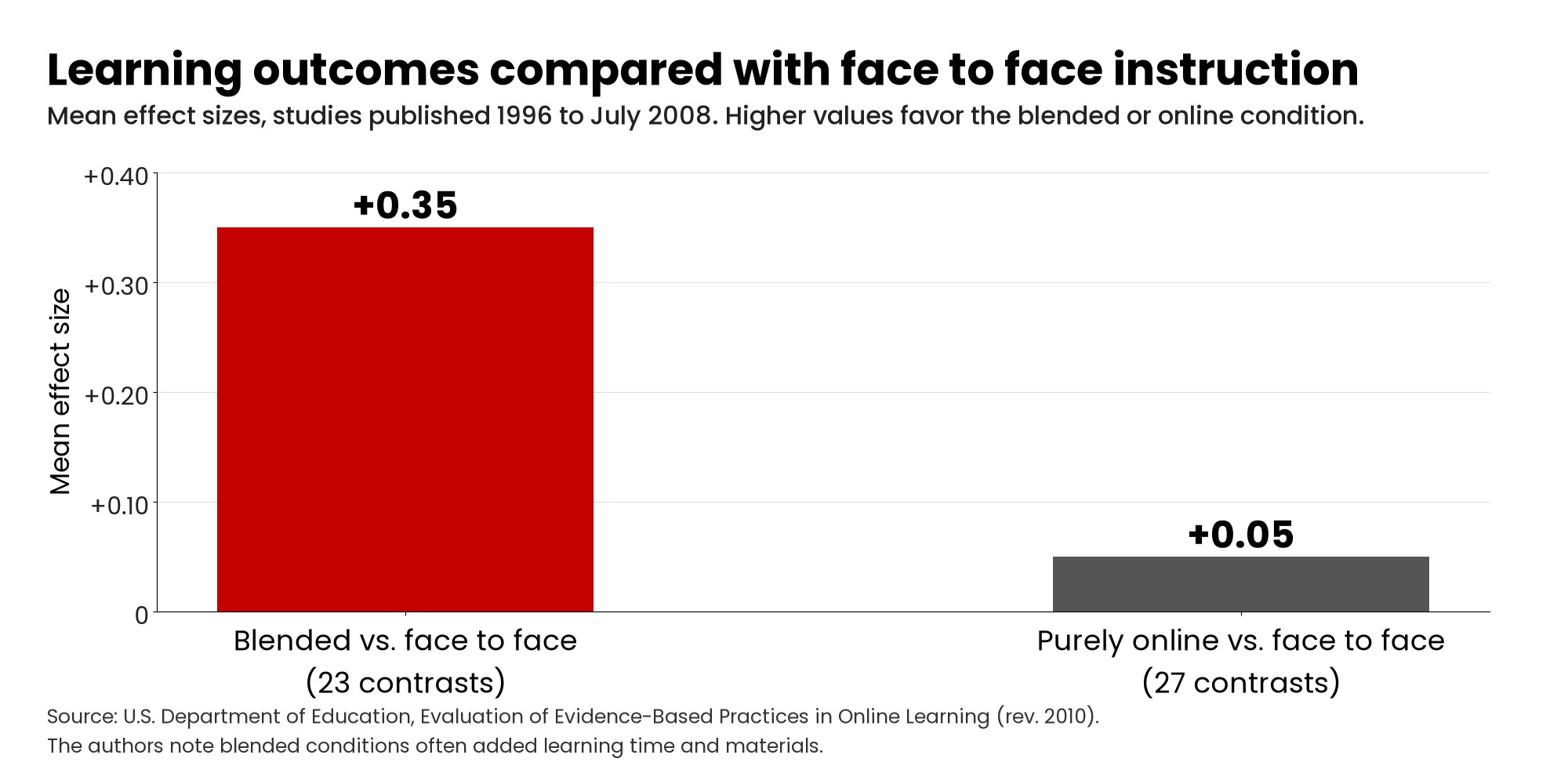
Mean effect sizes compared with face to face instruction. Source: U.S. Department of Education, Evaluation of Evidence-Based Practices in Online Learning, revised 2010.
The authors are careful about what this means. Many studies did not equalize curriculum, pedagogy, or learning time, so the advantage is not necessarily caused by the online medium itself. Much of the research also came from settings such as medical training and higher education. The practical takeaway for training teams is that blended learning works when the design adds something, such as more practice, better feedback, or better use of live time, not simply because part of the program moved online.
The Main Blended Learning Models
The Blended Learning Universe describes seven blended learning models. They were written for schools, but each has a clear workplace version. They grow out of the Christensen Institute's 2012 paper, Classifying K-12 Blended Learning, which grouped most programs into four overarching models: Rotation, Flex, Self-Blend (later renamed A La Carte), and Enriched Virtual. The Rotation model has four sub-models: Station Rotation, Lab Rotation, Flipped Classroom, and Individual Rotation.
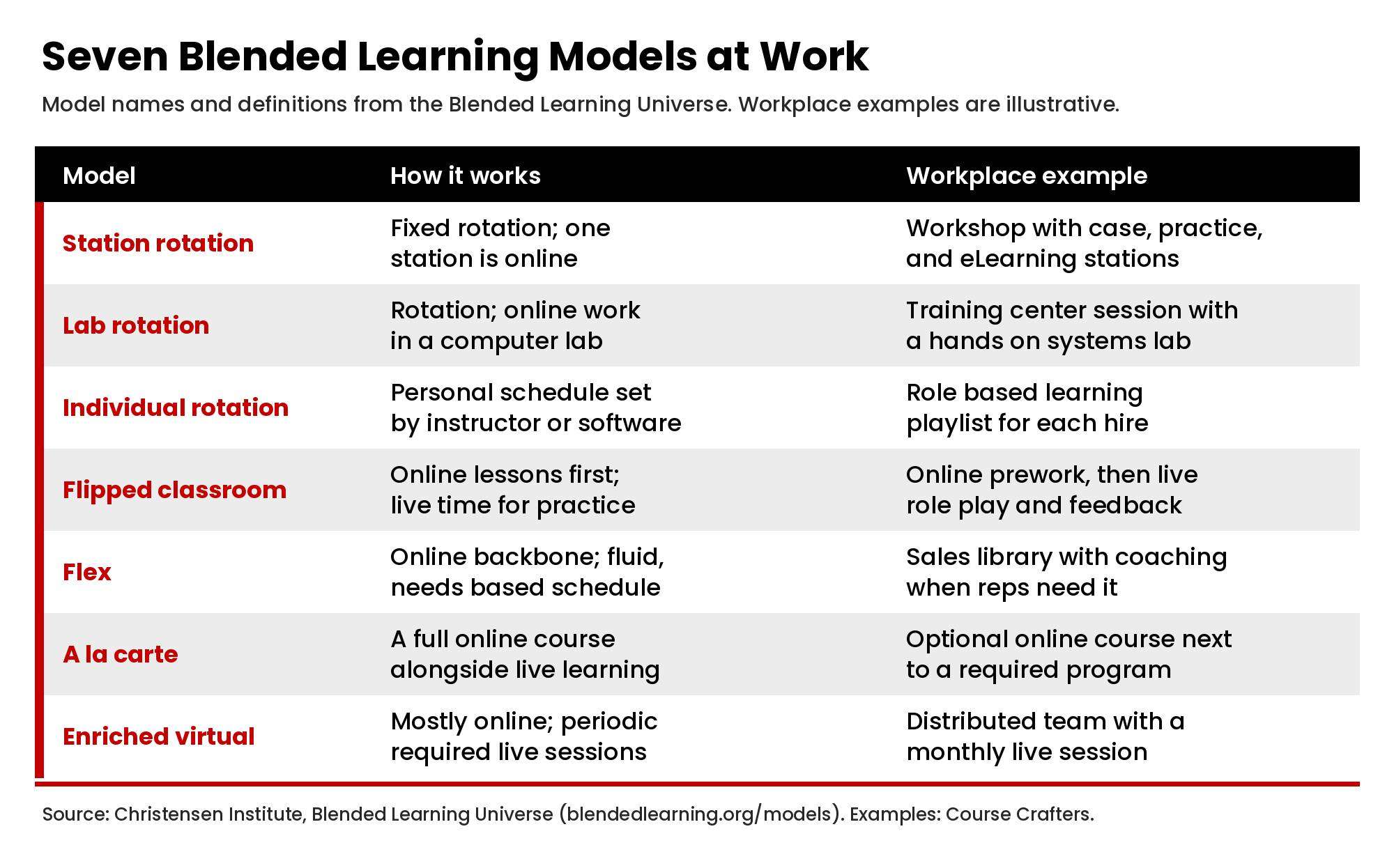
The seven blended learning models, with illustrative workplace examples.
Rotation models
In the station rotation model, learners rotate through stations on a fixed schedule, and at least one station is online. The lab rotation model is similar, but the online learning happens in a dedicated computer lab. In the individual rotation model, each learner follows a personal schedule set by an instructor or software. In the Christensen Institute's definition, the other modalities in a rotation can include small group instruction, full class instruction, group projects, individual tutoring, and pencil and paper assignments. In corporate training, rotation looks like a workshop day where small groups move between a facilitator led case discussion, a hands on practice station, and a short eLearning module.
Flipped classroom model
The flipped classroom model, often shortened to the flipped model, flips the traditional relationship between class time and homework. Learners complete online coursework and lectures first, and live time is used for guided practice or projects. This is one of the most useful blended learning strategies for professional development, because it saves expensive live sessions for discussion, role play, and feedback instead of slides.
Flex model
In the flex model, online learning is the backbone, even if it directs learners to offline activities at times, and learners move among activities on fluid schedules according to their needs, with instructors providing support as needed. The Blended Learning Universe notes this model can give students a high degree of control over their learning. In the workplace, a flex design suits large populations with different starting points, such as a sales team where some reps need product basics and others only need advanced scenarios.
A la carte model
The a la carte model lets learners take a full online course alongside their other in person learning. In companies, this often looks like an optional online course that employees take in addition to a required live program.
Enriched virtual model
In the enriched virtual model, learners complete most coursework online and attend required in person sessions only periodically. For distributed teams, this can mean mostly self paced learning with a scheduled live session each month or quarter.
How Blended Learning Works in Schools
Because the models were developed for K-12 education, it helps to see how they look in a traditional classroom before adapting them to the workplace. According to the Blended Learning Universe:
- Station rotation is most common in elementary schools, because teachers are already familiar with rotating students through centers. During a class period, students rotate between an online station, a station for direct instruction with the teacher, and a station for collaborative or offline work, so the teacher can work with a small group while the rest of the entire class keeps learning.
- Lab rotation moves the online portion into a dedicated computer lab, which lets schools use existing labs and schedule staff flexibly.
- Individual rotation gives individual students a playlist set by a teacher or software, so they rotate only to the activities on their schedule.
- Flipped classroom has students learn at home through online coursework and lectures, so the teacher can use class time for guided practice or projects.
- A la carte lets students take an online course with an online teacher of record alongside face to face courses, which the Blended Learning Universe describes as one of the more popular models in blended high schools.
- Enriched virtual has students complete most coursework online and attend school for required face to face sessions, usually not every day.
The common thread in all of these blended classrooms is that the online portion gives students some control over time, place, path, or pace, and the teacher uses face to face time for the teaching strategies that need a person: feedback, discussion, small group instruction, and support for student motivation. The same logic applies when you move from student learning to employee learning, and in higher education, where many universities combine online course material with in person seminars and labs.
Benefits of Blended Learning in Corporate Training
When it is designed well, a blended learning approach gives training teams several advantages over a single format.
- Better use of live time. Moving knowledge transfer online frees in person sessions for practice, coaching, and active learning.
- Learner control over pace. Employees can review course material at their own pace, which helps adult learners with different backgrounds and schedules.
- Consistent core content. A shared online module means every cohort gets the same foundation, while facilitators adapt the live sessions.
- Room for personalized learning. Digital resources can branch by role or skill level, while live sessions handle the questions that need a person.
- More chances to practice. Spacing online learning activities between live sessions gives learners time to try skills on the job and bring real questions back.
Downsides of Blended Learning and How to Avoid Them
Blended learning programs also have real downsides. Planning for them is part of effective blended learning.
- Disconnected parts. If the online and in person pieces were built separately, learners feel the seams. Design both from one set of learning objectives.
- Uncompleted prework. A flipped design fails when people skip the online portion. Keep prework short, make it clearly necessary for the live session, and track completion.
- Technology friction. Logins, broken links, and confusing platforms erode motivation. Test the learner path end to end before launch.
- More coordination. Blended programs involve more moving parts, from scheduling to facilitator guides. Assign an owner for the whole learning process, not just each piece.
- Facilitator readiness. Facilitators used to lecturing need guidance on running practice focused sessions.
Choosing the Mix of Online and In Person Learning
There is no single correct ratio of online to live time. The right blended learning approach depends on what learners need to do and where they work. These questions help training teams decide.
- How much is knowledge and how much is skill? Product facts, policies, and process steps fit digital learning well. Judgment calls, conversations, and hands on tasks usually need in person learning, small group instruction, or coached practice.
- Where are learners located? A single office can run frequent in person sessions. A distributed workforce may lean on an enriched virtual model with occasional live sessions.
- How varied are starting points? When individual learners arrive with very different experience, more self paced online material lets each person move at their own pace before the group meets.
- What do live sessions cost? Facilitator time, travel, and time away from work make live sessions expensive. Protect them for activities that benefit from people being together.
A common misconception is that blended learning should be designed around individual learning styles. Learning preferences are real, but strong blended learning experiences are designed around the task and the content, not a learner label. A negotiation skill needs practice with another person no matter how someone prefers to learn.
Tools for Implementing Blended Learning
Implementing blended learning does not require a large technology stack, but a few digital tools make the blended model easier to run:
- A learning platform to host online modules, track completion, and show learner progress before each live session.
- Authoring and video tools to build short eLearning and demonstrations.
- Virtual classroom software for live online sessions when some learners cannot attend in person meetings.
- Practice and assessment tools, such as scenario simulations, quizzes, and observation checklists.
- Communication channels for reminders, discussion between sessions, and questions for facilitators.
Choose technology tools that make the learner path simple. Every extra login or platform adds friction to the blended learning experience.
How to Measure a Blended Learning Program
Measurement keeps blended learning environments from drifting into a pile of disconnected content. Track a few signals across the whole learning path, not just one piece.
- Completion of the online portion before each live session, since unfinished prework weakens the live time.
- Assessment results on the learning objectives, ideally before and after the program.
- Participation in live sessions, including the quality of practice and questions.
- On the job application, such as manager observations, quality checks, or performance data tied to the skill.
- Learner feedback on which pieces helped and which felt redundant.
Review these after each cohort and adjust the mix. Often the fix is small, such as shortening a module, moving a demonstration online, or adding a practice round to a live session.
How to Design a Blended Learning Program
A practical blended learning program starts with performance, not format. A practical sequence looks like this.
- Define the job outcome. Write learning objectives in terms of what people will do differently at work.
- Split knowledge from skill. Content people need to know usually works online. Skills people need to practice, judge, or discuss usually need live time or coached practice.
- Choose a model. Pick the blended learning model that fits your audience, schedule, and locations, such as flipped for a cohort program or enriched virtual for a distributed team.
- Design the connections. Decide exactly how each online module prepares learners for the next live session, and how each live session leads into on the job practice.
- Build the digital pieces. Produce eLearning, video, job aids, and assessments that fit the learning path, rather than repurposing old slide decks.
- Prepare facilitators. Give facilitators guides that focus on activities, questions, and feedback, not on repeating the online content.
- Measure and adjust. Track completion, assessment results, and on the job behavior, then refine the mix after each cohort.
For planning help, see our approach to course strategy and structure. If your program depends on clear instructional design for complex professional content, our guide to instructional design consulting explains what that work involves.
Blended Learning Examples for the Workplace
Here are common ways companies apply blended learning strategies. These are illustrative designs, not benchmarks.
- Manager development. Short online modules on coaching and feedback, followed by monthly live practice sessions with role play, then peer coaching between sessions.
- Product training for sales. A self paced product library online, a live workshop on customer conversations, and scenario practice in small groups.
- Compliance with application. An online course for required policy content, plus a live discussion of real cases where the policy is hard to apply.
- Technical onboarding. Video walkthroughs of tools, a hands on lab session with a trainer, and job aids for the first weeks on the job.
The digital pieces of these programs are where production quality shows. Our guides to corporate eLearning development and training video production explain how to build modules and videos that support live instruction instead of replacing it. If you are delivering the online portion through a learning platform, see when organizations need learning management system consulting.
Frequently Asked Questions
What is blended learning in simple terms?
Blended learning combines online learning with in person instruction in one connected program. Learners do part of the work digitally, often at their own pace, and part of it live with an instructor or facilitator.
What are the four models of blended learning?
The Christensen Institute's 2012 taxonomy grouped most programs into four models: Rotation, Flex, A La Carte (originally called Self-Blend), and Enriched Virtual. The Rotation model includes four sub-models: Station Rotation, Lab Rotation, Flipped Classroom, and Individual Rotation.
What are the main models of blended learning?
The Blended Learning Universe describes station rotation, lab rotation, individual rotation, flipped classroom, flex, a la carte, and enriched virtual. Many lists group the first four as rotation models, which gives four broad types: rotation, flex, a la carte, and enriched virtual.
What is an example of blended learning?
A flipped manager training program is a common example. Managers watch short online lessons on giving feedback, then practice feedback conversations in a live session with a facilitator.
What are the downsides of blended learning?
Common downsides include disconnected online and live content, learners skipping prework, technology problems, and more coordination. Good design and clear ownership reduce each of these.
Is blended learning the same as hybrid learning?
The terms are often used interchangeably. Both describe a mix of online and in person learning. Some organizations use hybrid to mean some learners attend live sessions remotely while others are in the room.
Is blended learning more effective than classroom training?
A U.S. Department of Education meta-analysis found that blended instruction, on average, outperformed face to face instruction alone. The authors note that blended conditions often included extra time and materials, so the design of the program matters more than the format.
Build a Blended Learning Program That Changes Performance
Blended learning works best when every online module and live session serves the same job outcome. Start with what people need to do, choose a model that fits your audience, and design the connections between each part. If you want help planning or producing a blended training program, contact Course Crafters.
Sources: Christensen Institute, Classifying K-12 Blended Learning (2012) and Is K-12 Blended Learning Disruptive?. U.S. Department of Education, Office of Planning, Evaluation, and Policy Development, Evaluation of Evidence-Based Practices in Online Learning: A Meta-Analysis and Review of Online Learning Studies, revised September 2010. Christensen Institute, Blended Learning Universe, What is Blended Learning? and Blended Learning Models.