Employee Onboarding Program: How to Build One That Works
An employee onboarding program is a structured plan that helps new hires learn their role, understand company culture, build relationships with key colleagues, and reach full performance. A strong program starts before the first day, runs for several months rather than a single week, and combines HR tasks, role specific training, an onboarding buddy, and regular check ins with clear performance expectations.
Onboarding is often treated as an HR task: paperwork, a laptop, and a welcome lunch. Effective onboarding programs go further. They give new employees role clarity, ongoing support, and a reason to stay. This guide explains what an employee onboarding program includes, the stages of the employee onboarding process, how to build one step by step, how to handle remote onboarding, and how to measure whether it works.

What Is an Employee Onboarding Program?
An employee onboarding program is the full set of activities, content, and people that move a new hire from accepted offer to productive team member. Orientation is one part of it. Orientation is usually a one time event that covers essential information such as policies, benefits, and tools. Onboarding is the longer process that follows, often three months to a year depending on the job.
Many organizations structure onboarding around four building blocks that researcher Talya Bauer described in a SHRM Foundation guide: compliance, clarification, culture, and connection.
- Compliance: policies, legal forms, safety rules, and required training.
- Clarification: role expectations, how performance is measured, and what success looks like in the first months.
- Culture: company values, norms, and the unwritten rules of how work gets done.
- Connection: relationships with the manager, the team, and key colleagues across the organization.
Programs that stop at compliance leave new hires with forms completed but little idea of how to succeed. The best programs cover all four.
Why Onboarding Matters for Employee Retention
Onboarding is one of the earliest experiences a new hire has with your company, and it shapes how they feel about the job. Gallup reports that only 12 percent of employees strongly agree that their organization does a great job onboarding new employees. Gallup also found that employees who had an exceptional onboarding experience were far more likely to say they have the best possible job and to be extremely satisfied with their workplace.
Onboarding is not just an HR task. It affects employee retention, how quickly new hires ramp up, and how managers spend their time. When new employees understand their role and feel connected to their team, they need less correction, ask better questions, and contribute sooner.
The Stages of the Employee Onboarding Process
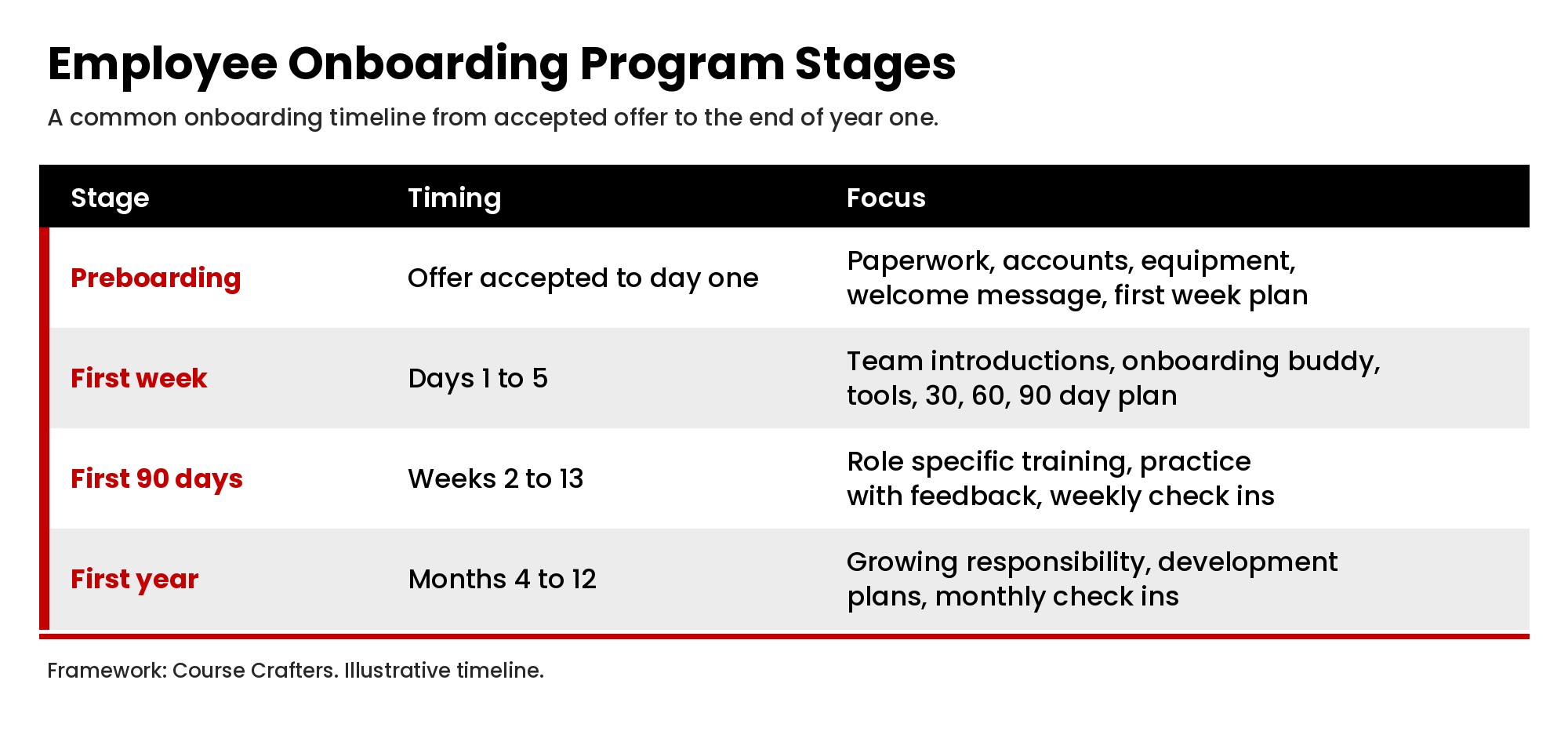
An effective onboarding process follows the new hire through clear stages. The timeline below is a common structure that you can adjust for complex roles or leadership positions.
Stage 1: Preboarding
Onboarding begins when the offer is accepted. Send the welcome message, complete paperwork, set up accounts and equipment, and share a first week schedule. Preboarding reduces first day stress and lets the new hire spend day one meeting people instead of filling in forms.
Stage 2: The first day and first week
The first week sets the tone. Introduce the team, assign an onboarding buddy, walk through tools and workflows, and review the 30, 60, and 90 day plan. Give the new hire one small, real task they can finish so they leave the week with a sense of progress.
Stage 3: The first 90 days
This is where role specific training happens. New hires learn the processes, systems, and standards of their job, practice with feedback, and take on more responsibility over time. Weekly check ins with the manager help employees understand what is going well and what to adjust.
Stage 4: Through the first year
Onboarding should extend past the first quarter. Continue regular check ins, connect the new hire with development opportunities, and review progress against performance expectations. For many roles, full proficiency takes months, so ongoing support matters.
What to Include in an Employee Onboarding Program
Most effective onboarding programs include the same core elements, organized around the employee experience rather than the HR checklist.
Clear performance expectations and role clarity
New employees need to know what the job is, how success is measured, and what they should accomplish in their first 30, 60, and 90 days. Write these performance expectations down and review them in the first week. Clear performance expectations reduce anxiety and help hires stay on track.
Role specific training
General orientation content is not enough. Each role needs training on the specific tools, processes, and decisions the person will face. Structured, practice based training works best. Our guide to skills based training explains how to design training around what people need to do on the job.
An onboarding buddy
An onboarding buddy is a peer, not the manager, who answers everyday questions and helps the new hire build relationships. A buddy explains the unwritten rules, introduces key colleagues, and gives the new hire someone to ask without worrying about looking uninformed.
Manager check ins
Managers play an active role in successful onboarding. Schedule regular check ins: daily or every other day in the first week, weekly for the first few months, then monthly. Use them to share feedback, answer questions, and adjust the plan.
Company culture and company values
Explain how the company works, not just what it sells. Share company values with examples, the company goals the new hire's work supports, and how decisions are made. Culture is learned mostly through people, so introductions and team rituals matter as much as written content.
Onboarding content and resources
Collect the essential information new hires need in one place: a handbook, process guides, short videos, and a list of who to ask for what. Well organized onboarding content reduces repeated questions and helps managers spend time on coaching rather than explaining basics.
How to Build an Effective Onboarding Program Step by Step
Use these steps to design an employee onboarding program or improve the one you have.
- Define the outcome. Decide what a new hire should know and be able to do at 30, 60, and 90 days for each role.
- Map the current onboarding experience. List every step from accepted offer to the end of the first quarter, and note where new hires get stuck or wait.
- Separate HR tasks from learning. Automate onboarding workflows such as forms, accounts, and reminders so human time goes to coaching and connection.
- Build role specific training. Turn the knowledge of your best performers into short modules, job aids, and practice activities.
- Assign people. Name the manager, onboarding buddy, and any subject matter experts responsible for each stage.
- Schedule check ins. Put check ins on the calendar before the start date so they happen.
- Gather feedback and improve. Ask new hires what helped and what was missing at 30 and 90 days, then update the program.
Many teams turn their onboarding content into a short internal course so every new hire gets the same foundation. If you are building a larger training system, our article on corporate training programs that drive measurable employee performance covers how onboarding fits into it.
Remote Onboarding for Distributed Teams
Remote employees face the same onboarding needs with fewer chances for informal learning. Without a shared office, new hires do not overhear how problems are solved or meet colleagues in the hallway. Remote onboarding needs more structure, not less.
- Ship equipment and set up accounts before day one.
- Schedule video introductions with key colleagues in the first two weeks.
- Assign an onboarding buddy and set up short, regular calls.
- Record common walkthroughs so new hires can review them on their own time.
- Create a shared channel where new hires can ask questions and build relationships with others who started recently.
Social connection takes deliberate effort on distributed teams. Community building activities, small group introductions, and cohort start dates can help new hires feel connected.
How to Measure Your Onboarding Program
An onboarding strategy should be measured like any other program. Useful measures include:
- Ramp up time: how long it takes new hires to reach agreed performance levels.
- Early turnover: how many hires stay through the first 90 days and the first year.
- New hire feedback: short surveys at 30 and 90 days about the onboarding experience.
- Manager feedback: whether managers see new hires meeting expectations on schedule.
- Completion: whether required training and HR tasks are finished on time.
Review these numbers each quarter and use them to adjust the onboarding process.
Common Onboarding Program Mistakes
- Treating onboarding as a one week event. Most of the learning happens in the months that follow.
- Information overload on day one. Spread essential information across the first weeks.
- No clear expectations. New hires cannot meet performance expectations they have not been told.
- Leaving managers out. The manager relationship shapes the early experience more than any document.
- No feedback loop. Without asking new employees what worked, the program never improves.
Frequently Asked Questions
What are the 5 stages of the onboarding process?
A common way to describe them is preboarding, orientation, role specific training, transition into full responsibility, and ongoing development. Some organizations combine these into three or four stages.
What should be included in an onboarding program?
Include preboarding tasks, orientation, clear performance expectations, role specific training, an onboarding buddy, manager check ins, company culture and values, and a way to share feedback.
How long should an employee onboarding program last?
Many programs run at least 90 days, and many organizations extend onboarding through the first year for complex roles. The right length depends on how long the role takes to learn.
What is the difference between orientation and onboarding?
Orientation is usually a one time event that covers policies, benefits, and tools. Onboarding is the longer process of helping new hires learn the job, build relationships, and reach full performance.
Do you usually get paid for onboarding?
In most cases, onboarding and orientation are part of the job and are paid time. Pay rules depend on the employer and local law, so check with your HR team or a qualified advisor.
Turn Onboarding Into a Repeatable Training System
An employee onboarding program works when it gives new hires clarity, connection, and practice, then supports them past the first week. Start with clear expectations, build role specific training, assign people to support each stage, and measure the results. If you want help turning your onboarding knowledge into a structured course your team can reuse, see our course creation services or contact Course Crafters.
Sources: Gallup, Why the Onboarding Experience Is Key for Retention and 8 Practical Tips for Leaders for a Better Onboarding Process. Talya N. Bauer, Onboarding New Employees: Maximizing Success, SHRM Foundation Effective Practice Guidelines Series.