
Training Needs Analysis: How to Identify Skill Gaps and Plan Training
A training needs analysis is the process an organization uses to find the gap between the skills and performance it needs and the skills and performance it has today, and to decide whether training is the right way to close that gap. A training needs analysis (TNA) looks at the organization, the job roles, and the individual employees, then turns what it finds into a prioritized plan for training. Done well, a training needs analysis keeps a training program focused on real skill gaps instead of assumptions, protects the training budget, and connects employee training to business objectives.
This guide explains what a training needs analysis (TNA) is, why it matters, the three levels of analysis, how to conduct a training needs analysis step by step, the data collection methods to use, and how to turn the results into targeted training programs.

What Is a Training Needs Analysis?
A training needs analysis (TNA), sometimes called a training needs assessment, is a structured review of what people need to know and do to meet organizational goals, compared with what they can do now. The U.S. Office of Personnel Management describes a needs assessment as the process of identifying the gap between performance required and current performance, then exploring the causes of that gap and the methods for closing it (OPM, Planning and Evaluating Training).
Two points in that definition matter for any training needs analysis:
- It starts with performance, not courses. The question is what employee performance the organization needs, not which training content to buy.
- Training is not always the answer. A performance gap can come from unclear processes, missing tools, or poor job descriptions. A good needs analysis tests whether employees require training at all before anyone designs a training program.
In practice, a training needs analysis (TNA) produces a short list of priority skill gaps, the employees or job roles affected, the training methods best suited to each gap, and the measures that will show whether each training program worked.
Why a Training Needs Analysis Matters
Many organizations still plan each training program from requests: a manager says the team needs training, and a new training program appears. A training needs analysis replaces that habit with evidence. OPM notes that a needs assessment tied to critical behaviors and the agency mission can help eliminate redundant training efforts, reduce unnecessary training spending, and help managers identify performance requirements that training can best meet (OPM).
The main benefits of a training needs analysis are:
- Better training investments. Money and time go to the skill gaps with the biggest effect on overall organizational success rather than to the loudest request, which protects the training budget.
- Targeted training programs. Each training program is built for specific skills and specific job roles, which makes it more relevant to the people who take it and supports training engagement.
- Stronger employee performance. Effective training that closes real knowledge gaps and performance gaps is more likely to change how people work and enhance employee performance over time.
- Employee development and engagement. Employees see a clear link between their employee training and their growth, which supports employee engagement, employee development, and a continuous learning culture.
- A baseline for evaluation. Because the analysis records current skills before training, it gives you something to measure training effectiveness against later, and it shows which training requirements are still open.
The Three Levels of Training Needs Analysis
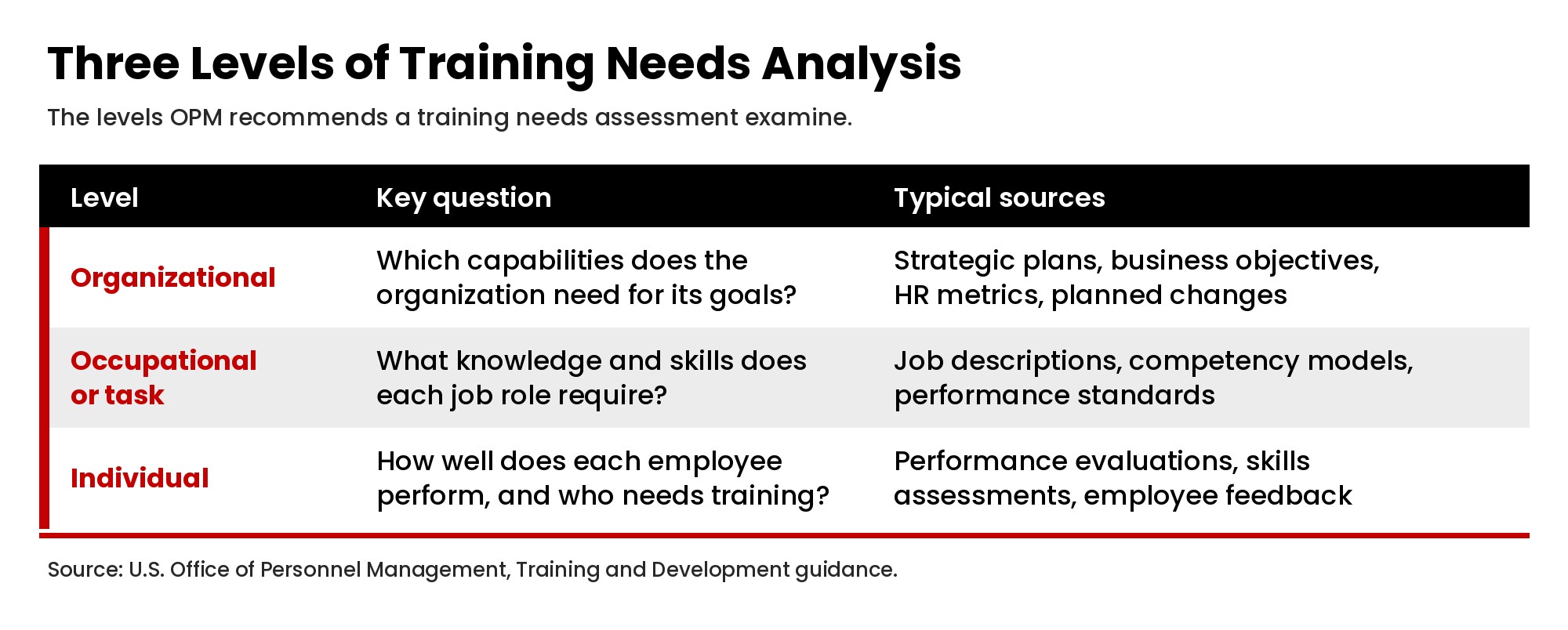
OPM recommends that a training needs assessment examine needs on three levels (OPM, Training Program Management):
Organizational analysis
Organizational analysis looks at the organization as a whole. It asks which capabilities the organization needs to meet its strategy and business objectives, where performance is weak, and how changes in technology, the market, or the workforce will affect future skills. This is where training priorities are tied to organizational goals, and where leaders decide how much of the training budget goes to each area.
Occupational or task analysis
Occupational analysis, often called task or job analysis, looks at job roles. It examines the knowledge, skills, and abilities each role requires and identifies where gaps exist, including gaps created by a new direction such as a new system or service. Job analysis draws on competency models, core competencies, and performance standards to define the necessary skills and training requirements for each role.
Individual analysis
Individual analysis looks at each employee. It measures how well a person performs the current job and whether they have the current skills for new or different work. OPM notes that individual assessment shows which employees need training and what kind. Performance evaluations, skills assessments, and employee feedback are the usual sources.
A complete training needs analysis (TNA) connects all three levels. A skill gap matters most when it appears at the individual level, affects an important job role, and links to an organizational goal.
How to Conduct a Training Needs Analysis
To conduct training needs analysis work well, follow a clear sequence. The steps below follow the sequence OPM outlines for planning and conducting a needs assessment, adapted for a typical business. Use them at any size, from one team to a whole company, and adjust the depth to the size of each training program.
1. Define the business objectives
Start with the result the organization wants, such as faster onboarding, fewer errors, higher customer satisfaction, or readiness for a new product. Write each objective in measurable terms, and limit the list to the outcomes that the training program can realistically affect. A training needs analysis that starts here keeps every later decision tied to organizational success.
2. Involve key stakeholders
Involving key stakeholders early builds support and improves the data. Key stakeholders usually include senior leaders, department heads, frontline managers, HR, and a sample of employees. Agree on the scope, the timeline, and who will act on the findings. OPM recommends setting goals for the needs assessment and reviewing earlier needs assessments as part of planning.
3. Identify the skills required for each role
List the skills required for each job role that affects the objective. Separate technical skills, such as software or equipment use, from practical skills, employee skills that apply across roles, and communication skills, such as handling a customer complaint. Existing role documents and competency models are the starting point, but confirm them with managers, because written role profiles are often out of date. A job analysis interview with a high performer in each role helps you identify gaps between the written role and the real work.
4. Collect relevant data on current skills
Collect relevant data on employee skills and what employees can do now. OPM lists sources such as strategic plans, HR metrics, job descriptions, surveys, and performance appraisals. Combining several methods gives a more reliable picture than any single source; the methods are covered in the next section.
5. Identify skill gaps
Compare the skills required with what employees can do today to identify skill gaps and knowledge gaps. Record each gap by role and by team, and note how many employees it affects. Training gaps that appear across several teams usually point to a missing training program rather than an individual issue. Look for existing skill gaps that already hurt performance as well as future gaps created by planned changes. This is the core of the training needs analysis.
6. Find the cause of each gap
Before you prioritize training, ask why each gap exists. If people know how to do the task but lack time, tools, or clear expectations, no training program will fix it. OPM advises determining why the needed behaviors do not currently exist and researching integrated performance solutions before choosing training.
7. Prioritize training needs
Not every gap deserves the same attention, and different training needs call for different responses. Prioritize training by asking how much each gap affects business objectives, how many people it affects, how urgent it is, and what it would cost to close. A simple priority score, or an analysis template with columns for impact, reach, urgency, and cost, makes the choices transparent to key stakeholders.
8. Choose training methods and build the plan
For each priority gap, choose the training methods that fit the audience and learning styles of the group: instructor led sessions, eLearning, coaching, on the job training, or short microlearning modules. OPM lists options such as classroom training, web based training, rotational assignments, shadowing, on the job training, and self study (OPM, Sustaining High Performance). Our guide to learning objectives explains how to turn each gap into clear, measurable objectives before content is built.
9. Plan the training evaluation
Decide how you will measure effective training before the training program starts. OPM references the Kirkpatrick four level model, which evaluates reaction, learning, behavior, and results (OPM, Guide for Collection and Management of Training Information). Link each level to the performance metrics you recorded during the training needs analysis, such as error rates, time to proficiency, or customer satisfaction scores.
Data Collection Methods for a Training Needs Analysis
The best training needs analysis uses more than one method. Common methods include:
- Surveys and questionnaires. Quick to run across large groups and useful for perceived training needs, but self ratings can be optimistic.
- Interviews. One to one conversations with managers and employees reveal context and the reasons behind a gap.
- Focus groups. Small group discussions surface shared problems and ideas. Focus groups work well when you want employee feedback on a new process or system.
- Observation. Watching the work shows how tasks are actually done and where errors happen.
- Skills assessments and tests. Practical tests measure specific skills directly instead of relying on opinion.
- Performance data. Performance evaluations, quality reports, sales figures, and customer satisfaction scores show where results fall short.
- Learning management system data. A learning management system shows completion rates and assessment results, which helps you see where an earlier training program did not stick.
Combine what people say with what the data shows to gain valuable insights. When a survey, a focus group, and performance metrics point to the same gap, you can prioritize it with confidence.
Training Needs Analysis Example
The following is an illustrative example, not a client case. Imagine a software development company with sixty engineers that wants to cut the number of security issues found late in its release cycle. Its training needs analysis might look like this:
- Organizational analysis. Leaders set a goal to reduce late stage security defects and protect customer satisfaction.
- Task analysis. The team lists the skills required for developers, testers, and product owners, including secure coding practices and threat modeling.
- Individual analysis. A short skills assessment and a review of recent code reviews show knowledge gaps in secure coding for newer developers, while senior developers need little more than a refresher.
- Cause check. Interviews show that some issues come from a missing checklist in the review process, which is fixed without training.
- Plan. The software development company builds a targeted cybersecurity training program for newer developers, adds the checklist, and tracks defect rates as the result measure.
The example shows how the needs analysis narrows a broad goal into specific training, a process fix, and a clear measure, instead of sending every employee to the same training program.
Turning Results into Targeted Training Programs
The output of a training needs analysis should be a short, practical plan and training strategy, not a long report. For each priority gap, record the role, the employees affected, the learning objective, the training method, the timeline, the owner, and the measure of success.
From there, tailor training programs to the audience. Adaptive learning and personalized learning paths let employees skip what they already know and spend time on their own skill gaps, and adaptive learning tools can adjust the difficulty as they progress. Effective training also depends on timing, so schedule each module close to when employees will use the skill. Some organizations use AI driven learning platforms to recommend content based on assessment results; if you use one, check its recommendations against the priorities in your analysis so the tool supports the plan rather than replacing it. Short formats such as microlearning work well for reinforcing specific skills after the main training. For new hires, connect the findings to your employee onboarding program so that common gaps are covered from the first week.
Training Needs Analysis Template
A simple analysis template keeps the training needs analysis consistent across teams. A spreadsheet with one row per gap works for most organizations. Useful columns include:
- Job role and team. Where the gap appears.
- Skill or knowledge needed. The specific skills or knowledge the role requires, written as observable behavior.
- Current level. What employees can do now, based on assessments, performance evaluations, or observation.
- Gap and cause. The size of the gap and whether training, a process fix, or a tool will close it.
- Business impact. Which business objectives and organizational goals the gap affects.
- Priority. A score for impact, reach, and urgency.
- Training program. The planned training program, training methods, owner, and timeline.
- Measure. The training evaluation measure and the business performance metric that will show progress.
Reviewing the template with key stakeholders before you design any training initiatives makes the priorities visible and helps you defend the training budget.
Building a Successful Training Program From the Analysis
A training needs analysis only pays off when the findings shape the training program. A successful training program built from a needs analysis has a few traits in common:
- Every module maps to a gap. Each part of the training program addresses a skill gap recorded in the analysis, so nothing is included simply because it was available.
- Objectives come first. Write the learning objectives for the training program before you build content, and tie each objective to the performance you measured.
- The format fits the gap. Technical skills often need practice and feedback, while policy updates may only need a short module. A comprehensive training program can mix several formats.
- Managers are involved. Managers reinforce new behaviors on the job and help employees develop after the course ends.
- Results are reviewed. Compare post training results with the baseline from the analysis, then adjust the training program for the next group.
Successful training depends on this connection. When the training program and the training needs analysis share the same data, you can show how employee training contributed to organizational success.
Common Challenges and How to Avoid Them
- Treating requests as needs. A request for training is a starting point for the needs analysis, not the answer.
- Relying on one data source. Self assessment surveys alone can miss gaps. Add performance data and observation.
- Skipping the cause check. Training cannot fix a broken process or a missing tool.
- Analysis that never ends. Set a time limit, focus on the most important job roles, and accept that a training needs analysis is updated over time.
- No link to evaluation. Without a baseline and a plan for training evaluation, you cannot show whether the training program changed employee performance or business performance.
How Often to Conduct a Training Needs Analysis
There is no single schedule, but a regular cycle keeps training aligned with organizational goals. OPM requires federal agencies to assess training needs at least annually (OPM), and many private organizations follow a similar annual review. Beyond that, conduct a training needs analysis when something changes: a new system, a reorganization, a new product, new regulations, or a sustained drop in performance metrics. Treating the analysis as part of continuous learning and ongoing learning, rather than a one time project, helps build a continuous learning culture in which employees develop new skills as the work changes.
Frequently Asked Questions
What is the main purpose of a training needs analysis?
The purpose of a training needs analysis is to identify the gap between required and current performance, decide whether training is the right solution, and focus training efforts on the gaps that matter most to business objectives.
What are the three levels of training needs analysis?
The three levels are organizational analysis, occupational or task analysis, and individual analysis. Together they show what the organization needs, what each role requires, and which employees need training.
What is the difference between a training needs analysis and a training needs assessment?
The terms are usually used interchangeably. Some practitioners use assessment for the data gathering stage and analysis for interpreting the results, but both describe the same process.
How do you identify training needs?
Start with the goals of the business, list the skills required for each role, collect relevant data on current skills through surveys, interviews, focus groups, observation, and performance data, then compare the two to identify skill gaps.
Plan Training That Closes Real Skill Gaps
A training needs analysis turns each training program from a list of requests into a focused plan tied to organizational success. By defining clear goals, involving key stakeholders, collecting relevant data, identifying skill gaps, and planning the training evaluation up front, you can build each training program around the skills that matter. If you want help turning the results of a training needs analysis into a training program your employees will use, explore our corporate training programs guide or contact Course Crafters.