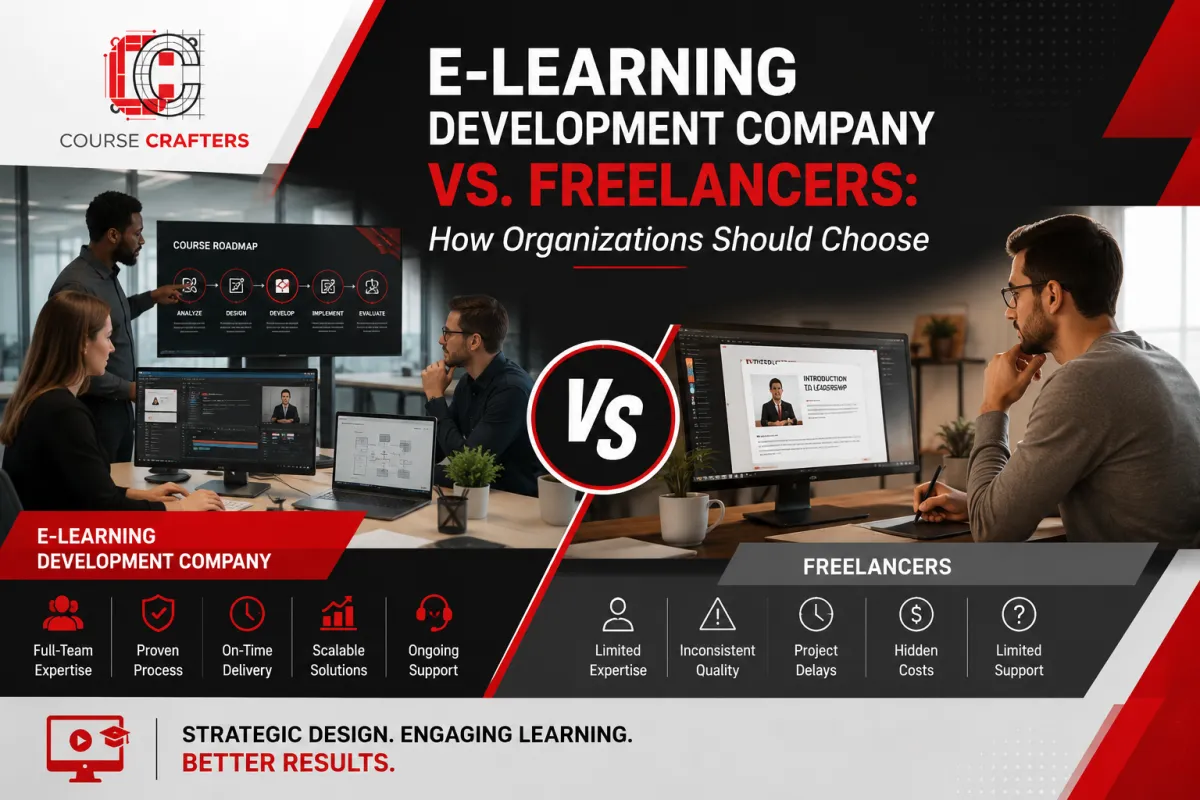
E-Learning Development Company vs. Freelancers: How Organizations Should Choose
When it's time to build a professional learning program, the first decision most organizations face isn't about content or technology. It's about who will build it. Should you hire a custom elearning development company, or assemble a team of freelancers? This guide breaks down the comparison across strategy, production, cost, and long-term value so you can make the right call.
Answering the Core Question: Company vs. Freelancers (Read This First)
Choosing between a full-service elearning development company and freelancers depends largely on the complexity and scale of your training needs. For organizations planning comprehensive, multi-module corporate training or university and association training programs, partnering with an elearning development company like Course Crafters by Masterly typically ensures better strategic alignment, consistent quality, and reliable long-term support.
Freelancers can be a practical choice for smaller, one-off microlearning projects, limited budgets, or internal pilots with simple content and low compliance risk. However, they often lack the integrated expertise and project management that complex programs demand.
At Course Crafters, we specialize in partnering with organizations to deliver end-to-end custom elearning solutions that align training with specific business goals, ensuring engaging, effective, and scalable training programs. As a custom elearning development company, we create tailored digital training materials that reflect real workplace situations and internal procedures.
Consider these scenarios when deciding which model fits your needs best: Companies are ideal for large-scale, multi-module programs requiring strategic alignment with business outcomes, consistent quality and branding, long-term maintenance, and compliance training across multiple regions. Freelancers work well for small, simple projects or pilots, limited budgets or one-time needs, niche or specialized tasks like voiceover or illustration, quick turnaround for isolated tasks, and simple content refresh or translation.
Ready to elevate your employee training with a trusted partner? Read on to understand exactly what separates these two models.
What Is Custom eLearning Development Today?
Custom elearning development is the comprehensive development process of analyzing learning needs, designing curriculum, creating interactive elearning content, and delivering it via learning management systems or learning platforms. Unlike off-the-shelf online courses, custom elearning is tailored to your audience, brand, technology stack, and specific performance goals—such as reducing safety incidents by 20% within a set timeframe.
The process begins with learning needs analysis and goal identification, then moves through instructional design, storyboarding, media production, and delivery. Elearning development follows a planned process for creating courses that can be reused and updated according to evolving company regulations or processes.
Modern custom content development goes well beyond slide-based modules:
Scenario-based learning with branching simulations
Video production and custom animation
Virtual instructor-led training (vILT) combined with self-paced digital learning
Adaptive learning pathways driven by learner data
Mobile learning for on-the-go access
Gamification that increases learner engagement and retention rates
A custom elearning development company like Course Crafters integrates instructional design, media production, learning technology, and project management into a seamless workflow. Instructional design enhances learner engagement and retention while ensuring courses comply with learning standards. Custom elearning should also meet accessibility standards such as WCAG or Section 508, and courses may be designed to be compatible with learning management systems using standards like SCORM or xAPI.
Organizations across corporate training, educational institutions, and professional associations use custom elearning for onboarding, compliance training, leadership development, certification, and continuous learning programs.
Key Differences Between an eLearning Development Company and Freelancers
When rolling out complex online training—such as compliance programs for 5,000 employees across multiple regions or launching a university certificate by Fall 2027—the choice between a company and freelancers affects every aspect of delivery.
Organizations investing in custom elearning span sectors like healthcare, finance, and technology. A strong custom elearning vendor demonstrates experience in specific industries and training topics. Top elearning development companies have extensive industry experience, and professional teams include elearning designers and project managers working in concert.
Key distinctions include:
Learning Strategy: Elearning development companies conduct thorough needs analysis and align training with business goals. Freelancers may jump straight into content creation without full strategic context.
Curriculum Design: Companies field multi-disciplinary instructional design teams to build cohesive curricula. Freelancers often cover limited roles.
Media Production: Companies coordinate video, animation, and interactive design elements with consistent quality. Freelancers may require additional coordination from your internal team.
Technology Integration: Companies ensure LMS/LXP compatibility and compliance with standards like SCORM/xAPI. Freelancers may lack this expertise.
Quality Control: Companies follow structured QA processes with style guides. Freelancers' quality can vary.
Project Management: Companies use formal tools and methodologies. Freelancers often rely on ad-hoc communication.
Scalability: Companies can scale resources for large projects and multi-language rollouts. Freelancers have limited capacity.
Long-Term Support: Companies provide ongoing updates and analytics-driven improvements. Freelancers may lack availability for maintenance.
Process transparency and clear communication are essential in the custom elearning development process. For organizations treating learning as a business-critical asset, partnering with an elearning development company is usually the strongest path to measurable business results.
Strategic Alignment: Learning Needs, Business Goals, and Stakeholders
Top elearning development companies begin with discovery workshops to understand your business challenges, learner profiles, constraints, and success metrics. Course Crafters conducts interviews with subject matter experts and maps learning objectives to measurable KPIs, such as faster onboarding, improved sales conversion, or higher assessment scores.
Effective custom elearning requires a thorough needs analysis to identify performance gaps before any content creation begins. Custom elearning can be tailored to specific business goals, and effective instructional design leads to measurable business results. Tailored training can significantly improve productivity and performance metrics across your organization.
In contrast, many freelancers start course development without robust needs analysis or stakeholder alignment, risking misaligned outcomes and wasted budget.
When evaluating potential partners for your learning services, ask:
How will you connect learning objectives to business results?
How will you involve our stakeholders throughout the development process?
How do you validate that your elearning solutions achieve intended learning outcomes?
What valuable insights will you provide from learner data and analytics?
Strategic alignment is critical for corporate compliance, leadership development, sales enablement, soft skills training, and accredited university programs. Without it, even polished elearning content can miss the mark entirely.
Instructional Design and Curriculum Depth
An elearning development company like Course Crafters assembles specialized teams—learning strategists, curriculum architects, instructional designers, assessment specialists, and learning analysts—to create comprehensive curricula grounded in adult learning principles.
Instructional design ensures effective learning experiences and behavioral change. Instructional designers apply cognitive load theory to improve learning, managing how information is structured so learners retain more and feel less overwhelmed. Instructional design also ensures courses comply with learning standards required by regulatory bodies and educational institutions.
Custom elearning solutions enhance knowledge retention and engagement through methods such as:
Scenario-based learning with realistic workplace dilemmas
Branching simulations that adapt to learner choices
Competency-aligned assessments with feedback loops
Microlearning pathways for performance support and just-in-time training
Blended learning combining digital content with live instruction
Gamification strategies that increase learner engagement and motivation
When reviewing elearning companies, request sample courses, storyboards, design documents, and finished modules. Look for clear learning objectives, alignment with assessments, realistic scenarios, and inclusive design solutions that accommodate diverse learning styles.
For complex programs like a 10-course leadership academy, culture transformation initiatives, or multi-year professional development pathways, curriculum coherence is best maintained through a dedicated elearning agency rather than fragmented freelance work.
Production Capabilities: Media, Interactivity, and Technology
Custom elearning development companies typically utilize a robust production stack. Authoring tools like Articulate Storyline and Rise are industry standards—over 119 million learners use Articulate's elearning tools globally. Companies also leverage video production, animation, interactive simulations, and responsive design to create engaging learning experiences.
Course Crafters combines designers, elearning developers, video producers, and QA training specialists to deliver polished, LMS-ready content compliant with SCORM and xAPI standards. Custom LMS development supports tailored learner experiences that integrate with your existing learning technology ecosystem.
Key production capabilities that distinguish development companies from freelancers include:
AI tools that enhance personalized learning experiences in elearning, powering adaptive pathways and AI-driven insights
VR training solutions that create immersive learning environments for safety, technical, and soft skills training
Interactive content that boosts knowledge retention far beyond passive slide-based delivery
Video production that enhances knowledge retention through visual storytelling
Gamification that increases learner engagement and retention rates, turning compliance training into engaging experiences
Freelancers often require separate coordination for video, animation, voiceover, and development, which can lead to inconsistencies in style and technical quality. Advanced elearning development solutions such as artificial intelligence-assisted learning, immersive learning simulations, and analytics dashboards require coordinated expertise usually found in established elearning content providers.
Ask vendors about their tools, hosting, testing processes, and LMS compatibility to ensure seamless integration with your management systems.
Project Management, Timelines, and Risk Management
Managing complex elearning projects in 2026–2027 demands formal project management beyond informal coordination. Agile project management is commonly used in elearning companies, enabling iterative development with regular stakeholder checkpoints.
Course Crafters employs dedicated project managers using Agile or hybrid methodologies and tools like Jira and Asana to manage milestones, dependencies, and stakeholder reviews. Professional elearning companies ensure faster project turnaround times through structured workflows and clear accountability.
Timeline benchmarks every decision-maker should know:
Custom elearning programs typically take 6 to 10 weeks to develop for standard interactive modules
Rapid elearning can be completed in approximately 3 to 4 weeks for simpler content
Complex simulations or VR modules may take 12 to 16 weeks to deliver
Freelancer management risks include misaligned schedules, unclear ownership when issues arise, and increased coordination burden on internal training needs teams.
Key questions to ask any prospective partner:
Who owns the project plan and timeline?
How are scope changes managed?
What contingencies exist if team members become unavailable mid-project?
Effective project management reduces risk and ensures on-time delivery—whether you're targeting a compliance deadline in January 2027 or an academic term starting in September 2026.
Scalability, Multi-Language, and Long-Term Support
Custom elearning companies are structured to scale teams to meet large project demands, adding instructional designers, developers, or media specialists as needed. Scalability is a key advantage of custom elearning solutions for global teams operating across multiple time zones and regulatory environments.
Global learning organizations benefit from multi-language and localization services including translation, cultural adaptation, subtitles, and multi-language voiceover workflows. Custom elearning development can be particularly beneficial for organizations with proprietary products or regulatory requirements that demand specialized training materials.
Course Crafters provides ongoing support for content updates, regulation changes, platform upgrades, accessibility improvements, and data-driven refinements based on learner analytics. Custom elearning solutions enhance knowledge retention and engagement over time through continuous improvement cycles informed by operational efficiency data.
Data security and compliance are crucial considerations when developing custom elearning courses, especially in regulated industries like healthcare and finance. Relying solely on freelancers for long-term support risks availability issues and knowledge loss when contractors move on to other projects.
Choose partners who view themselves as long-term elearning content providers supporting your evolving learning ecosystem—not just project vendors who disappear after delivery.
How to Evaluate and Select the Right Custom eLearning Development Company
Build a shortlist based on domain experience (e.g., healthcare, finance, higher education), portfolio relevance, client testimonials, and capability in both content development and learning technology. Leading elearning firms demonstrate thought leadership in the elearning industry through case studies, published research, and innovative elearning solutions.
Key questions for RFPs or discovery calls:
How do you conduct needs analysis to improve performance?
What instructional design methodologies drive your course development?
How do you ensure accessibility and quality assurance across all training materials?
What performance support solutions and support do you provide post-launch?
Request 2–3 recent case studies matching your use case and showing concrete business outcomes. Look for examples of elm learning partnerships, obsidian learning approaches, or elb learning methodologies that demonstrate measurable results.
Consider starting with a small paid pilot to evaluate collaboration, quality, and speed before a larger commitment. This approach lets you test the development process and communication style without full financial exposure.
When Freelancers Make Sense—and How to Use Them Wisely
Freelancers add value as niche subject-matter experts, specialized animators or illustrators, or for overflow production under strong instructional design leadership. They can serve as excellent elearning developers for clearly scoped tasks.
Good use cases include:
Updating a handful of existing online courses
Creating simple explainer videos or digital content assets
Translating content into a single language with clear templates
Producing voiceovers or custom illustrations for an existing elearning course
Safely blend freelancers with an elearning agency or internal team by centralizing learning strategy and curriculum while outsourcing clearly defined production tasks. This hybrid approach gives you cost flexibility without sacrificing coherence.
Avoid relying solely on freelancers for complex, multi-year programs. The risks include inconsistent quality, lack of documentation, technical debt in LMS integrations, and serious maintenance challenges after 12–24 months.
Think of freelancers as specialist contributors within a well-governed learning program—not a substitute for full-service design solutions and project leadership.
Next Steps: Choosing an eLearning Development Partner
For organizations with serious corporate learning development goals, partnering with a full-service custom elearning development company like Course Crafters by Masterly is the smartest choice. We deliver strategic alignment, instructional excellence, seamless technology integration, and reliable long-term support that drives real business results.
Map your upcoming training initiatives—whether 2026–2027 compliance programs, new certificate launches, or leadership academies—against the criteria outlined here to make an informed decision. The right partner should offer not just content creation, but a complete learning strategy built around your learners, your brand, and your performance goals.
Ready to transform your learning programs? Contact Course Crafters by Masterly to schedule a consultation and explore how we can help you achieve your training goals with innovative, engaging, and scalable custom elearning solutions.
Contact us today:
Course Crafters by Masterly
Phone: (404) 726-7261
Visit: https://www.thecoursecrafters.com/articles
Schedule your elearning development consultation now.
