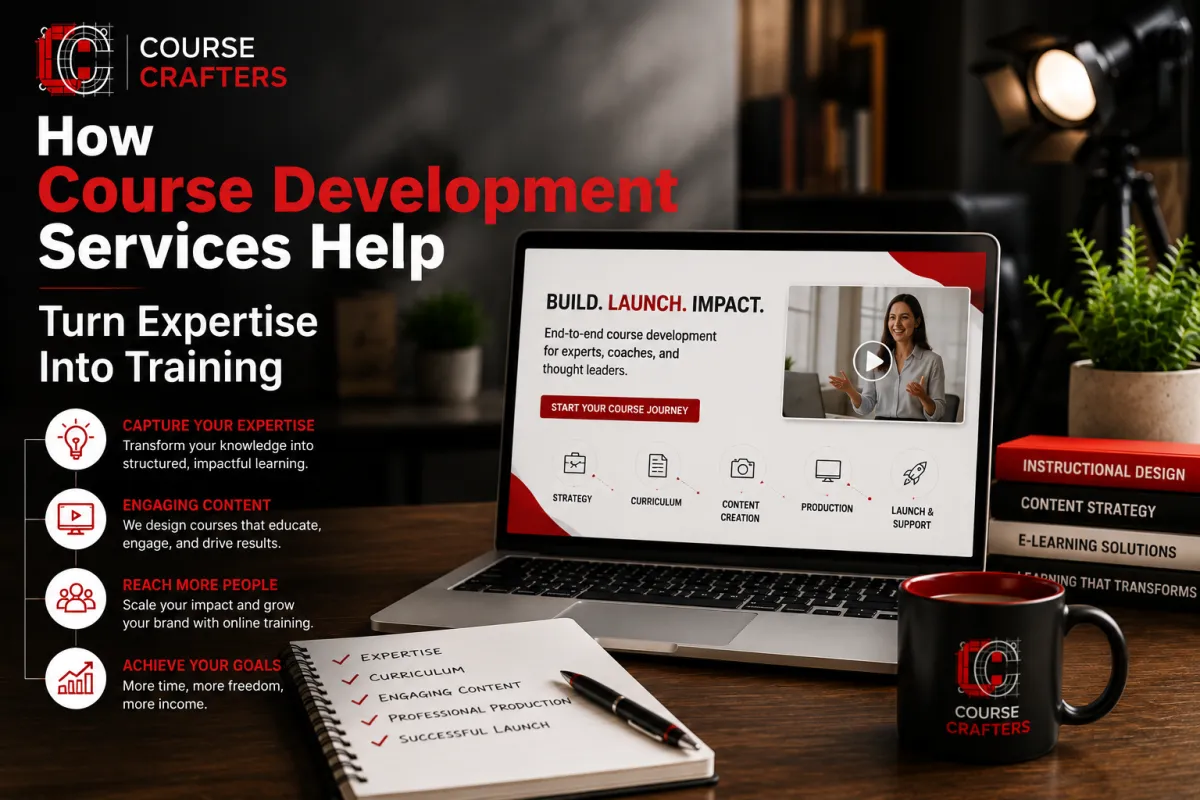
How Course Development Services Help Turn Expertise Into Training
Knowing something deeply and teaching it effectively are two very different skills. Many subject-matter experts have years of knowledge locked in slide decks, recorded calls, coaching notes, and their own heads - but struggle to transform that expertise into training programs that learners can actually follow and apply.
That's exactly the problem Course Crafters solves with our expert course development services. Our dedicated team of instructional designers, multimedia developers, content writers, and project managers collaborate closely with you to plan, design, and produce complete, engaging courses. Instead of spending months figuring out e-learning content development on your own, partner with Course Crafters to handle the heavy lifting while you focus on what you do best—sharing your expertise.
The demand is real. In 2024, the global e-learning market was valued at $299.67 billion, and projections show it climbing past $764 billion by 2030. Organizations, consultants, and educators are all racing to develop courses that scale—whether that means online learning modules, video-based programs, or blended training for a global workforce.
This article walks through what modern course development services actually include, the step-by-step development process, and how to think about pricing, timelines, and long-term course support.

What Course Development Services Include (Beyond Just "Making Slides")
Course Crafters provides comprehensive solutions for educational program creation—far more than assembling a few slides. Here's what a typical engagement covers:
Strategy and planning: Needs assessment, audience analysis, gap analysis, and defining course goals up front.
Instructional design support: Structuring modules and lessons, writing learning objectives, selecting assessments, and designing interactive content like branching scenarios and knowledge checks. Interactive content fosters better retention and knowledge transfer compared to passive lectures.
Content creation: Developing materials like text, videos, and assessments—including lesson scripts, worksheets, downloadable resources, and facilitator guides.
Media production: Video course production (scripting, filming, editing), audio narration, custom graphics, animation, and motion graphics.
Course delivery setup: Technical implementation integrates courses into Learning Management Systems via SCORM or xAPI packaging, with responsive design for phones, tablets, and desktops.
Typical deliverables include:
Full course outlines and blueprints
Lesson scripts and slide decks with consistent quality and branding
Quizzes, knowledge checks, and branching scenarios
Worksheets, job aids, and templates
LMS-ready files and facilitator guides
Our course development services support various formats: self-paced e-learning, recorded video courses, hybrid workshops, or cohort-based online courses with live sessions. Utilizing Course Crafters' expertise can improve learner outcomes and engagement across all of them.
Step-by-Step Course Development Process
The course development process follows a structured, repeatable path. Course Crafters follows instructional design processes like ADDIE and SAM to keep every project organized and aligned with objectives.
The ADDIE model—which includes Analyze, Design, Develop, Implement, and Evaluate phases—is the most widely used framework. Here's how it typically unfolds in practice:
Discovery and Analysis. Our team conducts a needs assessment to identify learner requirements and specific educational goals. This phase involves collecting existing materials (slides, SOPs, recordings, manuals), researching the target audience, and clarifying the program scope. Curriculum design structures content into manageable modules and lessons starting here.
Blueprinting. Instructional designers define learning objectives, map out the course structure, and align assessments with business goals. The course development process includes planning, design, and evaluation stages—and blueprinting is where that plan takes shape.
Content Drafting. Course content is written and refined: lesson scripts, activities, worksheets, and assessments. Experts review drafts while the team ensures clarity for learners who don't share the expert's background.
Media Production. Scripts become videos. Graphics get designed. Screen-share tutorials, animations, and audio narration are produced. This is where raw knowledge becomes polished course materials.
Build and QA. Content is assembled into the chosen platform. Technology integration ensures courses are compatible with existing LMS and accessible formats. Quality assurance processes ensure content meets approved standards before anything goes live.
Launch and Handover. Our team supports uploading, runs final checks, and transfers all assets and documentation. Course development typically takes 6 months to 1 year depending on scope and complexity.
How Instructional Design Turns Expertise Into a Learnable Journey
Instructional design is the discipline that makes complex topics learnable, memorable, and actionable. Course Crafters' instructional designers help create engaging and effective learning experiences by sitting between the expert's deep knowledge and the learner's perspective.
Here's how we work closely with subject-matter experts:
Structured interviews extract tacit knowledge that the expert might not think to include
Content mapping sessions organize raw ideas into a logical sequence that builds complexity gradually
Alignment workshops ensure assessments align with learning objectives to measure student success effectively
Learning objectives are written using concrete verbs from Bloom's Taxonomy—words like "calculate," "design," "configure," or "evaluate"—tied to specific performance outcomes. This ensures every lesson has a measurable purpose.
Instructional design frameworks like ADDIE and backward design help teams plan assessments and learning activities before building content. High-quality course design requires a structured process that includes feedback and refinement at every stage.
Common problems our instructional designers solve:
Information overload—too much theory, not enough practice
Unclear structure that confuses students
Missing practice exercises or real-world application
Misaligned assessments that don't measure what was taught
A practical example: a 3-hour technical briefing gets transformed into a sequence of six 20-minute lessons, each with a micro-assessment and a practice exercise. The result is a fully realized learning experience that participants can complete at their own pace.
From Raw Content to Course Materials: Scripts, Worksheets, and Media
Most experts start with the same raw materials—existing slide decks, recorded webinars, whitepapers, SOPs, or coaching notes. Course Crafters transforms these into polished, learner-ready resources.
Content creation involves developing materials across multiple formats. Scripts get rewritten for clarity. Slides are redesigned with consistent brand typography and layout. Worksheets become interactive tools that reinforce learning. SOPs become downloadable job aids that learners reference on the job.
For video course production, the process includes planning shot lists, recording talking-head and screen-share content, professional editing, adding captions, and applying brand elements.
Accessibility features include closed captions and screen-reader compatibility. ADA and WCAG guidelines are essential for making course materials accessible to all learners. Courses designed for accessibility are usable by learners with different needs—and accessible courses reach more learners while demonstrating professionalism.
Multi-device design is no longer optional. Field workers, remote teams, and students all access content from phones, tablets, and desktops. Every resource must render correctly across devices.
Custom Courses vs. Off-the-Shelf Training
Custom courses built by Course Crafters are tailored specifically for your organization's processes, software, compliance requirements, and culture. Customized courses align with unique training objectives that generic content simply can't address.
Custom development makes sense when:
You use proprietary technology or workflows
Your compliance requirements are industry-specific
You need branded customer service standards
Custom course development considers diverse learning styles and needs across your workforce
Off-the-shelf training works when:
Topics are broad (time management, basic software skills)
Budget is tight and speed matters
Regulatory compliance training is standardized across industries
Custom courses better support organizational culture, language, and real examples that learners recognize from their own work. Customized content can also be designed for future translation needs—a major advantage for organizations with a global team. Organizations use Course Crafters' course development services to meet regulatory or accreditation requirements that generic libraries can't satisfy, creating customized learning experiences that align perfectly with their unique needs.
Pricing, Timelines, and the Real ROI of Course Development Services
Cost ranges for custom e-learning vary based on several factors:
Main cost drivers include: course length, level of interactivity, custom graphics or animations, number of review cycles, and translation or accessibility requirements.
A small pilot course of 60–90 finished minutes typically takes 8–12 weeks from kickoff to launch. A multi-module program spanning 5–10 hours of content may require 3–6 months or more. Course development typically takes 6 months to 1 year for comprehensive programs.
Concrete ROI looks like:
Reduced onboarding time for new hires
Fewer errors and higher compliance scores
Course development can lead to scalable and consistent training experiences across offices
Course development services can reduce the workload for educators and organizations
New revenue for experts selling online courses externally
Starting with a minimum viable course and repurposing existing materials are smart ways to control budget while still producing expert guidance that transforms knowledge into training.
Continuous Improvement and Ongoing Course Support
A course isn't finished at launch. High-performing training programs follow a continuous improvement cycle informed by real data from course delivery—completion rates, quiz performance, learner progress, and direct feedback.
Typical post-launch support services include:
Content refreshes when policies, tools, or regulations change
Adding new modules to address emerging skills gaps
Optimizing activities based on where learners drop off or struggle
Updating videos and interactive elements to track learner progress more effectively
Quality Matters is a set of standards for course design evaluation, and Quality Matters standards include accessibility criteria for courses. PROCES is another set of course design standards including accessibility that helps teams review and maintain quality over time. Course development cycles occur twice a year at some educational institutions, ensuring materials stay current.
Course Crafters sets up simple processes for clients to request updates or schedule annual course reviews—so your courses never become stale or misaligned with current practices.
How to Get Started with Course Crafters
The path from raw expertise to a structured, scalable training program starts with a single conversation. Schedule a course planning call with Course Crafters to discuss your goals, audience, content, and timeline. We'll give you a clear picture of what the development process looks like for your specific project.
Bring whatever you have: slides, manuals, recordings, outlines. These materials accelerate planning and help our team develop content that reflects your real-world knowledge.
Request a course planning call with Course Crafters today! Visit https://www.thecoursecrafters.com/ or call us at (404) 726-7261. Our consultative approach is focused on clarifying whether professional course development services are the right fit for you. No pressure—just a practical discussion to transform your expertise into training that scales.