Building Effective Online Sexual Harassment Training for Employees
Sexual harassment training for employees is no longer a once-a-year formality. For HR and L&D leaders navigating hybrid teams, evolving regulations, and rising expectations in 2026, it is a strategic investment in culture, compliance, and risk reduction. This article walks you through the key decisions involved in building online training that actually works-from content and scenario design to assessments, accessibility, and completion records.
Purpose of Sexual Harassment Training for Employees
Sexual harassment training is a structured workplace compliance course designed to prevent harassing conduct, reduce legal and reputational risks, and support a respectful culture across the organization. Employers use it to meet federal expectations under Title VII of the Civil Rights Act and state or local laws. As of 2026, thirteen states-including New York, California, Illinois, and Connecticut-require periodic sexual harassment prevention training with specific content and delivery standards.
Modern online harassment training goes well beyond legal definitions. It combines law, policy, and behavior-change content: bystander intervention, digital communication boundaries, and gray-area navigation. Effective sexual harassment training fosters a culture of respect and accountability, and a positive workplace culture can improve employee morale and retention across the organization.
Course Crafters' perspective is direct: organizations need programs that are trackable, accessible, and tailored to their workforce. Generic slide decks or passive video modules are not sufficient. With hybrid and remote work now standard, online training must reach every person on every team-whether they are in an office, at home, or in the field.
The sections ahead cover learning objectives, scenario design, course format, assessments, accessibility features, tailoring by role and location, rollout strategies, and when to bring in professional course design support.
Key Legal and Compliance Drivers (Without Giving Legal Advice)
This section provides high-level compliance context. Organizations should consult legal counsel for jurisdiction-specific guidance.
Under federal law, Title VII of the Civil Rights Act prohibits harassment based on sex. EEOC guidance makes clear that employers have a duty to prevent and promptly correct harassment-even though the act itself does not mandate training in all cases. The EEOC's recommended practices include strong policies, accessible reporting channels, and regular interactive training.
State and local mandates fill the gap with specific training requirements. Key examples:
New York State requires annual sexual harassment training for all employees. Employers in New York City must also provide sexual harassment training under city-level rules. New York State mandates a sexual harassment prevention policy for all employers and offers online training that fulfills these requirements. Employers with 15 or more employees must meet additional training requirements.
California requires supervisors and employees to complete harassment prevention training under AB 1825 and SB 1343, with supervisors trained within six months and refresher courses on a set schedule.
Illinois and Connecticut impose their own frequency and content rules based on employer size.
Common statutory elements across these states include a written anti-harassment policy, clear complaint channels, non-retaliation protections, and recordkeeping of training completion. Regulators increasingly expect training to be interactive-meaning it should include knowledge checks, scenario branching, or questions rather than passive video-only content.
Industries with elevated risk and regulatory scrutiny include hospitality, retail, healthcare, higher education, and tech. In these sectors, unions, accreditors, or labor agencies may review training materials directly.
The reassuring takeaway: employers can meet these regulations with well-planned, trackable online training courses instead of ad-hoc sessions.

Core Learning Objectives for Sexual Harassment Training
Before building a workplace compliance course, define measurable learning goals. Clear objectives guide every downstream decision-from scenario development to assessment design.
For general employees, objectives should include the ability to:
Recognize quid pro quo and hostile work environment harassment in verbal, visual, physical, and digital forms
Identify at least three internal reporting options available in the organization
Understand that harassment encompasses conduct based on gender, sexual orientation, gender identity, gender expression, and intersectional identities
Apply bystander intervention techniques to safely support impacted coworkers and stop harassment
Training should clarify behavioral standards regarding harassment so that every person in the workforce understands the line between acceptable and unacceptable conduct.
For supervisors and managers, add objectives around:
The duty to act on complaints, including documentation basics and escalation steps
Avoiding retaliation and protecting complainant confidentiality
Intervening when observing misconduct, even without a formal report
Clear reporting mechanisms encourage employees to report harassment, so objectives should reinforce knowledge of those channels.
Use SMART-style outcomes. For example: "At the end of this module, learners can identify at least three reporting options in our organization and correctly classify two scenario-based examples of hostile environment harassment." These measurable goals make it easier to build assessments and demonstrate impact to executives and regulators.
From Policy to Practice: Translating Rules into Real-World Scenarios
Employees rarely remember policy text, but they do remember vivid situations. Effective scenario design bridges the gap between written rules and daily behavior.
Start by mapping your organization's common risk areas into short narrative case studies:
Virtual meetings - inappropriate comments in chat, webcam-related misconduct, or screen sharing errors
Messaging tools - unwanted DMs after work hours via Slack or Teams
One-on-one supervision - power dynamics in mentoring or performance review settings
Team offsites and social events - blurred boundaries at company dinners or conferences
Best practices for scenario design include using diverse characters (varying in gender, race, seniority, and work model), maintaining a neutral tone, and presenting multiple viewpoints-target, bystander, and manager. Each scenario should reach a clear decision point that asks learners, "What would you do next?"
Gray areas matter most. Scenarios covering repeated jokes about appearance, flirtatious messages, or unwanted gifts teach learners to navigate ambiguity rather than just identify extreme misconduct.
Sector-specific scenarios improve relevance: patient interactions in healthcare, guest behavior in hospitality, client events in finance. Course Crafters often builds branching pathways where learner choices lead to different consequences, reinforcing both correct and incorrect responses through realistic feedback loops.

Designing Effective Online Training Courses
Structure, pacing, and format directly affect whether learners engage or click through passively. Here are the key design decisions.
Course length: Aim for 30–60 minutes for employees and 60–90 minutes for managers. Shorter, focused modules (10–15 minutes each) consistently outperform a single long session in both completion rates and knowledge retention.
Content structure: Break courses into logical micro-units:
Definitions and common myths
Scenarios and examples
Responsibilities and bystander roles
Reporting process and resources
Assessment and wrap-up
Multimedia and engagement: Use professional voiceover, captions, interactive questions, and short video dramatizations. Avoid dense text screens. Training should include interactive formats to engage employees-polls, decision trees, and branching scenarios all outperform static reading.
Responsive design: Employees may access the module on a desktop computer, tablet, or mobile device. Courses must adapt across operating systems and browsers without losing readability or interactivity. For workers unable to access high-bandwidth video, consider downloadable or low-bandwidth versions.
Personalization: Pre-assessment or diagnostic questions can route learners into the right track. If a person self-identifies as a supervisor, the system adds manager-specific segments automatically.
Course Crafters aligns each module with LMS capabilities-bookmarking, progress tracking, and due-date reminders-so that every learner can save their place and return without losing ground.
Assessments, Knowledge Checks, and Completion Records
Proving learning and documenting compliance are equally important. Here is how to handle both.
Informal knowledge checks include embedded questions, quick polls, and scenario-based choices placed throughout the course. These reinforce learning in real time without high stakes.
Formal assessments are scored quizzes at module or course completion. Structure questions directly around your learning objectives-recognizing harassment forms, choosing appropriate responses, and identifying correct reporting channels. A practical standard is an 80% passing score with two attempts allowed. Always provide feedback that explains why an answer is incorrect, not just whether it is wrong.
Completion records should capture:
Date and time of completion
Course version completed
Score and pass/fail status
Learner role (employee vs. supervisor)
Electronic attestation that the learner reviewed the organization's policy
Keep completion records for several years. Highly regulated states and sectors expect employers to generate and produce exportable reports quickly during investigations or audits. Your system should allow you to print or export records sorted by department, geography, or date.
A certificate of completion adds a layer of documentation for both the learner and the organization's account of compliance.
Course Crafters designs courses to integrate with common LMS standards (SCORM, xAPI) so organizations can track completions and assessment results within their existing tools and systems.
Accessibility Features and Inclusive Design
Accessibility is both a legal obligation and a reflection of organizational values. Under ADA, Section 508, and the DOJ's 2024 rule expanding WCAG 2.1 compliance expectations, online training must be usable by learners with disabilities.
Specific accessibility features every online course should include:
Accurate closed captions on all audio and video content
Full transcripts available for download
Descriptive alt text for all images
Sufficient color contrast meeting WCAG 2.1 AA guidelines
Keyboard operability for all interactions-no mouse required
Screen reader–compatible navigation and clear labels on buttons and links
Design interactions so they work with assistive technologies such as screen readers, switch devices, and screen magnifiers. Avoid flashing elements or time-limited interactions that create barriers for learners with cognitive or visual disabilities.
Provide multiple ways to engage: audio narration plus on-screen text, visual plus written descriptions. This approach also supports learners across the world who may access content through different devices or connectivity levels.
New York's model training, for example, is available in multiple languages-Spanish, Chinese, Korean, Bengali, and others-reflecting the principle that accessible online harassment training must reach multilingual teams through professionally localized content, not just auto-generated subtitles.
Course Crafters builds accessibility reviews into the development process and aligns training with each organization's internal digital accessibility standards from day one.
Tailoring Content for Roles, Locations, and Work Models
A single generic course will not advance harassment prevention across a complex organization. Training should be customized to specific workplace risks and culture.
Role differentiation: Frontline workers, office staff, managers, and executives face different harassment dynamics and carry different responsibilities. A manager in healthcare deals with patient-related risks that a finance executive does not. Training should reflect those differences with targeted scenarios and role-specific learning paths.
Jurisdiction and localization: Keep a shared foundation of core content, then layer in state- or city-specific legal references and reporting options. An employee in California needs different compliance context than one in Texas. This also applies to language-offer professionally translated content in priority languages based on workforce composition, with culturally appropriate scenarios.
Remote and hybrid considerations: Include scenarios involving chat channels, webcams, after-hours digital communication, and screen sharing incidents. Over the past decades, the nature of workplace interactions has shifted dramatically, and training must reflect how harassment manifests in digital spaces.
Course Crafters helps organizations map a training matrix that defines which courses and versions each group must take, how often, and through which platform. This kind of tailoring improves relevance, drives higher completion rates, and makes compliance more than a one-time checkbox.
Implementation, Rollout, and Reinforcement Strategies
Even excellent content will underperform without a thoughtful rollout plan. Here is how to launch and sustain impact.
Timeline: For a mid-size organization, expect 8–12 weeks from design approval to launch. Key phases include policy review, needs analysis, scenario drafting, content development, pilot testing with a small group, revisions, LMS setup, and a communication plan.
Internal messaging: Leadership involvement is crucial for effective harassment training. Senior leaders should explain why sexual harassment prevention training matters-not just for compliance, but for the safety and wellbeing of every person on the team. Make expectations clear: who must complete training, by what date, and how to access it on the organization's website or LMS.
Driving completion: Use automated LMS reminders, micro-deadlines by department, and manager dashboards that show team progress. Employees who pay attention to structured deadlines are far more likely to finish on time.
Reinforcement beyond the initial course: Regular training refreshers help reinforce harassment policies over time. Tactics include:
Short refresher microlearning clips (quarterly)
Scenario-based email campaigns
Quick polls during town halls
Ongoing evaluation of training effectiveness is important. Collect learner feedback, track incident data, and refine scenarios where new risks emerge-such as adoption of new communication tools or changed work patterns. Course Crafters works with clients to develop multi-year training calendars that layer harassment prevention with broader DEI, ethics, and respect-at-work programs.
Employers must conduct annual sexual harassment training for employees to stay compliant and maintain cultural momentum.
When to Bring in Professional Course Design Support
At some point, most organizations face the question: build training in-house or partner with specialists?
Common triggers for seeking professional support include:
New or expanding regulatory requirements in your state
Rapid growth, mergers, or acquisitions that create policy misalignment
Negative climate survey results or low training completion rates
A recent complaint or investigation that revealed training gaps
The need to reach workers across multiple states or countries
Expert-designed workplace compliance courses offer advantages that are difficult to replicate internally: robust scenario design, consistent branding, built-in assessments, accessibility compliance, and smooth LMS integration with reliable completion records. Internal HR teams may lack the time or instructional design expertise to build engaging online harassment training while managing day-to-day responsibilities.
A consultation with Course Crafters typically starts with a needs analysis and review of existing policies, followed by a proposal of course formats-such as a core course plus annual refreshers-and clear implementation milestones. The goal is to learn where your current programs fall short and develop a plan with measurable deliverables.
Well-designed online sexual harassment training for employees can become a cornerstone of a safer, more respectful workplace when supported by leadership, policy, and ongoing learning. Companies that invest in this development see returns not just in reduced legal exposure, but in stronger culture and retention.
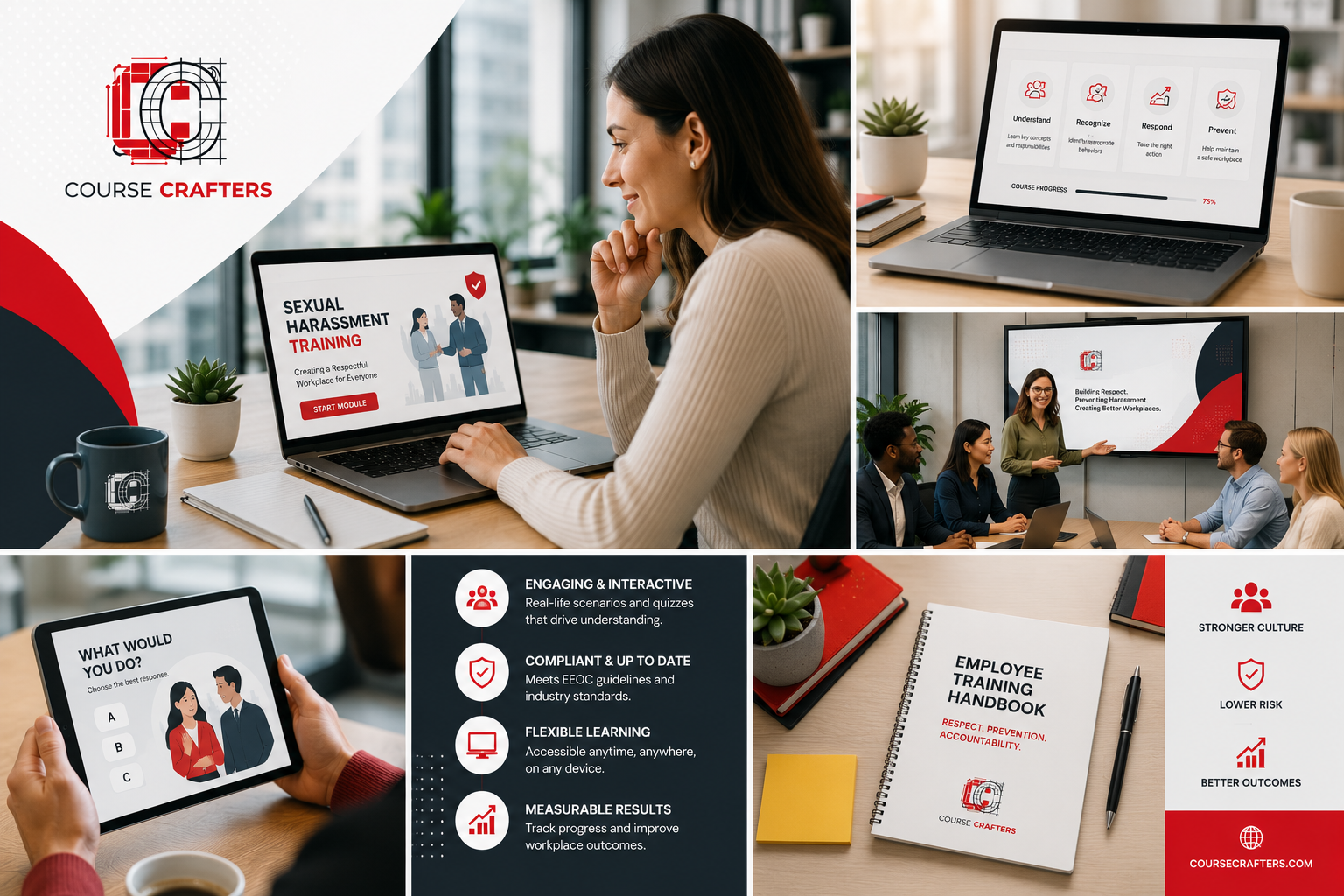
For expert assistance in building effective, compliant, and engaging online sexual harassment training for employees, contact Course Crafters today at (404) 726-7261 or visit https://www.thecoursecrafters.com/home to request a custom compliance-course consultation.
